
Summary
Effective solicitors growth strategies come from combining specialist, plain-English content with strong local visibility, credible reviews, professional referrals and transparent service information. Build content around profitable practice areas and real client questions, then distribute it through search, Google Business Profile, LinkedIn, PR, email and partner networks. Measure qualified enquiries, consultations and new matters rather than traffic alone, while maintaining rigorous SRA review and human oversight.
Key Takeaways
- Build content around defined practice areas, client types and buying triggers rather than publishing a general blog.
- Use service pages, fee information, lawyer profiles and practical guides to help prospective clients decide what to do next.
- Strengthen exposure through local search, ethical reviews, professional partnerships, PR, events, LinkedIn and email.
- Treat AI as a support tool, not a substitute for solicitor review, original expertise or jurisdiction-specific accuracy.
- Connect marketing to intake, response times and matter-opening rates so visibility produces measurable business growth.

Build Solicitors’ Growth Around Trust and Commercial Priorities
Content marketing works best for a solicitor’s firm when it is treated as part of a wider trust and distribution system. Publishing articles may attract attention, but growth depends on what happens afterwards: whether the visitor understands the issue, recognises the firm’s expertise, feels reassured about the process and can make contact easily.
Legal services are high-trust purchases. Prospective clients commonly want to know whether a firm handles their specific problem, understands their circumstances, explains matters clearly and provides a realistic view of cost and timescale. A polished website is not enough if it leaves those questions unanswered.
Choose a defined market before planning content
The starting point should be commercial focus rather than a calendar of blog topics. Identify the practice areas where the firm has genuine expertise, sufficient capacity and attractive long-term potential. Then define the client group and geographical area that matter most.
A family law firm may focus on financial remedy for business owners in a particular region. An employment practice might serve SMEs rather than employees. A conveyancing firm may prioritise first-time buyers, leasehold transactions or property investors. A narrow position makes it easier to create useful content and become recognisable for a particular need.
Buying triggers are especially valuable. A person who has received a letter before claim, is buying a leasehold property, needs a shareholder agreement or wants to make a will is likely to need different information from someone conducting general legal research. Content should reflect those moments.
Connect every topic to a client decision
A useful content programme follows the prospective client’s decision journey. Early content may explain whether a problem is potentially legal and what information the reader should gather. Later pages should address process, cost, risk, timescale and the reasons to seek tailored advice. Decision-stage content should make the firm’s expertise, service scope and contact route clear.
For example, a conveyancing firm could connect a first-time buyer guide with pages explaining property searches, leasehold questions, the transaction timeline and fees. Each page should lead naturally to a relevant consultation or estimate rather than forcing a reader back to a generic homepage.
This approach also helps prevent the common traffic trap: attracting large numbers of visitors with broad topics that have little connection to the services the firm wants to provide.
Create Content That Demonstrates Expertise and Helps People Act
Prioritise service pages over a general blog
A strong service page should explain who the service is for, the problem it addresses and what the firm can and cannot do. It should describe the main stages, relevant documents, likely risks, factors affecting cost and who will carry out or supervise the work.
The page should also include a clear solicitor profile, a relevant jurisdiction statement and an accessible way to make contact. A detailed employment settlement agreement page, for instance, is more commercially useful than a series of loosely related employment articles if it answers the questions that arise before instruction.
Supporting guides can then deepen the subject. A practice-area hub may link naturally to pages covering redundancy, disciplinary procedures, workplace grievances, settlement agreements and employment tribunal processes. Internal links should help a reader make sense of the next decision, not simply repeat keywords.
Make authorship and review visible
Legal content gains credibility when the firm shows who created and checked it. A page should identify its solicitor author or reviewer, their role, qualifications, practice-area focus and relevant experience. A review date and a process for updating significant legal or pricing information can also reassure readers that the page is not being left to age indefinitely.
Where appropriate, link to primary or authoritative material such as legislation, government guidance, court information, HM Land Registry, ACAS, HMRC or SRA resources. State clearly which jurisdiction applies. Advice relevant to England and Wales should not appear to apply automatically in Scotland or Northern Ireland.
A disclaimer that information is general and not a substitute for legal advice may be appropriate, but it cannot compensate for vague, inaccurate or overconfident writing. The useful content must stand on its own.
Use plain English without oversimplifying the law
Many prospective clients are anxious, unfamiliar with legal terminology and trying to understand what to do next. Dense prose and unexplained jargon create friction. Plain English does not mean removing important qualifications; it means explaining them in a way a non-lawyer can understand.
Good content should address practical questions such as what happens first, what evidence may be needed, what affects the outcome, how long the process may take and when urgent advice is sensible. It should also explain limits and exceptions. Helping an unsuitable prospect recognise that a service may not apply can save intake time and increase trust.
Short videos, solicitor-led question-and-answer recordings and downloadable guides can support written pages, provided the information is accurate, current and professionally presented. Interactive tools may be useful for early-stage research, but any calculator or questionnaire should explain its limitations and avoid presenting an estimate as a legal assessment.
Turn transparency into a conversion advantage
For services covered by the SRA’s transparency requirements, firms must publish prominent and accessible information covering matters such as pricing, the charging basis, VAT, disbursements, inclusions and exclusions, qualifications, key stages and typical timescales. The SRA also requires publicity to be accurate and not misleading. See the SRA Transparency Rules and guidance on transparency in price and service.
These requirements should not be treated as administrative text hidden on a separate page. Clear fee guides, service boundaries and process explanations reduce uncertainty and help visitors decide whether to make contact. They also discourage claims such as “guaranteed compensation”, “the best solicitor” or “the cheapest service” unless such statements can be properly substantiated.
Increase Exposure Through Local and Professional Channels
Strengthen the firm’s local presence
For regional and consumer-focused practices, the Google Business Profile is a practical foundation. Google states that local results are mainly influenced by relevance, distance and prominence. Firms should therefore ensure that their name, address, telephone number, website, opening hours, categories and services are accurate and complete.
A profile should represent a genuine staffed location. Creating duplicate profiles for virtual offices or adding keywords to the firm name can undermine trust and create compliance or platform problems. Local landing pages should also offer genuine value and reflect a real service area or office presence, rather than producing near-identical pages for every nearby town.
Reviews contribute to reputation and can support local prominence, but they are not a substitute for relevance or proximity. Establish a consistent process for inviting feedback after a matter concludes, without buying reviews, fabricating them or selectively manipulating the process. Client confidentiality must also be respected.
Earn visibility away from the firm’s own website
Search is only one route to a new instruction. A 2025 UK legal digital-traffic study reported falling search traffic among surveyed firms alongside growth in direct and referral traffic. The research describes the figures as directional rather than a universal industry benchmark, but the underlying lesson is useful: recognisable expertise and third-party exposure deserve deliberate investment.
Digital PR can involve solicitor commentary on legal developments, local business issues or regulatory changes. Professional partnerships may include estate agents, accountants, mortgage brokers, HR consultants, financial advisers and other organisations that serve the same audience. Any referral arrangement must be transparent and consistent with SRA requirements.
LinkedIn is particularly suitable for commercial, employment, corporate and professional-services practices. Useful posts might explain a legislative change, clarify a recurring client question or share insight from an event. They should demonstrate judgement rather than make promises about results.
Webinars, local talks and short briefings can turn recurring questions into useful public education. Follow-up should provide relevant information rather than relying on aggressive sales messages. Email communications should be appropriately targeted and managed in line with consent and other applicable requirements. Solicitors must not make unsolicited approaches to members of the public to advertise legal services, other than to current or former clients, as explained in the SRA’s marketing to the public guidance.
Use AI Carefully and Preserve Human Accountability
Google’s guidance allows the responsible use of AI-assisted content, but using automation primarily to manipulate search rankings breaches its spam policies. The practical distinction is quality and purpose. AI may help with research organisation, transcription, outlines or editing, but it should not be allowed to produce unreviewed, scaled legal advice pages.
Legal content requires checks for accuracy, dates, sources, jurisdiction and appropriate levels of certainty. A lawyer should make or approve substantive claims, particularly where the page discusses rights, deadlines, liability, remedies or costs. The firm should also ensure that the final material contains real expertise rather than generic wording that could describe any practice.
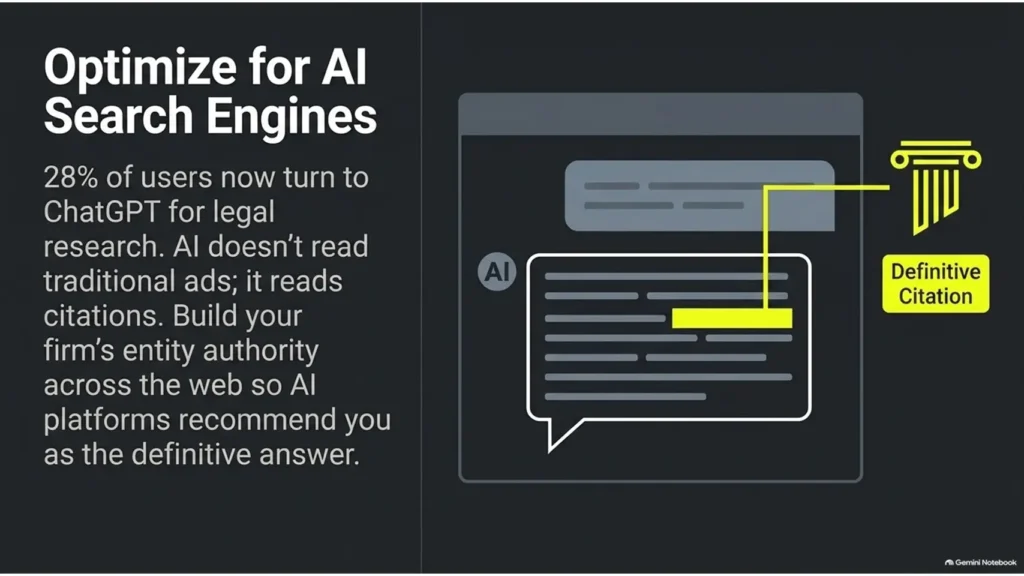
AI-generated search summaries make clear authorship, reliable sources, a defined subject and original insight even more valuable. The objective should not be to fill pages with repetitive questions designed for machines. It should be to publish information that is genuinely useful to people and sufficiently reliable to be referenced by other platforms.
Connect Marketing to Intake and Revenue
A firm can generate strong exposure and still experience weak growth if enquiries are routed slowly or handled poorly. High-traffic pages need visible, low-friction contact routes, mobile-friendly layouts and clear expectations about what happens after a form is submitted or a call is made.
Reception and intake teams should know which matters the firm accepts, what information is needed for an initial assessment and how urgent enquiries are escalated. Tracking the source of an enquiry is useful, but it should be combined with its quality and outcome.
The most meaningful measures may include qualified enquiry rate, consultation bookings, response time, matter-opening rate, average matter value, source-to-revenue performance and repeat or referral work. Impressions, rankings and sessions can help diagnose visibility, but they should not be mistaken for commercial success.
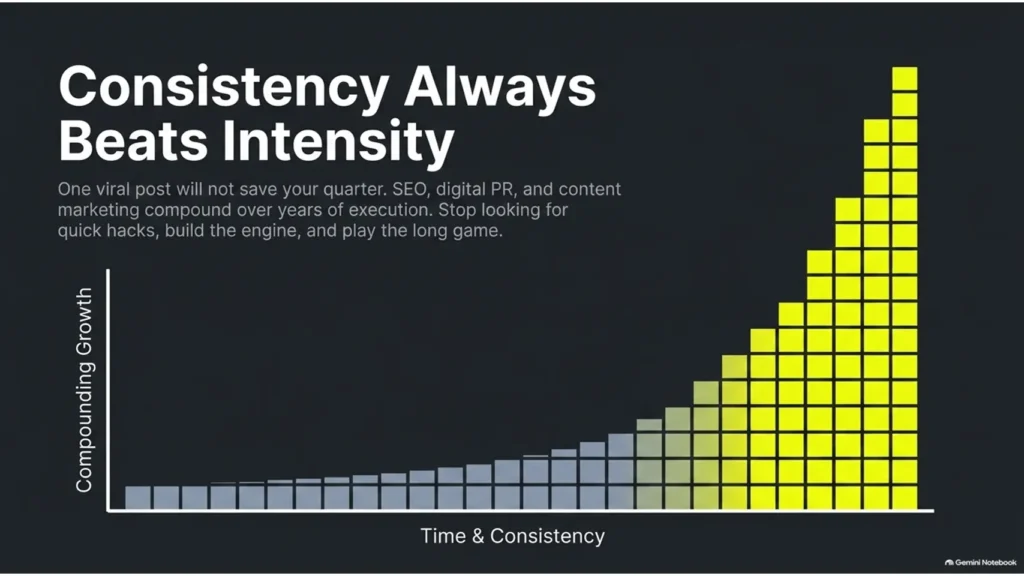
Cash flow also affects consistency. Practices working on contingency, delayed billing or long-running litigation may experience “realization lockup”, where revenue remains tied up in active matters. That pressure can lead firms to stop marketing during quieter cash periods, even though interruption damages the continuity of long-term activity. A planned budget and realistic expectations are safer than alternating between intense campaigns and complete inactivity.
Create a manageable operating rhythm
The first stage of implementation should focus on one or two priority services, their core pages, fee and process information, solicitor profiles and a small set of decision-support guides. At the same time, correct the Google Business Profile, establish a review process and make enquiry handling measurable.
The next stage can expand distribution through professional partners, LinkedIn, events, email and relevant PR. Intake questions should feed back into future content, while high-value pages receive defined legal and factual review dates.
Consistency matters more than trying to operate every channel at once. A small firm may begin with work it can manage internally, while a larger practice may need specialist support for technical search, paid advertising, design or PR. What matters is clear ownership, solicitor involvement and accountability for business outcomes.
Research Insights
| Topic / Area | Key Finding | Business Impact | Why It Matters |
|---|---|---|---|
| Local visibility | Google uses relevance, distance and prominence | Accurate profiles support local discovery | Local growth needs more than website keywords |
| People-first content | Helpful content serves a real audience | Prioritise useful, reviewed legal pages | Trust supports informed enquiries |
| SRA transparency | Covered services require clear price and service information | Compliance can reduce buying uncertainty | Transparency improves confidence and conversion |
| AI-assisted content | AI is permitted; manipulative automation is not | Use AI with human legal oversight | Accuracy and originality remain essential |
| Digital exposure | Surveyed firms reported referral growth alongside search decline | Invest in PR, partnerships and brand | Search is only one acquisition route |
Sources
Google Business Profile – Improve your local ranking on Google
Google Search Central – Creating helpful, reliable, people-first content
Google Search Central – Google Search’s guidance about AI-generated content
Byfield Consultancy – UK legal sector digital market share performance
Frequently Asked Questions
Should a small solicitor’s firm manage marketing internally?
A small firm can begin with practical internal work such as improving its service pages, Google Business Profile and client-question content. Specialist support becomes useful when the firm needs technical search, paid advertising, PR or broader campaign management that internal staff cannot realistically maintain.
How often should legal content be reviewed?
Set a review date according to the subject’s risk and rate of change. Pricing, regulatory information, deadlines and process pages need particularly careful review. Each page should have an owner responsible for checking legal accuracy, sources, jurisdiction and whether the service information remains current.
What is the right way to request client reviews?
Invite feedback consistently after an appropriate stage or conclusion of the matter, without buying reviews, fabricating them or selectively seeking only positive responses. The process should protect confidentiality and avoid revealing information about the client or their case without proper consent.
Should solicitors use paid advertising as well as organic activity?
Paid advertising can provide immediate exposure for high-intent searches, but legal advertising costs can be substantial. It should complement rather than replace useful organic content, local visibility, referrals and reputation-building. Campaigns should be judged by qualified enquiries and retained matters, not clicks alone.
How can a firm prevent marketing content from becoming outdated?
Assign an owner and review date to important pages, particularly those covering law, costs, procedures and regulatory requirements. Use a documented approval process in which a solicitor checks substantive claims, sources, jurisdiction and wording before publication and after significant legal developments.