
Summary
Content syndication is the authorised distribution of existing content through third-party publishers, websites or networks. In B2B marketing, it usually means promoting a gated asset such as a report, white paper or webinar to a targeted professional audience and capturing registrations. It can create relevant reach and useful research signals, but a registration is not automatically a qualified lead or sales opportunity.
Key Takeaways
- Content syndication can mean editorial republication or registration-based B2B lead generation; the two models have different goals and SEO considerations.
- A content download indicates interest in a subject, not necessarily purchase readiness.
- Strong campaigns begin with a defined commercial outcome, precise audience criteria, valuable content and agreed lead-acceptance rules.
- Measure accepted leads, account engagement, opportunities and revenue contribution rather than relying on registration volume or cost per lead.
- Publicly syndicated content needs careful indexing, link and privacy arrangements; a canonical tag alone does not guarantee protection for the original page.

Content syndication extends existing assets beyond owned channels
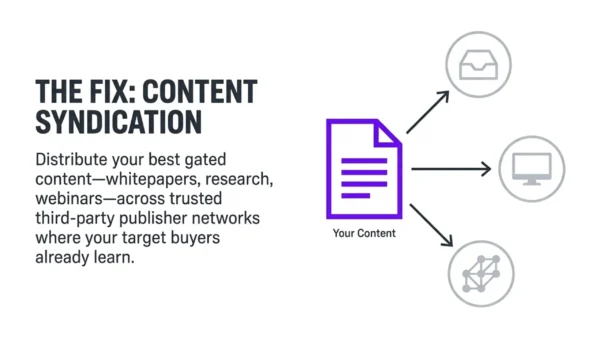
Content syndication is the authorised republication or distribution of existing content through third-party websites, publishers or networks. The purpose is to reach people who may not discover the content through a company’s own website, email database or social channels.
In B2B marketing, the term usually refers to a lead-generation activity. A company promotes an asset such as a research report, eBook, white paper, buyer’s guide or webinar through a relevant publisher or media network. A prospect registers to access it, and the resulting contact record is passed to the sponsoring organisation for validation, nurturing and possible sales follow-up.
That is different from simply publishing a blog article on another website. Editorial syndication is primarily concerned with reach, awareness and referral traffic. B2B lead-generation syndication is concerned with identifiable engagement and the development of relevant contacts or account relationships.
How is syndication different from related tactics?
Content distribution is the broad activity of getting content in front of an audience. Syndication is one distribution method, using a third-party channel to republish or promote existing material.
Content promotion may involve paid advertising or a link to the original asset without republishing it. Repurposing changes the format, such as turning an article into a video or podcast. Syndication generally changes where the existing content appears or where it can be accessed.
Guest posting is also different. It usually involves creating an original contribution specifically for another publication. Buying a contact list is different again: a purchased record does not prove that the individual interacted with a particular asset.
How B2B content syndication generates leads
A successful campaign begins before the content is submitted to a publisher. The organisation needs to decide what it wants the campaign to achieve and what evidence will show that it is working.
Start with the audience and commercial outcome
The audience might be defined by industry, company size, geography, job role, seniority or a named target-account list. Some programmes add topic-level intent signals to identify organisations that are actively researching a relevant problem. These signals can improve prioritisation, but they do not prove that an individual is ready to buy.
The commercial objective should be equally specific. It could be to introduce a new topic to relevant accounts, increase engagement within existing target companies, reach missing members of a buying group, generate sales-accepted leads or create qualified opportunities.
A campaign designed only to produce a large number of registrations will be managed differently from one designed to create engagement across a small list of strategic accounts.
Match the asset to the decision being considered
The asset should help the intended audience understand a problem, compare approaches, build an internal business case or evaluate implementation. A sales brochure is rarely a strong offer for a prospect who is still researching.
Useful gated content needs to justify the registration. Original research, practical benchmarks, implementation guidance, detailed analysis and genuinely useful tools are more defensible than a thin overview that could be found elsewhere.
The format should support the decision. A research report may suit early investigation, while a detailed guide, webinar or implementation checklist may be more useful during evaluation. A case study, calculator or risk assessment may be more relevant when a prospect is comparing suppliers or preparing a business case.
NetLine’s 2026 report shows that registration behaviour varies considerably by content format. It reported approximately 859 registrations per eBook asset compared with 63.5 per white paper in its 2025 dataset. That is an observation from one provider network, not proof that eBooks inherently outperform white papers. Subject matter, targeting, promotion and the mix of assets all affect the result.
Define the hand-off from registration to pipeline
The publisher or network presents the offer to a relevant audience and captures the registration. The record should then be checked against the agreed criteria before delivery into the CRM or marketing automation platform.
This creates several distinct stages. A registration means that someone requested an asset. A valid lead is a usable record that meets the agreed sourcing and targeting requirements. A marketing-qualified lead meets the organisation’s own documented qualification threshold. A sales-accepted lead is accepted by sales for further investigation. An opportunity has met the business’s criteria for a potential purchase.
These stages should not be treated as automatic. A content-syndication lead is not necessarily BANT-qualified, sales-ready or an MQL. Budget, authority, need and timing require additional evidence.
A registration is a research signal, not a sales opportunity
The most important discipline in content syndication is interpreting the action accurately. A person who downloads a report has shown enough interest to request that report. They may be researching a future project, supporting a colleague, gathering background information or simply comparing viewpoints.
NetLine’s latest research recommends treating most gated-content registrations as research signals rather than immediate buying signals. Its published summary recorded 7.2 million registrations in 2025 across its network, but also reported an 8.6% year-on-year decline. The figures demonstrate the scale of activity in that network, not the number of unique buyers, completed reads or sales opportunities.
Follow-up should reflect the action taken. Make the promised asset available immediately, record its source and subject, and send a helpful acknowledgement where permitted. A relevant additional resource may be appropriate. A demo request, a pricing enquiry and a general white-paper registration should not trigger the same sales response.
NetLine reported an average 47.7-hour gap between registration and content consumption in its 2025 data. That does not mean every organisation should impose a fixed 48-hour delay. It does suggest that a light acknowledgement may be more appropriate than an immediate substantive sales conversation for a prospect who has only requested educational content.
Account-level context also matters. One engaged contact does not represent an entire buying group. If the campaign targets named organisations, look for engagement from several relevant roles and connect content activity with other account information before concluding that the account is sales-ready.
Best practices for designing a campaign
Agree the rules before buying distribution
The campaign brief should state which industries, locations, company sizes, roles and seniority levels are acceptable. It should also identify exclusions, including existing customers, competitors, open opportunities and contacts already present in the CRM.
The commercial terms need the same precision. Clarify whether leads are exclusive or shared, whether repeated contacts count as new records, what makes a registration valid and how quickly rejected records will be replaced. The brief should also specify the qualification questions, source information, delivery format and privacy records that the provider must supply.
A small, measurable pilot is usually a sensible operating approach. Review the reasons for rejection, the quality of the audience, the response to the asset and the progression of accepted leads before expanding the campaign.
Use targeting more precisely than job title alone
Firmographic filters can establish whether an organisation resembles the ideal customer profile. Role and seniority can make the audience more relevant, while target-account lists can focus investment on strategically important businesses.
Intent information may help prioritise accounts that are researching a topic. However, it should be treated as an indication of activity rather than proof of authority, budget or purchase timing. The campaign should still measure what happens after registration.
Choose a partner based on traceability
Ask where the offer will appear, whether the provider operates its own publisher network and whether subcontractors or additional data suppliers are involved. A credible provider should be able to explain how contact details, employer information and job roles are checked.
The definition of a “qualified” or “verified” lead should be written into the agreement rather than accepted as marketing language. Ask how duplicates, invalid records, personal email addresses, out-of-profile contacts and missing consent information are handled.
Privacy assurances also need examination. A claim such as “GDPR-compliant leads” is not a substitute for understanding how the person was informed, what data was shared and what subsequent marketing is permitted.
Measure pipeline quality rather than registration volume
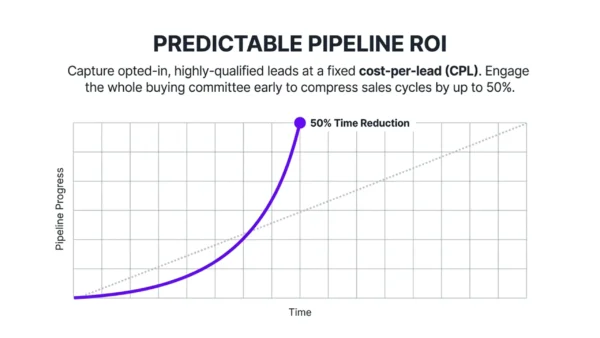
Cost per lead is useful for budgeting, but it is not a quality metric by itself. A low-cost record that fails validation or never progresses may be less valuable than a more expensive contact from a relevant target account.
A practical dashboard can compare campaign cost with delivered leads, accepted leads, opportunities and attributed revenue. Acceptance rate shows how many delivered records meet the agreed criteria. Lead-to-opportunity rate shows downstream progression. Cost per opportunity gives a more commercial view than cost per registration.
Account-level engagement can also be valuable where the campaign supports an account-based strategy. Measure how many target accounts show qualifying engagement and whether relevant roles beyond the first contact become involved.
Attribution needs careful interpretation. Sourced pipeline and influenced pipeline are not interchangeable, and one opportunity may involve several people and channels. Attributed revenue is not the same as profit, while attribution alone does not prove that the campaign created incremental demand.
The measurement challenge is widespread in content marketing. The Content Marketing Institute’s 2025 B2B research reported that 56% of respondents had difficulty attributing ROI to content efforts, with the same proportion reporting difficulty tracking customer journeys. This is a reason to define measurement before launch, not a reason to rely on a single headline metric.
SEO, privacy and compliance need separate treatment
Public republication can create an indexing problem
If a partner publishes a full copy of an article, the partner’s version may compete with the original in search. Google’s current guidance says that a canonical link is not the recommended solution for publishers trying to prevent syndication partners from outranking or replacing the original. Its preferred approach is for the syndicated copy to be blocked from indexing, typically with a robots meta tag such as noindex.
That instruction applies to the partner’s copy, not automatically to the original page. Robots.txt is also not a reliable way to prevent a URL from being indexed.
The correct treatment depends on what the partner actually hosts. A publicly accessible duplicate article creates a different issue from a registration page containing an original summary, or a gated asset that is not available as a crawlable duplicate. Review the implementation rather than assuming that every lead-generation campaign creates an SEO problem.
Paid links should also be qualified appropriately. Google permits advertising and sponsorship links when they use rel="sponsored" or rel="nofollow". Buying placements primarily to obtain ranking credit is a separate practice and can create link-spam risks.
Legitimate syndication is not automatically spam, and there is no reliable basis for claiming that publishing more copies guarantees search or AI-search visibility. Reach, attribution and indexing outcomes should be monitored in practice.
UK marketing rules still apply to business contacts
Business contact information can constitute personal data under the UK GDPR. PECR also treats corporate subscribers and sole traders differently, so it is inaccurate to say either that every B2B email requires consent or that B2B marketing is exempt from privacy obligations.
Before accepting syndicated leads, establish what the individual was told at registration, whether data sharing and intended marketing were explained, which organisations are involved and what lawful basis supports processing and follow-up. Where consent is required, the provider should be able to supply evidence.
The ICO states that indirectly collected personal data generally requires privacy information within a reasonable period and no later than one month, unless an exception applies. Buying or receiving business contact data does not remove the recipient organisation’s responsibilities. The ICO’s guidance is under review, so check the current position before launching a UK campaign.
Common mistakes that reduce campaign value
Treating every download as a hand-raiser creates poor sales experiences and weak conversion rates. The remedy is to distinguish the requested action from the evidence needed to establish buying intent.
Selecting a provider solely because it offers the lowest cost per lead can produce a large volume of records with limited commercial value. Compare acceptance, account engagement and opportunity progression instead.
Broad targeting can waste budget, while overly narrow targeting can limit useful reach. The right balance depends on the campaign objective, market size and value of the opportunity.
It is also a mistake to use generic content simply because it is available. Syndication gives a third party access to the audience; it does not make an undifferentiated asset more valuable. The content still needs a clear point of view, useful evidence or practical detail.
Finally, do not assume that a canonical tag solves every republication issue, that intent data proves authority, or that one contact speaks for an entire buying group. Good syndication depends on judgement after the registration, not just activity before it.
Research Insights
| Topic / Area | Key Finding | Business Impact | Why It Matters |
|---|---|---|---|
| Network engagement | 7.2 million registrations recorded in 2025 | Shows substantial activity, not sales | Volume needs careful interpretation |
| Registration trend | Registrations fell 8.6% year on year | Demand was not uniformly growing | Avoid optimistic volume assumptions |
| Consumption timing | Average content gap reached 47.7 hours | Immediate pitching may be premature | Follow-up should reflect engagement |
| Content attribution | 56% struggle to attribute content ROI | Measurement remains difficult | Define commercial outcomes early |
| Syndicated SEO | Google recommends partner-side noindex | Protects original visibility more effectively | Canonical tags are not guaranteed protection |
Sources
NetLine – Consumption Is Changing: Introducing the 2026 Report
Content Marketing Institute – B2B Content Marketing Trends Research 2025
Google Search Central – Troubleshooting Canonicalisation
Frequently Asked Questions
How quickly should sales follow up after a content registration?
Send the promised asset and a useful acknowledgement promptly, but do not assume that a general download is a request for a sales call. Prioritise follow-up using fit, explicit requests and additional engagement. A demo or pricing enquiry should receive a different response from an early-stage research registration.
Should every syndicated asset be gated?
No. Gating is most defensible when the asset offers distinctive value, such as original research, detailed benchmarks, practical tools or implementation guidance. Ungated summaries can support reach and trust, while registration can be reserved for material that justifies exchanging contact information.
Can a syndication partner guarantee lead quality?
A partner can agree targeting, validation and replacement standards, but no provider can guarantee that every registration represents purchase intent. Ask how records are sourced and checked, define rejection criteria contractually, and judge quality through downstream acceptance and opportunity progression.
How should duplicate leads be handled?
Agree the definition of a duplicate before launch. Check records against existing CRM contacts, customers, open opportunities and previous campaign activity. The contract should state whether duplicates are rejected, replaced or billable, and how quickly disputed records must be reported.
Does content syndication improve visibility in AI search?
There is no established guarantee that more syndicated copies produce more AI citations. Syndication may increase the number of places where expertise is encountered, but visibility depends on content quality, clarity, attribution, authority and the implementation of each published copy. Measure actual outcomes rather than assuming them.
