
Summary
Content distribution is the planned delivery of useful content to a relevant audience through owned, earned, shared and paid channels. It matters for ROI because content creation is only one part of the investment. Distribution creates opportunities for discovery, engagement and conversion, while proper tracking shows whether those activities contribute to qualified enquiries, opportunities, revenue and profit rather than simply generating traffic.
Key Takeaways
- Content distribution connects a finished asset with the people most likely to use and act on it.
- The strongest channel mix depends on audience behaviour, commercial objectives and the level of control available.
- ROI calculations should include research, production, staff time, distribution, paid promotion, software and reporting.
- Traffic and impressions are useful diagnostic measures, but they do not demonstrate commercial return on their own.
- More distribution is not automatically better; additional reach only improves ROI when it creates sufficient incremental value.
Content distribution connects expertise with business value
Content distribution is the strategic process of delivering and promoting content through relevant channels so that a defined audience can discover it, use it and take an appropriate next step.
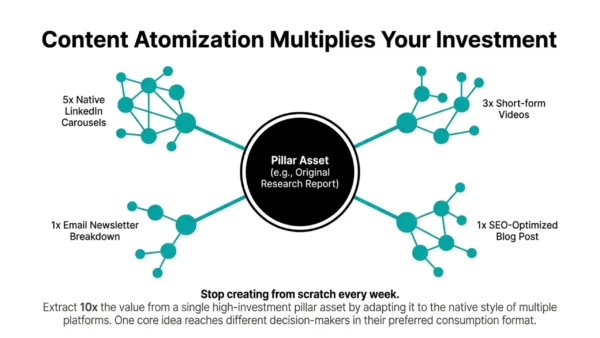
That makes distribution broader than publishing a blog post or sharing a link once. A guide may be published on a company website, introduced to subscribers by email, discussed in a webinar, adapted into social content, mentioned by a partner and used by a salesperson to answer a buying question. Each activity gives the original investment another opportunity to create value.
Content creation is the production of the original asset. Publishing makes that asset available. Distribution places it in front of relevant people. Promotion actively increases its exposure, often through paid activity or targeted outreach. Repurposing adapts the underlying ideas into a different format, while syndication involves republication through another publisher or platform.
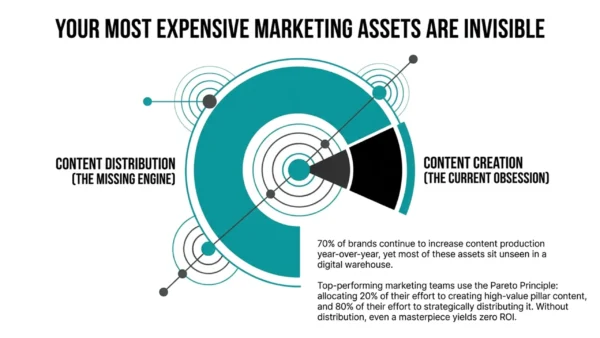
These activities overlap, but the distinction is commercially useful. A business can create excellent content and still achieve little if the intended audience never encounters it.
A useful way to view the process is through three connected layers of authority. Owned authority comes from the business’s own website, articles, service pages, case studies and email list. Distributed authority extends those ideas through podcasts, publisher networks, social platforms, video and other external destinations. Independent authority comes from reviews, customer references, partnerships, editorial coverage and third-party recommendations.
The first layer explains what the business knows. The second increases the number of places where that expertise can be discovered. The third provides evidence that others trust or value it. Visibility starts with being useful, but usefulness only matters if people can find it.
The four main content distribution channels
Some frameworks use the POEM model of paid, owned and earned media. It is also helpful to separate shared channels because social platforms and professional communities operate differently from a company’s own website.
Owned channels build a durable audience relationship
Owned channels include a website, blog, resource centre, email database and customer communications. They give a business greater control over the content, the user experience and the next action it wants a visitor to take.
They are valuable because the business is not entirely dependent on another platform’s feed or advertising costs. However, publishing on an owned channel does not automatically create an audience. A new article still needs to be discovered through search, email, referrals, partnerships, social sharing or other forms of distribution.
Earned channels provide third-party credibility
Earned distribution includes editorial coverage, independent recommendations, unsolicited links, customer advocacy and relevant mentions by other organisations. It can introduce the business to audiences it would not otherwise reach and may strengthen trust because the exposure is not entirely self-published.
The limitation is control. A business cannot fully determine whether it will be mentioned, how it will be described or when coverage will appear. The most defensible approach is to create something genuinely useful, develop relevant relationships and make expertise easy for others to reference.
Shared channels encourage discovery and discussion
Shared distribution includes social platforms, professional communities, employee sharing and partner activity. It can create conversations around an idea and help content travel through peer networks.
A company post on LinkedIn should not be treated as owned media in the same way as a company website. The business may own the message, but LinkedIn controls the feed, recommendations and access to audience data. Social visibility therefore depends partly on platform systems and audience behaviour.
Paid channels buy targeted exposure
Paid distribution includes sponsored newsletters, paid search, social advertising, sponsored content and event promotion. It can be useful when a business needs to reach a defined audience quickly or test a particular proposition.
Paid reach is not automatically profitable reach. The campaign needs a clear audience, conversion objective, budget limit and evaluation period. Cheap clicks are not necessarily valuable if they do not produce meaningful actions or commercially relevant leads.
Why content distribution affects ROI
Distribution influences ROI by improving the relationship between investment, audience quality and commercial action.
It allows one asset to create more value
A substantial piece of research or expertise can support several customer touchpoints. A guide might become a webinar, a newsletter explanation, a partner contribution, a sales resource and a series of platform-specific discussions.
This is not simply a matter of producing more posts. The useful ideas are being placed in contexts where different audiences can understand and apply them. A podcast or webinar can also become the source of articles, clips and follow-up resources, extending the useful life of the original work.
It supports a less predictable buying journey
People rarely move through a perfectly ordered sequence from article to enquiry to purchase. A potential customer may first see a social explanation, hear about the business from a colleague, attend a webinar, read a case study and make contact several weeks later.
Some of those interactions will be recorded by analytics. Others may happen through private conversations, word of mouth or untracked sharing. Distribution helps create the collection of touchpoints that supports recognition, consideration and trust, but it does not make every influence visible to a reporting platform.
It supports different commercial outcomes
Content may create awareness, generate demand, nurture an existing audience, support sales conversations or strengthen customer loyalty. These are different outcomes and should not all be judged by immediate sales attribution.
A useful early-stage article may not produce a direct enquiry but may help a prospect recognise a business later. A detailed case study may influence a decision more directly. The appropriate measure depends on the role of the content and the time period being assessed.
It creates opportunities to learn
Consistent campaign names, tagged links and recorded enquiries help a business compare channels. The aim is not to reward the channel with the most impressions, but to understand which activities attract relevant visitors, meaningful actions and commercially useful conversations.
The central qualification is that broader distribution does not automatically improve ROI. More activity can also mean more staff time, paid media costs and management overhead. The question is whether the additional value exceeds the additional investment.
How to calculate content distribution ROI
A credible calculation should measure contribution rather than simply counting revenue:
Content ROI = (incremental contribution before content costs − total content investment) ÷ total content investment × 100
Incremental contribution means the additional revenue attributable to the activity after relevant product or service delivery costs have been allowed for, but before the content investment is deducted.
Total investment should include research, strategy, writing, design, filming, editing, internal staff time, repurposing, channel adaptation, outreach, paid placements, software, agency fees, measurement, reporting, updates and maintenance. Counting only the writer’s invoice can make the return look considerably stronger than it really is.
For example, suppose a service business spends £2,000 creating and distributing a guide. It generates £8,000 in attributable revenue. The relevant service-delivery costs are £4,000, leaving £4,000 in contribution before marketing costs.
The calculation is therefore: (£4,000 − £2,000) ÷ £2,000 × 100 = 100% ROI.
This is a hypothetical illustration, not an industry benchmark. The result depends on the attribution assumptions, the measurement period and the confidence that the activity generated incremental business.
ROI is also different from ROAS. ROAS compares attributed advertising revenue with advertising spend and does not normally include the full cost of content production or service delivery. Pipeline influence is different again: it describes opportunities that interacted with content, but pipeline is not closed revenue and interaction does not prove that content caused the sale.
Measure the journey from distribution to commercial impact
Reporting should connect activity with outcomes rather than presenting a collection of disconnected numbers.
At the activity level, a business can record placements, emails delivered and assets deployed. Visibility measures whether the intended audience had an opportunity to discover the content through reach, relevant impressions or search appearances. Engagement measures whether people found it useful enough to click, reply, watch, read or discuss.
Conversion measures then ask whether that attention produced a useful next step, such as an enquiry, booking, sign-up or qualified lead. Commercial measures go further by connecting activity with opportunities, won business, contribution and acquisition cost.
Before launch, define the audience, customer problem, commercial objective, main destination, supporting channels, next action, owner, budget and measurement window. This prevents distribution becoming an unassigned task after the content has already been created.
Use consistent campaign naming and tag controllable external links with utm_source, utm_medium and utm_campaign. utm_content can distinguish creative variations where needed. Record meaningful website actions as analytics key events and connect enquiries with lead quality and eventual sales outcomes.
UTM values are case-sensitive, so inconsistent naming can fragment reporting. Campaign tags identify where traffic came from; they do not prove that the campaign caused an incremental sale. Customer feedback and CRM records remain important, particularly where recommendations and private conversations influence the buying journey.
Build distribution into the content plan
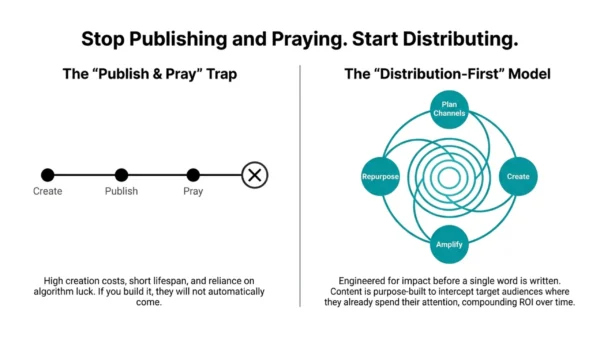
Distribution should be considered before commissioning an asset, not added as an afterthought. The intended audience and channel mix may affect the format, length, examples and call to action from the beginning.
Choose channels based on audience fit rather than popularity. A B2B thought-leadership report may suit LinkedIn, email and speaking events, while a local service business may gain more from useful website content, local discovery, customer referrals and carefully chosen community relationships. There is no universal channel allocation that guarantees profitable results.
Adapt the content for each setting. An email should explain why the subscriber should care. A social post should offer a useful idea rather than merely repeat a headline. A webinar should create space for explanation and questions. A partner publication should reflect that publisher’s audience, and a sales follow-up should address a specific concern in the decision process.
Expert collaboration can also improve relevance and reach. Interviews with practitioners, customers and complementary organisations can add experience that generic content lacks. Survey evidence associates influencer collaboration with stronger blogging results, but that is an association rather than proof that collaboration causes a particular return.
AI can assist with transcription, drafting variants and production preparation, but human oversight remains necessary for accuracy, originality, judgement and channel suitability. Faster content production is not the same as better performance. The useful principle is to automate workload, not judgement.
Visibility is not the same as referral traffic
Search, social feeds and commercial performance are separate systems. Google’s guidance emphasises useful, reliable, people-first content, distinctive expertise, crawlability, internal links, accessible text and a sound page experience. These are foundations, not a checklist that guarantees rankings or inclusion in an AI-generated answer.
Google’s newer guidance also rejects the idea that there is an ideal page length or a special requirement to divide content into tiny sections. Distributing content across more websites does not, by itself, make an AI system more likely to cite or recommend a business. Distinctive expertise and credible information are more defensible than mass-producing interchangeable summaries.
Social platforms make their own recommendations based on relevance, context and engagement. The practical response is to publish useful insight for a recognisable audience rather than rely on supposed magic posting times or guaranteed engagement thresholds.
Referral traffic may also become a less complete measure of visibility. Pew Research Center found that traditional-result links received clicks on 8% of Google visits where an AI summary appeared, compared with 15% where it did not, in its US browsing study. This does not predict the experience of every business, but it reinforces the need to measure enquiries, relationships and commercial outcomes alongside visits.
Common distribution mistakes that reduce ROI
The most common mistake is publishing without a distribution owner. When nobody is responsible for the audience, channels, follow-up and measurement, even strong content can be abandoned after its launch.
Another mistake is judging success entirely through impressions or page views. These measures show opportunity for exposure, not necessarily relevance, trust or business value. A smaller number of qualified enquiries may be more valuable than a large volume of untargeted traffic.
Copying identical messages across every platform can also weaken performance. Content needs to be adapted to the audience and behaviour of each channel. Similarly, placing paid spend behind weak or generic content can accelerate waste rather than solve the underlying problem.
Businesses often overproduce new content while neglecting useful existing assets. Reviewing, updating and redistributing a strong guide may create more value than commissioning another broadly similar article.
Finally, attribution should not be treated as proof of causation. Analytics can allocate credit across observable touchpoints, but it cannot capture every conversation, recommendation or offline influence. The most reliable view combines tagged activity, conversion records, CRM outcomes and informed customer feedback.
The best answer in the world has little commercial value if nobody discovers it. Content distribution gives useful expertise a chance to reach the right people, but ROI depends on what happens after discovery: whether the audience is relevant, the next step is clear and the resulting value exceeds the complete cost of creating and distributing the content.
Research Insights
| Topic / Area | Key Finding | Business Impact | Why It Matters |
|---|---|---|---|
| Thought-leadership channels | LinkedIn led at 76%; email reached 54% | Supports coordinated channel planning | Channel mix matters more than one outlet |
| ROI measurement | 56% reported attribution difficulty | Weakens confidence in simple ROI claims | Tracking must connect content with CRM outcomes |
| Blogging performance | 13.9% reported strong results; 18% were unsure | Publishing alone does not guarantee returns | Distribution and measurement cannot be optional |
| Google AI summaries | Traditional links clicked on 8% versus 15% | Referral traffic may understate visibility | Measure enquiries and commercial outcomes too |
Sources
Content Marketing Institute – B2B Content Marketing Trends: Research 2026
Content Marketing Institute – B2B Content Marketing Trends: Research 2025
Orbit Media – Blogging Statistics
Pew Research Center – Google Users Are Less Likely to Click on Links When an AI Summary Appears
Frequently Asked Questions
Is content distribution the same as content promotion?
No. Promotion is one part of distribution and usually refers to actively increasing exposure. Distribution is the wider process of deciding where content should appear, adapting it for each channel, reaching the relevant audience and measuring whether it contributes to useful business outcomes.
How much should a business spend on content distribution?
There is no reliable universal percentage. The appropriate investment depends on the asset, audience, channels, buying cycle and commercial value of a customer. Start with a defined objective and budget, then compare incremental contribution with the full production and distribution cost.
How long does it take to see content distribution ROI?
The timescale depends on the channel and buying journey. Paid campaigns may produce measurable actions quickly, while search visibility, audience growth and trust can take longer. Set a measurement window before launch and assess both immediate conversions and later commercial outcomes.
Can content distribution guarantee visibility in AI search?
No. Publishing across more websites does not guarantee that an AI system will cite or recommend a business. Distinctive expertise, useful information, technical accessibility and credible independent evidence improve the foundations for discovery, but no distribution tactic guarantees inclusion.
What is the difference between ROI and ROAS?
ROI compares commercial contribution with the complete relevant investment, including production and distribution costs. ROAS normally compares attributed advertising revenue with advertising spend alone. ROAS can therefore look positive even when the wider content and fulfilment costs make the activity unprofitable.
