
Summary
Organic vs paid content promotion isn’t about choosing one winner. Paid promotion delivers faster, targeted traffic, while organic content builds long-term visibility and authority. The most effective strategy combines both, measuring success through qualified visitors, enquiries and conversions rather than traffic volume alone.
Key Takeaways
- Neither organic nor paid content promotion wins every time; the better choice depends on goals, budget, audience and how traffic is measured
- Organic search drives roughly 53% of all website traffic across industries, making it a larger channel than paid search, social media, direct traffic, and referrals combined, though AI Overviews are changing how often any result gets clicked at all
- Paid promotion gives faster, more controllable results while organic content builds assets that can keep working long after a campaign ends
- Counting the true cost of each channel, including time spent creating content, is essential before declaring either one a winner
- A combined strategy that matches channel choice to specific goals tends to outperform relying on organic or paid content promotion alone
Business owners often ask the same question when planning a content strategy: should budget go into organic content or paid promotion? The honest answer is that neither approach consistently drives more traffic. What works best depends on the content itself, the audience being targeted, the budget available, and what success actually looks like for the business asking the question.
Neither Approach Wins Every Time
Treating organic versus paid as a straight competition misses the point entirely. Paid promotion tends to be the stronger tool when visits are needed quickly and a specific audience needs reaching right now. Organic promotion, on the other hand, can build sustained discovery and repeat readership without a fee attached to every single visit.
The most useful way to think about this is through incrementality: how many additional, relevant visits does each approach actually create, at what total cost, and with what outcome for the business? Framed this way, the question shifts from which channel wins outright to which channel wins for a particular goal. Content creation services built around this kind of goal-first thinking tend to perform better than content created first and promoted as an afterthought, since the promotion plan shapes decisions from the very start.
Measurement period matters too. A campaign judged over two weeks will usually favour paid promotion, since paid results appear almost immediately. The same comparison stretched over two years often favours organic content, because a well-built article or guide can keep attracting visitors long after the original publishing date.
Organic vs Paid: What’s The Difference
Organic content promotion covers unpaid discovery: showing up in search results, appearing in social feeds without boosting a post, or being shared by someone who found the content valuable. Paid promotion covers anything where money buys visibility: search ads, boosted social posts, display adverts, sponsorships, and paid newsletter placements.
Beyond SEO vs PPC: Owned and Earned Channels
Reducing this topic to “SEO versus PPC” ignores a large part of how content actually travels. Content promotion covers far more than search alone, and understanding the full picture helps explain why a combined approach so often makes sense.
- Organic search relies on discoverability through indexed articles, guides, and videos, with traffic driven by search demand and visibility rather than publication alone.
- Organic social includes unpaid posts, employee sharing, and participation in relevant online communities, though impressions on a platform are not the same as visits to a website.
- Owned distribution covers email newsletters and direct customer communications; there is no media fee per visit, but building and maintaining that audience still takes investment.
- Earned distribution includes editorial coverage, independent mentions, and voluntary sharing, where the business does not fully control placement or timing.
- Paid promotion spans search ads, promoted posts, display and native ads, sponsorships, and paid newsletter placements, where payment buys an opportunity for exposure rather than a guaranteed qualified visit.
Where Organic Content Still Wins
Organic content holds a lasting advantage in situations where trust and longevity matter more than speed. It rewards patience, but the payoff can continue for years without further spend on distribution.
Why Organic Search Still Leads
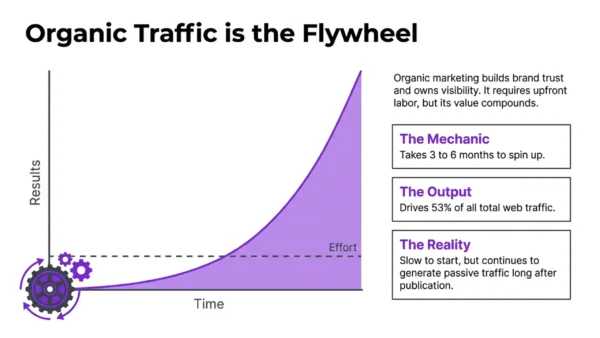
Organic search is consistently the largest traffic source for most websites, driving roughly 53% of all website traffic across industries, making it a larger channel than paid search, social media, direct traffic, and referrals combined. This matters because it shows that people are actively choosing organic results for a wide range of searches, not simply ignoring paid options by accident.
Trust, Loyalty and Long-Term Assets
Content that does not look or feel like an advertisement tends to earn more trust, and trust has a direct line to purchasing decisions. A well-researched article, optimised for search and genuinely useful to readers, can keep generating enquiries months or even years after it was first published, without needing a fresh advertising spend to justify its existence. That durability is what makes organic content behave more like an asset than an expense: once it is built and ranking, it keeps earning attention quietly in the background.
Where Paid Promotion Still Wins
Paid promotion earns its place when speed and precision matter more than longevity. For a product launch, a seasonal offer, or any time-sensitive announcement, waiting months for organic rankings to build simply is not practical.
Speed, Control and Targeted Reach
Paid advertising delivers immediate reach and uses targeting tools to put content in front of specific, relevant audiences, which makes it especially useful for launches or offers with a deadline attached. It also hands over a level of control that organic promotion cannot match: campaign timing, audience targeting, and daily spend can all be adjusted on demand. The trade-off is that this reach lasts only as long as the budget does. The moment spending stops, the traffic that paid promotion was generating stops too, which is why it rarely works as a sole long-term strategy.
How AI Overviews Are Reshaping Both
AI-generated search summaries are changing the search results page in ways that affect organic and paid promotion alike. These features already appear in a substantial share of Google searches, and their presence is reshaping click behaviour across the board.
Falling Click-Through Rates for Organic and Paid
When an AI Overview appears above traditional results, the effect on click-through rates is significant for both organic and paid listings. Research from Pew Research Center found that traditional search-result clicks occurred in just 8% of visits when an AI summary appeared on the page, compared with 15% of visits when no summary was shown, and that users clicked a link inside the AI summary itself in only 1% of visits where one appeared. Paid listings are affected too, and AI Overviews also tend to push paid results further down the page, reducing their visibility and adding to the drop in clicks.
Why AI-Referred Visitors Convert Better
There is a more encouraging side to this shift. Google has stated that clicks arriving from search pages with AI Overviews tend to be higher quality, with users more likely to spend meaningful time on the destination site. The pattern that emerges is one of fewer total clicks, but higher quality among the clicks that do happen, which means content built for depth and clarity may be better placed to benefit from this shift than content built purely for volume.
Counting the True Cost of Each Channel
Calling organic content “free” is one of the most common mistakes in this debate. Creating, distributing, and maintaining content all require investment, even when no media budget changes hands. The cost of creation, including research, writing, editing, and ongoing optimisation, still needs to be counted before comparing it fairly against a paid media budget.
Paid promotion comes with its own cost pressures. Average benchmarks for search advertising put cost-per-click, click-through rate, conversion rate, and cost per lead well above zero, reflecting how much businesses are already committing to this channel. Comparing the two fairly means looking at cost per qualified visit, not simply cost per click or cost per article, since a cheap visit that never converts is not actually a bargain.
Measuring What Actually Matters
Traffic volume alone tells an incomplete story. A spike in visits means very little if none of those visitors take a meaningful next step, which is why measurement needs to go further than counting clicks.
Why Traffic Volume Isn’t The Whole Story
A useful way to check content performance is to look beyond raw numbers and ask what actually happened after someone arrived on the page.
- Did the visit come from someone who matches the target audience, rather than an unrelated click?
- Did the visitor take a meaningful next step, such as signing up, enquiring, or browsing further?
- Did the visit contribute to a lead or sale, even if not on the same day?
- Would the business have reached this person without the content or promotion in question?
Tackling Attribution Challenges
Measuring content marketing return on investment is genuinely difficult, since content touches many stages of the customer experience across different channels, devices, and times. A visitor might read an article on a phone, see a paid advert on a laptop a week later, and finally convert after a third interaction entirely, making it hard to credit any single channel with the result. The practical response is to track qualified visits and leads over a realistic period rather than expecting one tidy number to explain the entire customer experience.
The Case For a Combined Strategy
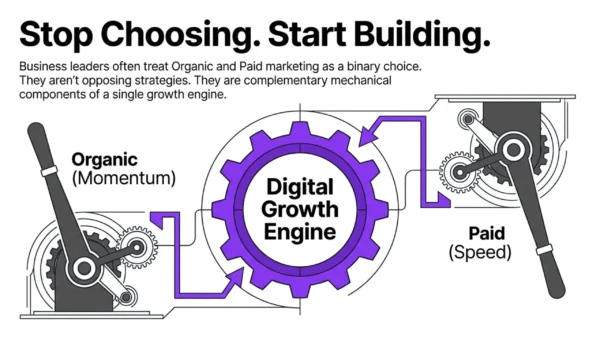
Given how differently organic and paid promotion behave, treating them as rivals rather than partners leaves performance on the table. Organic content builds the long-term foundation, while paid promotion can accelerate reach for time-sensitive goals or test which messages connect before committing further organic effort.
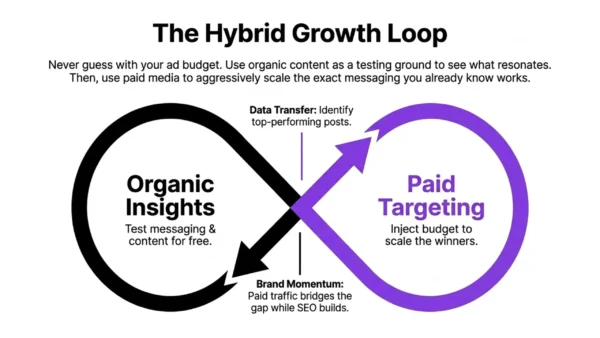
A practical approach is to publish strong organic content first, observe early response, and then use paid promotion selectively to amplify whatever is already showing signs of working. This reduces the risk of spending heavily on content that was never going to connect with the audience, while still giving well-performing content the extra push it deserves. Businesses that rely solely on one channel tend to plateau: purely organic strategies can feel too slow for urgent goals, while purely paid strategies can become expensive once budgets scale and the traffic disappears the moment spending pauses.
Traffic Depends on Goals, Not Channel Alone
The real deciding factor in this debate is never organic versus paid in isolation. It comes down to the goal behind the campaign, the audience being reached, the budget available, and the timeframe over which success is being measured.
Businesses chasing an immediate spike for a launch or offer will likely lean more heavily on paid promotion, while those building long-term authority and a steady stream of enquiries will find organic content pays off over a longer horizon. Most businesses, in practice, benefit from a blend of both, adjusted as goals shift throughout the year. Before settling on a plan, it helps to clarify exactly what traffic is meant to achieve, then build a strategy using content creation services designed around that specific outcome rather than chasing visits for their own sake.
| Topic / Area | Key Finding | Business Impact | Why It Matters |
|---|---|---|---|
| AI search behaviour | Traditional-result clicks: 8% with AI summaries; 15% without | Fewer website visits may follow informational searches | Prioritise qualified enquiries over traffic volume alone |
| Paid promotion | PPC offers immediate reach and adjustable targeting | Supports launches, seasonal offers and controlled campaign testing | Matches promotional spending to time-sensitive business goals |
| Organic ranking | Google Ads spending does not improve organic rankings | Advertising cannot replace investment in useful, searchable content | Budget separately for paid distribution and organic visibility |
| AI-search readiness | Existing SEO fundamentals apply; no special AI markup required | Avoid unnecessary spending on supposed AI-specific technical requirements | Prioritise accessible pages, internal links and helpful content |
Sources
Pew Research Center — 2025 browsing study of 900 US adults; observed click differences, not proof of causation.
Google Ads — Paid targeting, campaign flexibility and separation from organic rankings.
Google Search Central — Official requirements and practical guidance for AI-search visibility.
Frequently Asked Questions
How long does organic content take to generate website traffic?
Search-led organic content often needs three to six months to show measurable results, although competitive topics can take longer. Website authority, competition and implementation speed influence the timeline. Assess progress through relevant impressions, qualified visits and enquiries rather than expecting an immediate traffic surge.
How should a small business split its budget between organic and paid promotion?
There is no universal budget split. Start with your immediate revenue needs, existing audience and content resources. Allocate a controlled amount to paid testing while maintaining useful organic content. Adjust spending according to qualified enquiries and acquisition costs, rather than following an arbitrary percentage.
Is organic content still worth investing in with Google AI Overviews?
Yes, but focus on useful content rather than traffic volume alone. Google says established SEO practices still apply to AI Overviews and AI Mode. Publish original insights, answer relevant questions clearly and keep pages accessible to search engines; no special AI-specific markup is required.
Does paying to promote an article improve its Google organic rankings?
Paid promotion should be treated as a distribution investment, not an organic ranking tactic. It buys exposure, while organic visibility requires separate SEO work. Evaluate advertising by the relevant visitors and enquiries it generates, rather than assuming campaign spending will lift the article’s unpaid search position.
How do I choose which content to promote with paid advertising?
Prioritise content that addresses a clear customer need and offers a relevant next step. Look for early signs of engagement or enquiries, then test a limited budget. Compare qualified conversions, not just cheap clicks, before increasing spend or promoting additional articles.
