Summary
Most businesses expect SEO content to rank within weeks, but the evidence tells a different story. While new pages can be indexed quickly, meaningful rankings often take months, and top-performing content usually earns its position through sustained authority, relevance and consistency rather than shortcuts. Understanding realistic SEO timelines helps businesses set better expectations, invest more effectively and build content that delivers long-term organic growth.
Key Takeaways
- 72.9% of pages currently ranking in Google’s top 10 are more than three years old – meaning established content holds a structural advantage that new pages cannot shortcut.
- Only 1.74% of newly published pages reach the top 10 within their first year, making realistic timeline-setting one of the most important things any business can do before investing in SEO.
- Indexing and ranking are not the same thing – getting into Google’s index is just the starting line, not the finish.
- Content clusters, technical crawlability, and search intent alignment are the fastest legitimate levers for improving ranking speed – covered in detail below.
- West Pro Media Services provides content creation services built around long-term organic growth, helping businesses build authoritative, structured content that compounds over time.
Before spending another dollar on SEO, it helps to understand what the data actually says about how long ranking takes – and why most new pages never reach the top 10 at all.
Most New Pages Never Crack the Top 10
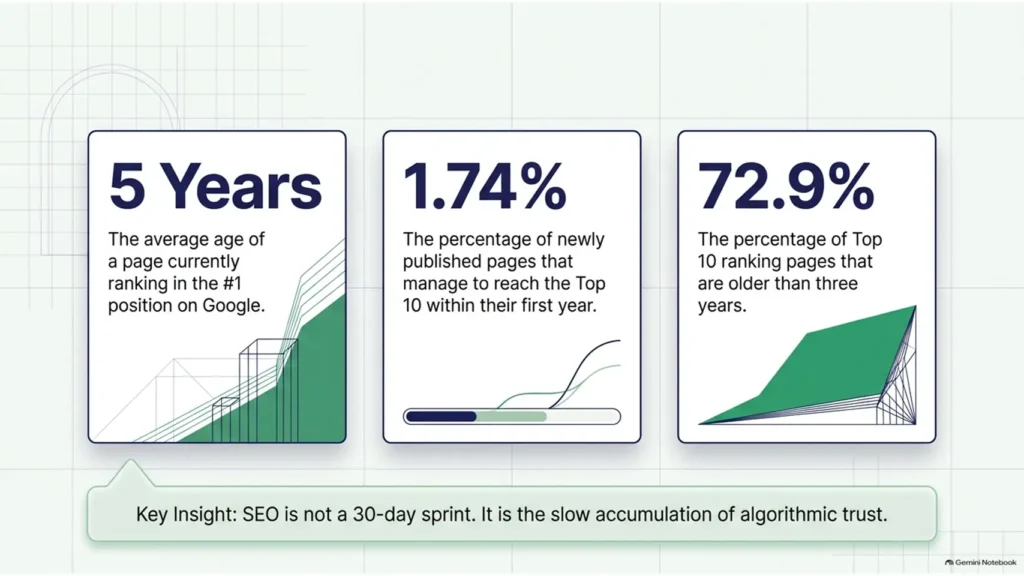
The uncomfortable truth: the overwhelming majority of content published online simply never ranks well. According to Ahrefs’ analysis, only 1.74% of newly discovered URLs reach Google’s top 10 within a year. Even when the sample is narrowed to non-empty, English-language content, that number climbs only to 6.11%. Competition for top rankings is fierce, and the incumbents – pages that have been sitting in those positions for years – are not easy to displace.
This is not a reason to abandon SEO. It is a reason to approach it with clear eyes and a realistic plan. New content can and does rank, but it does so by earning its place through accumulated signals – relevance, authority, engagement, and time – not by simply existing.
Indexed vs. Ranked: Not the Same Thing
One of the most common points of confusion in SEO conversations is treating “indexed” and “ranked” as interchangeable. They are not, and conflating them leads to misaligned expectations.
Getting indexed means Google has discovered, crawled, and processed a URL. Getting ranked – meaningfully, in a position that earns clicks – is a different achievement entirely, and it takes considerably longer. Here is how those stages look in practice:
- Indexed: Google has processed the URL. Often happens within days to weeks. Not a ranking achievement.
- Early impressions: The page appears for some queries, usually low-competition or long-tail. Typically weeks to a few months.
- Meaningful rankings: The page earns repeat visibility in the top 20 or top 10 for target terms. Commonly 3-12+ months.
- Business results: Rankings generate qualified traffic, leads, or conversions. May lag rankings depending on intent, click-through rate, and conversion path.
- Stable authority: The page remains competitive through algorithm updates and new content from rivals. Ongoing – not a finish line.
Key Milestones to Track: Crawling, Indexing, Impressions, and Traffic
Google Search Console is the right tool for tracking these milestones. The Page Indexing report confirms whether the intended URL is being processed correctly. The Performance report shows which queries are generating impressions and clicks, and how average position is shifting over time. Relying on third-party rank trackers alone gives an incomplete picture – they measure a snapshot, not the full spread of queries a page may be appearing for.
What the Data Really Shows
The 1.74% Statistic Explained
The 1.74% figure comes from Ahrefs’ analysis of newly discovered URLs across their index. The broad sample includes thin pages, abandoned content, duplicate URLs, and low-quality sites – which partly explains why the number is so low. But even among non-empty English-language content pages, only 6.11% reach the top 10 within a year. The takeaway: publishing alone is not a strategy. The quality, relevance, and authority behind a page determine whether it falls within the small percentage that actually breaks through.
Why the Average #1 Page Is 5 Years Old
The average page occupying position one on Google is roughly five years old. And 72.9% of pages in the top 10 are more than three years old. These are not just old pages – they are pages that have spent years accumulating backlinks, earning topical credibility, being updated with fresh information, and building engagement history. Page age itself is not a ranking signal Google rewards directly, but the things that tend to happen to good pages over time – links, refinement, authority – are. A new page can still compete, but it needs to earn those signals faster and more deliberately.
Realistic Timelines by Keyword Type
Long-Tail vs. Competitive Head Terms
Not all keywords are created equal, and ranking timelines vary significantly depending on what is being targeted. As a directional guide:
- Low-volume long-tail terms (e.g., “best accounting software for freelance designers in Texas”): 2-6 months
- Medium-demand terms (e.g., “small business accounting software”): 4-12 months
- High-volume head terms (e.g., “accounting software”): 6-24+ months, with no guarantee of top-10 placement
For small and medium-sized businesses, long-tail keywords are often the smarter starting point. They are more specific, attract higher-intent visitors, and face less entrenched competition. A well-structured long-tail strategy can begin delivering qualified traffic much sooner than chasing broad, competitive terms that dominant brands have owned for years.
Key Factors That Control Your Ranking Speed
Technical Crawlability
If Google cannot reliably discover, crawl, and render a page, no amount of content quality will move the needle. Before anything else, check HTTP status codes, canonical tags, robots directives, noindex tags, and sitemap inclusion. Orphan pages – content with no internal links pointing to it – are a particularly common and easily fixed problem. Tools like Google Search Console’s URL Inspection report surface these issues quickly. Technical fixes can improve crawlability fast, but they do not guarantee ranking increases on their own.
Search Intent Match
Keyword volume is a crude proxy for opportunity. The real question is: what does Google already consider a satisfactory answer for this query? Rankings take longer – sometimes much longer – when the SERP is dominated by entrenched publishers, government sites, or established brands. Progress also stalls when the format being used does not match what Google prefers for that query type. Trying to rank a blog post where Google consistently serves product category pages or video results is an uphill battle that better intent research could have identified early.
Content Quality and Information Gain
Google’s helpful content guidance is consistent: original, useful, people-first content. The practical implication for ranking speed is that generic explainers – especially those produced at scale without added insight – are increasingly outcompeted by content that brings something genuinely new. That means original data, first-hand experience, decision frameworks, documented workflows, or expert interviews. The question to ask before publishing: what does this page offer that the current top results do not? If there is no clear answer, the page is likely to stall.
Topical Authority and Site Architecture
A single strong article on an otherwise thin site is a slower path to ranking than the same article published within a well-linked content cluster. When a site demonstrates consistent, structured depth across a topic – through pillar pages, supporting articles, and deliberate internal linking – Google has more signals to confirm that the domain is a credible source. Building that cluster architecture is an ongoing editorial strategy that compounds over time, not a one-time setup task.
How Google’s Ranking Algorithms Actually Behave
The Rank Transition Patent: Why Rankings Fluctuate After Changes
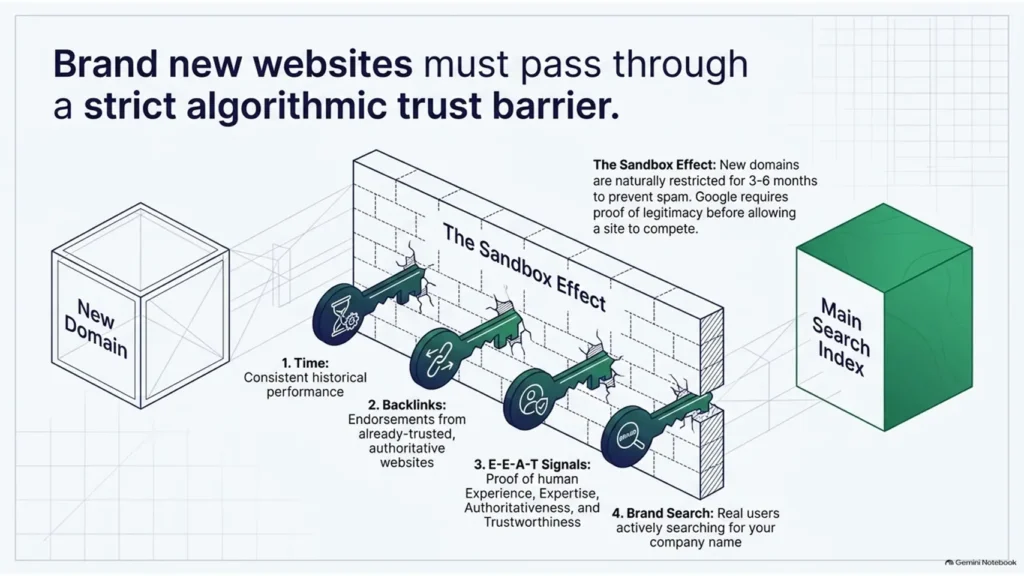
Most people chalk up post-publication ranking volatility to “Google testing.” That is accurate, but there is more precision available. Google’s Rank Transition patent (US8924380B1) describes a system where a document’s ranking may be temporarily suppressed or made to fluctuate after changes – specifically to observe long-term performance and deter manipulation. In practice, ranking drops in the weeks after optimization are often expected behavior, not a sign that something has gone wrong. The algorithm is calibrating. Abandoning a strategy during this window is one of the most common and costly mistakes businesses make.
How to Rank Faster Without Shortcuts
Content Clusters Build Topical Authority
Publishing an isolated article and waiting is the slow path. The faster approach is building interconnected content – a pillar page covering the broad topic, supported by articles addressing specific sub-questions, all linked with descriptive, natural anchor text. When a new article is added to an already well-linked, authoritative cluster, it enters a different competitive environment than a standalone URL. It inherits topical context, gets crawled faster, and accumulates relevance signals more quickly. This structural difference is what separates content that compounds from content that stalls.
What to Measure at 30, 90, and 180 Days
Tracking only rank position is a trap. Meaningful progress shows up first in leading indicators, not headline metrics. A more useful measurement framework looks like this:
- 30 days: Has the page been indexed? Are impressions appearing in Search Console? Are there internal links pointing to it from relevant pages?
- 90 days: Which queries is the page generating impressions for? Is average position improving? Are there intent mismatches to address?
- 180 days: Has measurable click traffic arrived? Are any target terms moving into the top 20? Does the content need a substantive update based on Search Console query data?
Progress that follows this kind of evidence trail – even if rankings are still building – is a healthy sign. Flat impressions after 90 days, on the other hand, usually point to a technical or intent issue that needs resolving before more content is published.
Common SEO Myths That Drain Your Budget
“Page One in 30 Days” and Other Dangerous Promises
Any agency or freelancer promising first-page rankings within 30 days is either targeting terms with no meaningful search volume or overstating what is achievable. The data is clear: even among pages that do eventually reach the top 10, the path typically takes months. Chasing that promise often leads to wasted budget, strategy whiplash, and the kind of premature abandonment that guarantees poor results.
Length, Keyword Density, and Date-Swapping Don’t Move Rankings
Writing longer content does not make it better – it makes it longer. Keyword density as a concept belongs to an earlier era of search. And simply changing the “Last Updated” date on a post without making substantive improvements has zero impact on rankings. What moves rankings is genuine information gain, correct intent alignment, and accumulated authority signals. There are no cosmetic workarounds for those fundamentals.
Consistent, Evidence-Based SEO Compounds – Impatience Doesn’t
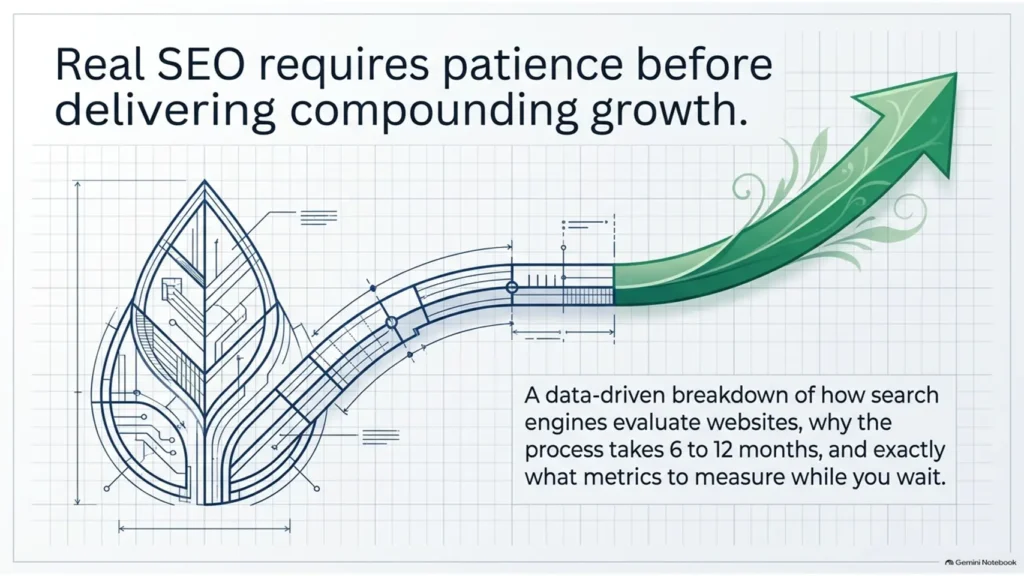
The data points to one consistent conclusion: top rankings belong overwhelmingly to established, authoritative content that has earned its position over time. New pages can compete, but they need to be built with purpose, published into a coherent structure, measured honestly, and improved based on real evidence rather than guesswork or short-term pressure. The businesses that win at organic search treat it as a compounding asset, not a quick-turnaround channel.
| Topic / Area | Key Finding | Business Impact | Why It Matters |
|---|---|---|---|
| New-content rankings | Only 1.74% reach top 10 within one year | Avoid unrealistic short-term ROI promises | SEO budgets need patience and sustained execution |
| Established-content advantage | 72.9% of top-10 pages exceed three years old | Incumbents hold accumulated authority advantages | New entrants need sharper relevance and differentiation |
| Indexing versus visibility | Indexed pages may still receive no meaningful traffic | Track impressions before judging campaign performance | Indexing confirms eligibility, not commercial search demand |
| Search Console measurement | Query, impression and click data reveal early momentum | Enables evidence-led optimisation before rankings mature | Prevents overreaction to isolated rank-tracker movements |
| Content quality strategy | People-first, genuinely useful content remains central | Differentiated content can earn durable organic visibility | Generic, scaled content carries higher performance risk |
How can I tell whether my new SEO content is making progress before it ranks?
Look beyond a single keyword position. In Google Search Console, check whether the page is indexed, gaining impressions for relevant queries, attracting initial clicks, and appearing for a widening set of long-tail searches. These are early signs Google is testing and understanding it.
Why is my page indexed but not receiving any organic traffic?
Indexing only confirms Google can include the page in its database; it does not mean Google sees it as the best result for a query. Review search intent, internal links, technical accessibility, content depth, and whether the page offers a clearer or more useful answer than existing results.
When should I update a page that is not ranking?
Avoid rewriting it immediately after publishing. Give the page enough time to be crawled, indexed and tested—then use Search Console data to identify poor query alignment, missing information, or weak click-through appeal. Make substantial improvements, not cosmetic date changes. Google prioritises helpful, people-first content.
Does publishing more content make existing pages rank faster?
Not automatically. Publishing many disconnected articles can dilute effort. New pages are more likely to support each other when they address closely related questions, link naturally to one another, and reinforce a clear topic area. Prioritise a connected content cluster over a high publishing volume.
What should I do if rankings drop after I update an article?
First, check that Google has crawled the revised version and avoid reacting to small, short-term movements. Compare impressions, clicks, queries and positions over a meaningful period. If the decline is sustained, assess whether the update weakened search-intent fit or removed useful detail.
West Pro Media Services helps businesses build exactly that kind of long-term organic presence – visit westpromediaservices.com to learn about their content and SEO services built for sustainable search growth.
