
Your GBP Is a Local Intent Landing Page — Not a Directory Listing
Most businesses still treat their Google Business Profile the way they would treat a listing in a printed phone directory: fill in the basics, set it up once, and move on. That approach no longer works. Google’s local algorithm has evolved to treat GBP as a live, dynamic representation of a business — one that it continuously re-evaluates based on data accuracy, user engagement, and content freshness.
When someone searches “emergency electrician near me” or “best coffee shop downtown,” Google is not simply scanning a database of addresses. It is weighing dozens of signals to determine which businesses deserve the top three spots in the Map Pack — and a stale, incomplete profile simply does not compete. A well-optimized GBP functions like a micro-homepage built for local intent: it carries conversion-oriented content (offers, photos, FAQs), answers specific questions, gets updated regularly, and mirrors the language real customers use when searching.
The businesses winning in local search have made a fundamental shift: they manage their GBP as an ongoing marketing channel, not a one-time administrative task. That is the frame this entire guide is built on.
Three Signals Govern Every Local Ranking
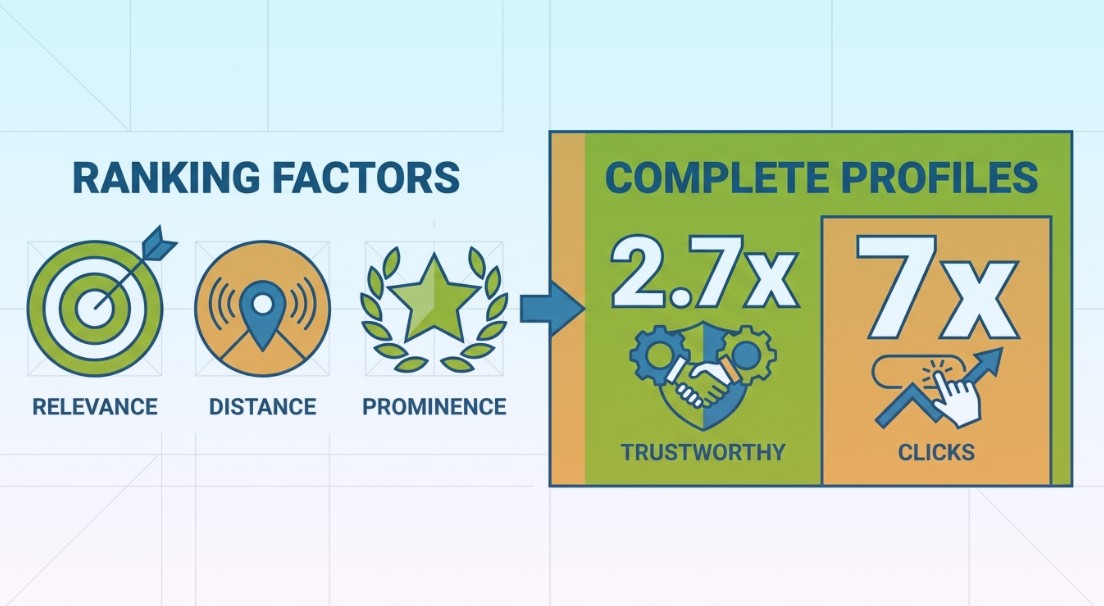
Before working through the optimization framework, it helps to understand the structural logic Google uses to decide which businesses rank locally. Everything flows from three foundational signals: relevance, proximity, and prominence. Google has confirmed these publicly, and every practical tactic in local SEO connects back to at least one of them.
Relevance: Matching the Query
Relevance measures how well a business profile matches what someone is searching for. It is driven by the information on the profile itself — the primary category, business description, services listed, products, attributes, and even the language used in reviews and responses. A plumber whose profile clearly identifies them as a “Drainage Contractor” specializing in “blocked drain repair” will surface for more precise queries than one whose profile simply says “plumber.”
This is where most of the controllable optimization happens. Every field filled in accurately, every service named in the language customers actually use, and every post that reinforces a location-service combination — all of it feeds relevance signals. Natural keyword placement throughout the profile is not about gaming the algorithm; it is about clearly communicating what the business does and for whom.
Proximity: The Structural Advantage You Cannot Fully Control
Proximity is straightforward: Google gives a ranking advantage to businesses that are physically closer to the person searching. In dense urban markets, this can mean the difference of a few blocks. It is the one major ranking factor that optimization cannot fully overcome — a business in Manchester cannot outrank a Manchester competitor for a search made from that competitor’s street.
What businesses can control is ensuring their physical address and service area are configured accurately and that their verified location is consistent everywhere online. Using a PO box, virtual office, or fake address violates Google’s guidelines and risks suspension — a far worse outcome than simply ranking second. For service-area businesses without a customer-facing storefront, correctly setting the service area within GBP becomes especially important.
Prominence: Authority and Engagement Built Over Time
Prominence is the broadest of the three signals. It encompasses everything that makes a business well-known and trusted — both online and offline. Review volume and rating, citation consistency across the web, website authority, brand search demand, and ongoing profile engagement all contribute to prominence.
Unlike relevance, which can be improved quickly by updating profile fields, prominence is built over months and years. A business with 400 four-star reviews, active posts, consistent citations, and a well-linked website carries significantly more prominence than a competitor with a complete but passive profile. Engagement signals have become more prominent inputs in 2025-2026, with Google increasingly treating continuous profile activity — posts, photos, Q&A updates — as a core ranking consideration, not just a supporting one.
Category Selection Is the Strongest Lever You Control
Of all the optimization variables within a business’s direct control, primary category selection is consistently ranked as the single most impactful. It determines which search queries a business is eligible to appear for — and eligibility is the prerequisite for everything else. No amount of reviews or posts will rank a business for queries it is categorically excluded from.
Choosing the Most Specific Primary Category
The primary category should reflect the core service the business provides, at the most specific level available in Google’s category library. Broad categories like “Contractor” or “Consultant” are almost always wrong — they compete against every contractor or consultant in the area and fail to signal specialization.
A landscaping company that primarily installs irrigation systems should select “Irrigation Service” rather than “Landscaping Service.” A family law attorney should use “Family Law Attorney” rather than “Law Firm.” The more specific the category, the more precisely it aligns the profile with high-intent searches — the queries most likely to convert into actual customers.
Practical check: search for the main service on Google and look at what category the top-ranked Map Pack results are using. That is the category to match or beat.
Selecting 2-5 Relevant Secondary Categories to Maintain Focus
Google allows up to 9 secondary categories, but more is not always better. Adding tangentially related categories can dilute relevance signals and confuse Google’s entity classification. The goal is to select 2-5 secondary categories that genuinely describe additional services the business offers — not categories chosen speculatively to chase broader traffic.
For example, a business primarily categorized as “Pest Control Service” might legitimately add “Exterminator” and “Wildlife Control Service” as secondary categories. Adding “Home Improvement” or “Cleaning Service” because those searches are high-volume would be a mistake — it weakens the core signal without adding meaningful ranking benefit.
 Build a Review System, Not a One-Time Ask
 Build a Review System, Not a One-Time Ask
The most common review mistake is not a bad response to a negative comment — it is inconsistency. Businesses that get 12 reviews in a single week after a push campaign, then go quiet for four months, are sending an unreliable signal to Google’s algorithm. Review velocity — the steady rate at which new reviews arrive — is a recognized local ranking input, and it rewards systematic, ongoing effort over sporadic bursts.
Generating Reviews at Consistent Velocity
Building a sustainable review system means integrating review requests into normal business operations, not treating them as a separate marketing campaign. Practical approaches include:
- Post-service SMS or email sequences that automatically send a review link 24-48 hours after job completion
- CRM-triggered review requests tied to closed deals or completed service tickets
- In-person prompts at point of sale, particularly effective for retail and hospitality businesses
- QR codes on receipts, packaging, or follow-up cards linking directly to the GBP review form
When asking for reviews, encouraging customers to naturally mention the specific service and location (e.g., “roof inspection in Denver”) reinforces the relevance signals that benefit rankings. This should not be scripted to the point of sounding forced — a simple suggestion works better than a template customers copy-paste verbatim.
Responding to Every Review With Purpose
Response rate matters for both rankings and buyer psychology. Businesses that respond to every review — positive, neutral, and negative — signal to Google that they are engaged and responsive. For prospective customers reading the profile, thoughtful responses to criticism demonstrate accountability and professionalism.
Effective review responses avoid generic phrasing (“Thanks for your feedback!”) and instead acknowledge the specific service, naturally incorporate relevant keywords without sounding robotic, and in the case of negative reviews, demonstrate a genuine effort to resolve the issue. A response like “We’re glad the emergency drain repair in [City] went smoothly for you” is more useful to both Google and future readers than “Thanks so much!”
Silent Ranking Killers Most Businesses Overlook
Optimization is not only about what is added to a profile — it is also about what is quietly working against it. The following issues are common, frequently overlooked, and consistently damaging to local rankings.
Inconsistent NAP Across the Web
NAP (name, address, phone number) inconsistencies across directories, social profiles, and the business website create conflicting data signals that erode Google’s confidence in the business’s identity. Even minor variations — “St.” versus “Street,” a suite number listed on the website but not on Yelp, an old phone number still live on a chamber directory — accumulate into meaningful trust problems over time.
A periodic citation audit — reviewing NAP data across the top 50-100 directories — is one of the highest-ROI maintenance tasks for local SEO. Tools like BrightLocal or Whitespark can streamline this process, identifying inconsistencies that would take hours to find manually.
Keyword-Stuffed Business Names
Adding locations or service keywords to the GBP business name field (e.g., “Johnson HVAC | Best AC Repair Dallas TX”) is a direct violation of Google’s guidelines. Beyond the policy issue, it is also a practical risk: profiles caught keyword-stuffing can be suspended, losing all accumulated reviews and ranking history in the process.
The frustrating reality is that some competitors do this and rank well — but Google’s enforcement, while inconsistent, is ongoing. Building a profile on a policy violation is building on sand. The appropriate place for keyword-rich language is the business description, services menu, posts, and review responses — not the business name field.
Abandoned Profiles With No Recent Activity
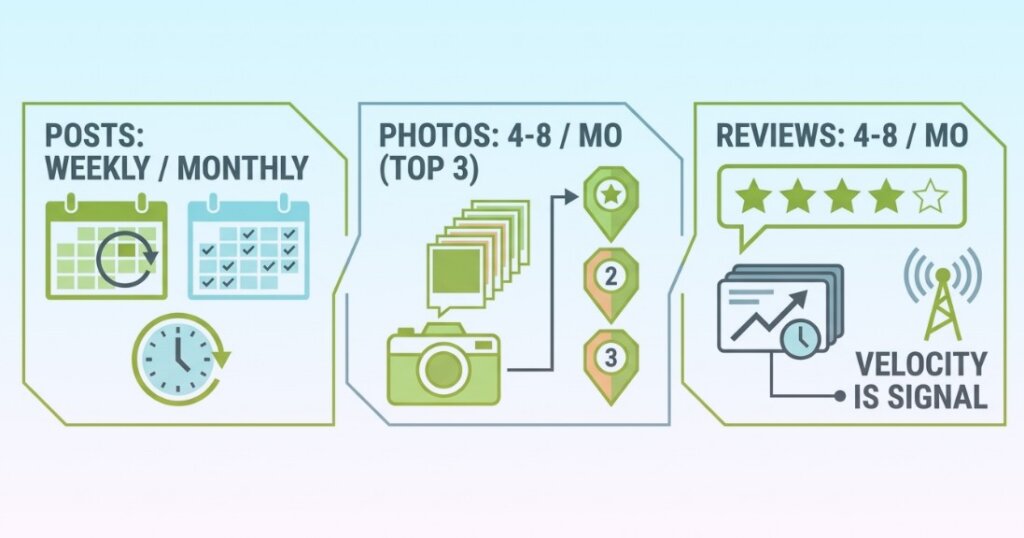
A profile that was fully set up in 2021 and never touched since is quietly losing ground to competitors who post weekly, add photos monthly, and update their Q&A section regularly. Google’s local algorithm increasingly treats continuous profile activity as a core ranking input — not a bonus signal. An abandoned profile does not just stagnate; it actively declines relative to active competitors in the same category.
The practical fix is scheduling: block time each week for one post, and each month for a photo batch and a Q&A review. It does not need to be elaborate — consistent beats creative when it comes to engagement signals.
GBP-Website Mismatches That Erode Trust Signals
When the GBP links to a website that is slow, not mobile-friendly, lacks local content, or shows a different business name or phone number than the profile itself, the mismatch weakens the authority that the website should be lending to the GBP. Google cross-references the linked website as part of evaluating the profile’s credibility.
Common mismatches to audit: NAP differences between the website footer and the GBP, the GBP linking to a homepage rather than a locally relevant landing page, and the website lacking schema markup that reinforces the business’s entity data. Each of these individually is minor — combined, they represent a meaningful drag on rankings.
 What’s Changed for Local Rankings in 2026
 What’s Changed for Local Rankings in 2026
Local SEO has been relatively stable in its fundamentals, but the past 12-18 months have introduced two developments that meaningfully change the optimization calculus for businesses competing in local search.
Profile Activity Is Now a Core Ranking Input
For years, GBP posts and regular photo uploads were widely described as supplemental signals — nice to have but not essential. That framing has shifted. Multiple 2025-2026 analyses now position consistent profile activity as a first-class ranking signal, comparable in weight to citation consistency or review velocity.
Playbooks for cracking the top three Map Pack positions in competitive markets recommend quite aggressive cadences: several posts per week, 4-8 new photos per month, regular Q&A updates, and sustained review generation. Businesses treating posts as optional are increasingly finding that their profiles are being outranked by competitors whose profiles are visibly more active — even when the inactive profiles have more total reviews or older authority.
GBP Data Feeds Google AI Overviews
Perhaps the most significant structural shift: Google’s AI Overviews and local answer boxes now directly ingest GBP data, reviews, and schema-enhanced website content to generate summarized local responses. When someone asks Google “what’s the best plumber in [City]?” or “which electricians near me are available on weekends?”, the AI-generated answer draws from structured, up-to-date profile information.
This raises the stakes for data accuracy and content richness significantly. A profile with detailed services, recent keyword-diverse reviews, and accurate attributes is far more likely to be cited in an AI Overview than a sparse or stale one. It also introduces a new risk: businesses with negative reviews on other platforms (not just Google) may find those surfaced in AI-generated local summaries, even if those review pages do not rank on their own. Monitoring and managing the broader review ecosystem — not just Google — has become a more urgent local SEO priority as a result.
Consistent GBP Maintenance Compounds Into a Map Pack Advantage
The businesses consistently appearing in the top three local results share one quality above all others: they treat GBP optimization as a system, not a project. Every week brings a new post. Every month brings fresh photos, new reviews, and a citation check. Every quarter, the profile is audited for accuracy — hours, services, categories, website link — and updated to reflect anything that has changed in the business.
This kind of systematic maintenance compounds over time in a way that sporadic effort simply cannot replicate. A profile that has been consistently active for 18 months carries more engagement history, more review velocity, and more entity authority than a profile that was perfectly optimized last month and then ignored. The Map Pack rewards businesses that demonstrate ongoing reliability — not just a strong launch.
The seven-tier framework outlined here provides the structure. The discipline to work through it consistently, tier by tier, is what turns a good profile into a dominant local presence. Start with core data accuracy, build toward a review system, maintain engagement cadence, and let the authority compound. That is the actual formula behind every local business ranking in position one.
For businesses ready to put this framework into practice, West Pro Media Services Ltd specializes in local SEO and GBP management designed to move businesses into and up the Map Pack.
