
Summary
For long-term brand awareness, blog posts and social media play different but complementary roles. Blog posts build lasting authority, organic visibility and owned business assets, while social media creates short-term awareness and engagement. The most effective strategy is to use blogs as the foundation and social media to amplify and distribute their reach.
Key Takeaways
- A blog hosted on your own website is a true owned asset – your audience, your data, your rules.
- Social media reach is controlled by platforms, not by you, making it inherently risky to rely on as your primary content channel.
- The strongest B2B content strategy pairs both: use social media to earn attention, and a blog to convert that attention into lasting authority and leads.
- Blog content compounds over time – a well-written post can drive qualified traffic and generate leads months or even years after publication.
- There is a practical content system (the hub-and-spoke model) that lets you get more mileage from every piece of content you create – more on that below.
Most marketing teams treat the social media vs. blog debate as an either/or decision. It isn’t. Understanding why each channel behaves differently – and what you actually own versus what you’re borrowing – can fundamentally change how you allocate content budget and effort.
Your Social Reach Isn’t Yours
Here’s an uncomfortable truth: every follower you’ve built on LinkedIn, every engagement spike on Instagram, every post that went viral on X – none of that is yours. The moment a platform decides to tweak its algorithm, reduce organic reach, or shut down entirely, your audience access goes with it.
This isn’t theoretical. Social media algorithms change multiple times a year. What worked six months ago may be actively penalised today. Brands that built their entire content presence on a single platform have watched their reach collapse overnight – with no warning and no recourse. Building your primary content strategy on social media alone is, quite literally, building on borrowed ground.
What You Own vs. What You Rent
Blog as Owned Asset
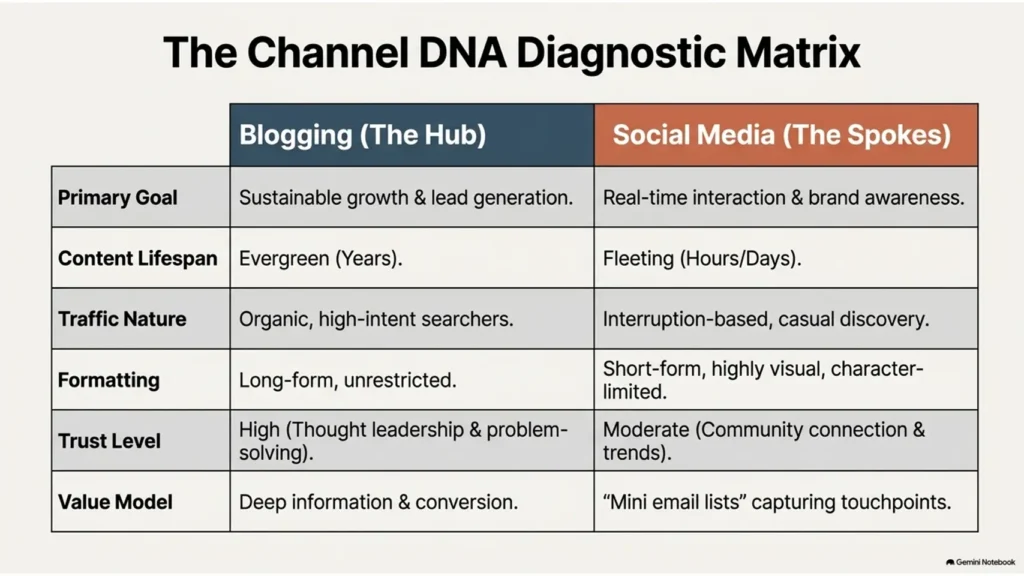
A blog hosted on your company’s website is owned media in the truest sense. You control the content, the branding, the data, and – critically – the audience relationship. There is no intermediary platform deciding how many of your subscribers see a given post. Every visit lands directly on your property, feeding your analytics, your email capture, and your conversion paths.
For B2B SaaS marketing teams specifically, this matters enormously. A blog is a lead-nurturing engine. It educates potential clients, demonstrates thought leadership, and moves prospects through the sales funnel – all without paying a platform tax on every impression. West Pro Media Services, which works with B2B brands on content creation strategy, emphasises this ownership dynamic as a significant and often undervalued advantage in modern content marketing.
Social Media as Rented Land
Social platforms, by contrast, are rented land. Many platforms retain broad rights to content posted by their users – a fact buried in terms of service most marketers never read. More practically, the relationship between your brand and your followers is mediated entirely by the platform. Change the algorithm, and your reach changes. Suspend your account, and your audience disappears. That’s a fragile foundation for any growth strategy.
The Algorithm Dependency Risk
How Often Platforms Change the Rules
Algorithm changes aren’t occasional disruptions – they’re the norm. Social platforms update their feed ranking logic frequently, sometimes multiple times within a single year. Each update can dramatically shift which content gets seen and which gets buried, regardless of quality. For a marketing manager trying to forecast pipeline, this unpredictability is a serious operational risk.
Organic Reach You Can’t Control
Organic reach on most social platforms has been in long-term decline, particularly for brand pages. What began as a relatively level playing field has shifted toward pay-to-play dynamics, where paid promotion increasingly supplements – or replaces – organic visibility. Search remains a primary discovery channel for buyers, and HubSpot’s 2026 State of Marketing Report identifies website, blog, and SEO as the top ROI-generating channel among marketers. Search isn’t dead – it’s still where much of discovery starts.
Where Each Format Actually Wins
Social: Fast Discovery, Short Lifespan
Social media genuinely excels at one thing: fast, algorithmic discovery. A sharp LinkedIn post can reach thousands of non-followers within hours. Short-form video – Reels, TikToks, YouTube Shorts – generates some of the highest engagement rates of any format, and a significant share of adult social media users visit platforms specifically to research brands and their content. For rapid awareness, community interaction, and testing messaging, social is unmatched.
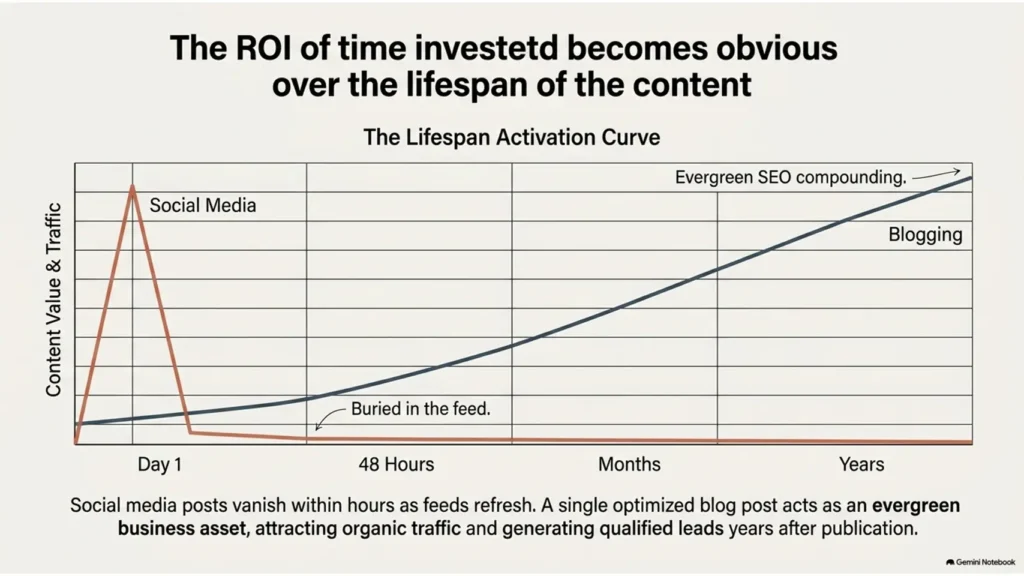
The catch is lifespan. Most social posts peak within 24-48 hours and then effectively disappear. The energy invested in creating them rarely compounds. Each post is a one-time event, not an asset.
Blog: Compounding Search Visibility
Blog content operates on a completely different timeline. A well-optimised post targeting a genuine search query can climb rankings over weeks and months, then sit at the top of results for years – continuing to attract qualified traffic long after the initial effort. This is what marketers mean when they talk about compounding returns. The post keeps working while your team moves on to other things.
HubSpot’s data supports this: blog posts remain among the five formats marketers most often identify as highest ROI, even as short-form video dominates usage volume. The formats aren’t competing – they serve different parts of the funnel at different speeds.
The Hub-and-Spoke Model
Blog as the Stable Hub
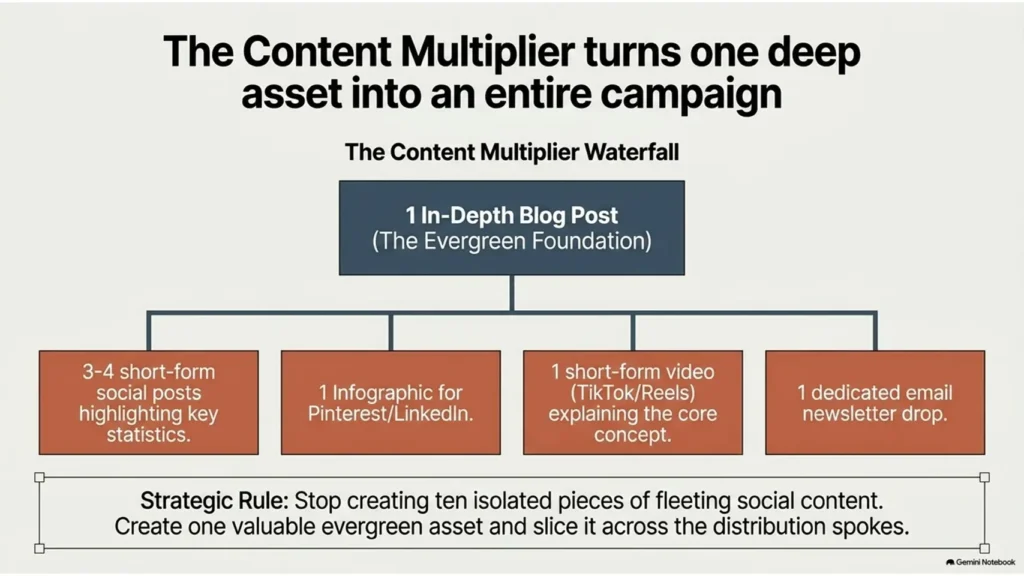
The most effective content strategies don’t choose between blogs and social media. They use a hub-and-spoke model, where one authoritative blog post serves as the central, owned asset – the hub. That post houses the complete thinking: the evidence, the framework, the nuance, the conversion path. It’s findable via search today and six months from now.
Social as the Distribution Spoke
Social content becomes the spokes – smaller, platform-native pieces that extract and distribute insights from the hub. A single blog post can yield a LinkedIn opinion piece highlighting one surprising finding, a carousel walking through the key framework, a short video demonstrating a real example, and a poll that gathers audience language for the next article. Each spoke drives awareness; the hub converts it into something lasting.
This approach also solves a common resourcing problem. Rather than creating entirely separate content streams for every channel, the hub-and-spoke model lets one strong idea do significantly more work – without requiring your team to start from scratch for each platform.
Short-Form Video’s Role in the Mix
Short-form video deserves its own mention because it’s no longer optional in most B2B strategies. HubSpot’s 2025 marketing data shows short-form video was the most-used content format among marketers at 60%. Platforms like TikTok factor in full watches, skips, shares, and comments when recommending content – meaning videos that earn sustained attention get disproportionate reach.
Within the hub-and-spoke model, short-form video is one of the most powerful spokes available. A 60-second clip distilling the core insight from a blog post can introduce that idea to an entirely new audience – one that then searches for the brand, lands on the article, and enters a proper conversion journey. That’s the flywheel working as intended.
Measuring What Actually Matters
Blog Metrics Beyond Clicks: Form Conversions, Email Sign-Ups, Time on Page, Scroll Depth, and Brand Authority Signals
Zero-click search results and AI-generated answer boxes mean that raw click volume is increasingly a poor proxy for blog performance. A post can build genuine brand authority – prompting branded searches, earning backlinks, influencing sales conversations – without ever topping a click-through chart. Measure what actually connects to revenue:
- Form conversions and demo requests generated from blog traffic
- Email sign-ups capturing readers into an owned channel
- Engaged session time and scroll depth indicating genuine content value
- Branded search trend in Google Search Console as a proxy for awareness
- Backlinks and referring domains as authority signals that compound over time
- Assisted conversions where the blog influenced a sale without being the final touchpoint
Social Signals Worth Tracking
On social, reach and likes are the least useful numbers in the report. What actually indicates traction worth caring about:
- Saves and sends – signals that content was useful enough to revisit or share privately
- Meaningful comments – especially questions that surface real audience pain points
- Non-follower reach – a sign the algorithm is distributing content beyond existing audiences
- Profile visits and follower quality – relevant prospects, not vanity numbers
- Qualified DMs and link clicks – evidence that social is moving people toward commercial action
Tracking both sets of metrics together, rather than in silos, gives a much clearer picture of how content investment is actually performing across the full buyer journey.
Stop Building on Borrowed Ground
The risk of algorithm dependency isn’t a future concern – it’s an active one. Every quarter spent investing entirely in social media content, without a corresponding owned asset strategy, is a quarter of compounding value surrendered. Social media earns the moment of discovery. The blog makes the brand worth remembering and easy to find again.
The practical path forward isn’t complicated: identify the questions your target buyers are genuinely asking, write authoritative blog content that answers them completely, then extract and distribute that thinking across social channels in native, platform-appropriate formats. That’s not a content hack – it’s a durable system that builds value on both sides of the equation simultaneously.
For B2B SaaS marketing teams looking to build that kind of content infrastructure, West Pro Media Services specialises in content creation strategies that turn owned media into a long-term growth channel.
| Topic / Area | Key Finding | Business Impact | Why It Matters |
|---|---|---|---|
| Content format demand | Short-form video is marketers’ top ROI-driving format | Accelerates awareness and message testing | Strong social hooks can feed deeper blog journeys |
| Blog as owned hub | Website content supports searchable, reusable conversion paths | Builds first-party audiences and lead capture | Reduces dependence on changing social algorithms |
| Social distribution | Social posts deliver rapid discovery but fade quickly | Useful for reach, feedback and audience engagement | Extend value by directing audiences to evergreen articles |
| AI-led search visibility | AI-generated results can reduce traditional organic click-through rates | Measure authority beyond traffic alone | Track citations, branded demand and assisted conversions |
| Measurement discipline | Search Console blends AI and standard organic performance | Attribution needs multiple signals and reporting context | Combine conversions, engagement, branded searches and lead quality |
Sources
Frequently Asked Questions
Is blogging still worth it for B2B brand awareness in 2026?
Yes. Blogs remain valuable because they answer high-intent search questions, strengthen topical authority, and give prospects a destination you control. Social posts may create an initial spark, but useful articles can keep attracting search, referral and AI-assisted discovery long after publication.
Should B2B companies prioritise LinkedIn content or SEO blog posts?
Prioritise neither in isolation. Use LinkedIn to test messages, reach relevant people quickly and start conversations; use SEO-led blog content to provide depth, capture intent and build durable conversion paths. The most effective approach links both channels around the same buyer questions.
How can I turn one blog post into social media content?
Identify the article’s core claim, strongest statistic, practical framework and common objection. Turn each into a distinct post format: a LinkedIn opinion, carousel, short video, poll or email snippet. Each piece should stand alone while giving readers a clear reason to explore the full article.
What metrics show whether social content is improving brand awareness?
Look beyond impressions and likes. Track non-follower reach, saves, shares, relevant comments, profile visits and qualified direct messages. Then monitor whether branded search, direct website traffic, newsletter subscriptions and repeat visitors rise after sustained social activity—these indicate stronger recall and interest.
How long does it take for a blog post to generate leads?
It depends on search competition, topical authority, distribution and how well the post matches buyer intent. Some articles drive enquiries immediately through promotion, while search-led posts often build gradually over several months. Update, internally link and repurpose promising articles to extend their value.
