
Summary
Consistent content publishing builds trust with Google and AI systems when it creates a dependable body of useful, accurate and original information. Publishing frequency alone is not a ranking factor or guarantee of AI citations. A sustainable programme can demonstrate expertise, answer related customer questions, keep important information current, strengthen internal links and create opportunities for credible third-party recognition.
Key Takeaways
- Consistency builds evidence of expertise; frequency by itself does not create authority.
- Google, AI citations and brand recommendations are separate outcomes.
- Original insights, first-hand experience and reliable maintenance matter more than publishing volume.
- External mentions can strengthen visibility, but correlation does not prove that publishing causes recommendations.
- A sustainable content system should include research, human judgement, technical accessibility, distribution and measurement.
Consistent Publishing Builds Evidence, Not Automatic Trust
Consistent content publishing can support trust with Google and AI search systems by creating a growing, coherent body of evidence about what a business knows. That evidence is useful when it is accurate, original, relevant to real customers and maintained over time.
The important qualification is that consistency does not mean publishing as often as possible. Google explicitly rejects the idea that adding content simply to make a website look fresh will improve its rankings. There is no universal publishing frequency that guarantees visibility, rankings or AI citations.
The more defensible principle is this: a reliable publishing process creates repeated opportunities to demonstrate expertise and satisfy users. A stream of generic articles does not.
“Trust” Means Different Things in Google and AI Search
Is ranking the same as being cited by AI?
No. Google visibility, AI citations and brand recommendations are related but different outcomes.
A page may be discovered, indexed and ranked for a relevant search without being selected as a source in an AI-generated answer. An AI system may cite a specific article as evidence without recommending the business behind it. A recommendation may also be based partly on independent reviews, industry coverage or other third-party sources rather than the company’s own website.
Google’s AI features use its core Search systems and can retrieve information from the Search index to help ground generated answers. This is different from saying that a newly published page has been absorbed into an AI model’s training data. New content can become available for discovery and retrieval without becoming part of a model’s learned parameters.
Google’s AI search guidance also makes clear that appearing in an AI feature is not a separate shortcut around the fundamentals of Search. Relevance, usefulness, originality, accessibility and clear information still matter.
How does E-E-A-T relate to publishing?
E-E-A-T stands for experience, expertise, authoritativeness and trustworthiness. Google describes these as qualities its systems seek to recognise through a mixture of signals. E-E-A-T is not a single ranking factor that a business can increase by publishing a certain number of articles.
Publishing regularly can help demonstrate these qualities when the work includes first-hand examples, named authors, relevant experience, appropriate sources and honest explanations of limitations. A professional business might publish a detailed guide, a case study based on real work, an explanation of costs and constraints, or an answer to a recurring customer question.
A byline alone is not proof of expertise. Nor does a large archive prove that every page is reliable. Trust comes from the quality and credibility of the information being published.
How Consistent Publishing Strengthens a Website’s Evidence
It demonstrates depth across related questions
One generic article gives Google and readers limited information about a business’s capabilities. A connected collection of genuinely useful resources can show that the organisation understands a subject from several practical angles.
For example, a building company might explain the extension process, planning constraints, likely costs, drainage issues and realistic timescales. These pages can support one another because they address distinct parts of the same customer decision.
This matters because Google’s AI features may explore several related searches while preparing an answer. A website with useful coverage of connected questions may have relevant information available for more of those searches.
That does not justify creating a separate page for every minor variation of a query. Near-duplicate pages produced mainly to capture search phrases can weaken the overall resource. Comprehensive coverage means adding meaningful depth, not multiplying similar URLs.
It keeps information dependable
Consistency should include maintenance as well as new publication. A business that regularly checks its important pages is more likely to remove outdated claims, correct errors and reflect changes in products, regulations, prices or procedures.
Freshness is not equally important for every topic. A current legal requirement or product comparison may need more frequent review than an explanation of a long-established principle. Google’s freshness systems are designed to respond to queries where newer information is particularly relevant, not to reward every newly dated page.
Changing a publication date without substantially improving the information is not meaningful maintenance. A genuine update should review the claims, sources, examples and customer questions addressed by the page.
It creates a clearer information resource
Publishing is more valuable when each new page has a clear relationship with existing content. Relevant internal links help readers move from a general explanation to a more specific answer, while also helping search engines discover and understand the site’s structure.
This is where a core guide supported by distinct examples, case studies and detailed explanations is more useful than a collection of isolated blog posts. The objective is not to build the largest archive. It is to build a navigable resource that makes the business’s expertise easier to understand.
External Recognition Adds a Different Layer of Trust
A business’s own content explains what it does and knows. Independent sources provide evidence that other people and organisations recognise that expertise.
This can be understood through three connected stages: recognition, relevance and recommendation. Publishing helps a business become recognisable and associated with particular subjects, services or locations. Stronger recommendations require additional proof, such as reviews, case studies, partnerships, credible coverage and third-party references.
This is also why distribution matters. Creating content is only part of the job; useful information needs a chance to be discovered beyond the company’s own website. Relevant professional publications, podcasts, videos, industry communities and genuine partnerships can extend the places where the business and its expertise appear.
That does not mean manufacturing mentions or repeating the same claims across low-quality websites. Artificial consensus is not the same as independent authority. The aim should be useful distribution and credible recognition.
Ahrefs’ observational research found a strong relationship between branded web mentions and AI visibility. Its May 2025 study reported a Spearman correlation of 0.664 between branded mentions and visibility in Google AI Overviews, compared with 0.218 for backlinks. These are correlations, not evidence that publishing more mentions will cause more recommendations. Larger, better-known businesses may naturally attract more searches, links, mentions and AI exposure at the same time.
What the Evidence Says About Freshness and AI Citations
An Ahrefs study examining approximately 17 million citations found that several AI assistants cited newer pages on average than the pages used in its organic-search comparison. The reported average age was 1,064 days for AI-cited URLs, compared with 1,432 days for the organic comparison.
That finding is useful, but it does not establish a required publishing schedule or prove that frequent updates caused the difference. The average AI-cited page was still nearly three years old, showing that established content can remain useful and citable.
The same research found that the average time since an AI-cited page had been updated was shorter than for the comparison pages. Again, this supports taking maintenance seriously, not changing dates mechanically or assuming that every old article needs to be replaced.
AI platforms also do not behave identically. Google AI Overviews, Google AI Mode and standalone assistants may retrieve different sources and respond differently to freshness. Evidence from one platform should not be presented as a universal rule for all AI search.
How to Build a Sustainable Publishing System
Start with customer decisions, not a content quota
The strongest topics usually come from real customer conversations. Sales questions, support enquiries, project discussions, common misunderstandings and concerns about cost or risk can reveal what prospective customers need before they are ready to buy.
A useful editorial plan connects these questions with the services the business wants to be known for. It should avoid covering unrelated subjects simply because they appear to offer easy search traffic.
The practical test is whether a page helps someone understand a problem, compare options, avoid a mistake or make a better decision.
Make every page contribute something distinctive
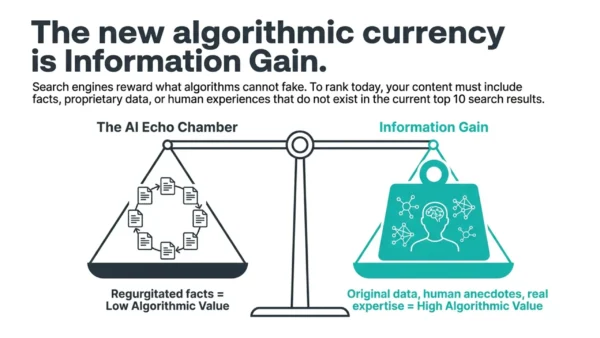
Before publishing, identify what the page adds that a generic summary would not. This might be first-hand experience, original research, a worked example, a documented method, an expert interpretation or a clearly explained limitation.
Google’s recent guidance refers to this kind of work as non-commodity content. The phrase describes information that goes beyond material easily reproduced from existing pages.
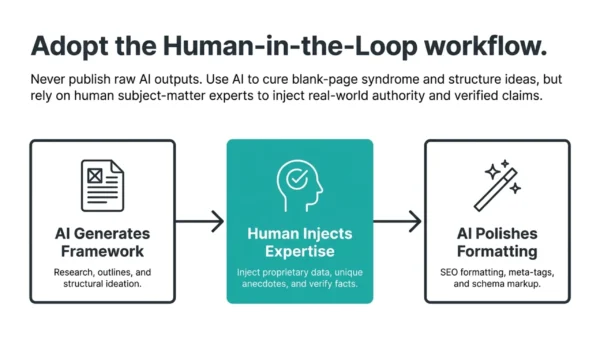
Generative AI can assist with brainstorming, outlining or identifying questions that need investigation. It should not replace professional judgement, fact-checking or the contribution of the people who actually understand the subject. A useful working principle is to automate the workload, not the judgement.
Choose a cadence that protects quality
There is no defensible rule that a business must publish weekly, daily or three times a week to build trust. A small specialist business might produce one substantial resource a month, add a case study when suitable evidence exists and review time-sensitive pages on a separate schedule.
That is an example of a sustainable system, not a Google requirement. The right cadence depends on the subject, the available expertise and how quickly the information changes.
Make pages accessible without chasing AI “hacks”
Clear headings, direct explanations, useful internal links and well-organised pages help both readers and machines understand the information. Important content should be accessible to relevant crawlers, available as text, usable on different devices and accurately represented in structured data where appropriate.
There is no special writing style, ideal word count or mandatory paragraph size for Google AI visibility. Google also says that special schema is not required for generative AI search, and its current guidance does not support relying on llms.txt to improve Google visibility or rankings.
Good structure is worthwhile because it improves comprehension and retrieval. It is not a guarantee of citation.
How to Measure Whether Consistency Is Helping
No single metric proves that Google or an AI system “trusts” a business.
Search Console can show impressions, clicks and performance for relevant queries. Analytics and conversion data can indicate whether the visibility is attracting useful visits and enquiries. AI visibility can be monitored by checking a defined set of relevant questions over time and recording whether particular pages are cited or whether the brand is mentioned.
It is also useful to record substantive updates, publication dates and distribution activity. This makes it easier to compare similar groups of content and identify patterns without attributing every improvement to publishing frequency. Changes in demand, competition, links, platform behaviour and brand recognition may also affect results.
The business outcome remains important. A growing archive of content has limited value if it does not help the right people understand the organisation and take the next step.
Mistakes That Undermine Trust
Confusing activity with authority
Daily publishing cannot compensate for inaccurate, repetitive or irrelevant content. A high volume of weak pages may make the site harder to manage and can dilute the useful information that deserves attention.
Refreshing dates instead of substance
A new date does not make old claims current. Updates should improve the evidence, accuracy, examples or usefulness of the page.
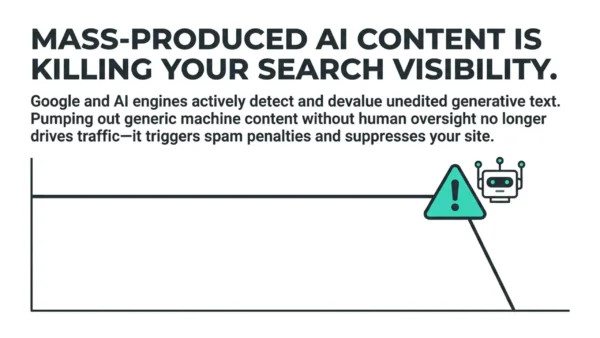
Mass-producing unreviewed AI content
Google does not reject content merely because AI was used to help create it. The risk comes from low-quality, inaccurate or manipulative content produced at scale without meaningful human review and original contribution.
Treating platforms as identical
A page cited by one AI system may not be selected by another. Google Search, AI Overviews, AI Mode and standalone assistants use different experiences and may show different sources.
Promising a fixed result
No honest publisher can guarantee that a content programme will produce rankings, citations or recommendations within a particular timeframe. Consistency is an operating discipline that increases the opportunities to be discovered and evaluated; it is not a promise of visibility.
The Practical Answer
Consistent publishing builds trust with Google and AI indirectly. It gives a business more opportunities to demonstrate real expertise, answer connected questions, maintain accurate information, create a clear internal resource and earn independent recognition.
The value comes from the system behind the publishing: choosing commercially relevant questions, adding information that is genuinely useful, involving knowledgeable people, maintaining important pages and distributing worthwhile work appropriately.
The goal is not to publish more for its own sake. It is to build a body of useful information that becomes increasingly difficult for competitors to match and increasingly valuable to the people trying to make a decision.
Research Insights
| Topic / Area | Key Finding | Business Impact | Why It Matters |
|---|---|---|---|
| Publishing frequency | Google prescribes no universal posting schedule | Quality can take priority over volume | Freshness alone does not improve rankings |
| AI citation age | AI URLs averaged 1,064 days old versus 1,432 | Established content can remain citable | Newness is not the only visibility factor |
| Content maintenance | AI-cited pages averaged 909 days since update | Important pages deserve substantive reviews | Current information supports dependable answers |
| Brand mentions | Correlation with AI Overviews reached 0.664 | External presence warrants attention | Independent visibility may support recognition |
Sources
Google Search Central – Creating helpful, reliable, people-first content
Ahrefs – Do AI Assistants Prefer to Cite Fresh Content?
Ahrefs – AI Brand Visibility: Correlations and Insights
Frequently Asked Questions
Does Google reward businesses for publishing every day?
No. Google does not prescribe a universal publishing frequency and rejects adding content solely to make a website appear fresh. A sustainable schedule is useful only when it supports accurate, original and relevant work that meets genuine audience needs.
Can an older article still rank or receive an AI citation?
Yes. Older pages can continue to perform when they remain accurate, relevant and useful. Research into AI citations found that many cited pages were several years old, although some AI assistants cited newer content more often on average.
Is updating an existing page better than publishing a new one?
It depends on the reader’s need. Update an existing page when its subject remains relevant but the evidence or details have changed. Publish a new page when the question, purpose or information is genuinely distinct. Consolidation may be better than maintaining overlapping articles.
Does using AI to create content damage trust?
Not automatically. Google evaluates the quality, accuracy, originality and usefulness of content rather than banning it solely because AI assisted with production. Unreviewed, mass-produced or generic content is risky because it may lack expertise, factual reliability and meaningful human contribution.
Do businesses need special schema or llms.txt for AI visibility?
Google’s guidance does not require special schema for generative AI search and does not support llms.txt as a Google visibility shortcut. Accurate structured data and accessible content can help systems understand a page, but neither guarantees indexing, citation or recommendation.
