
Summary
Create a successful content amplification strategy by defining a commercial objective, researching the audience, selecting and strengthening the right content, choosing a focused mix of owned, shared, earned and paid channels, adapting the content to each format, assigning promotion responsibilities and measuring meaningful actions. Review performance across the full customer journey, then refine the content and channel mix rather than simply publishing more.
Key Takeaways
- Relevant reach matters more than maximum reach; every campaign needs a clear audience and next action.
- Strengthen the content and its conversion path before investing heavily in promotion.
- Use a focused combination of owned, shared, earned and paid channels rather than trying to appear everywhere.
- Adapt the central idea for each channel instead of copying the same post and link.
- Measure business contribution, costs and assisted influence alongside impressions and clicks.
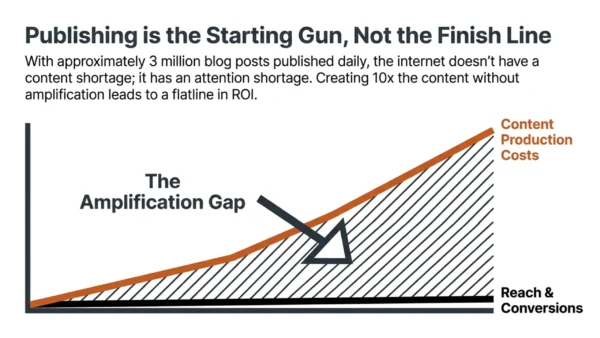
Set the Business Outcome Before Choosing Channels
Content amplification is the coordinated use of owned, shared, earned and paid channels to extend the relevant reach, engagement and business impact of content. It is broader than simply publishing a link or paying for advertising.
Content distribution describes where and how content is delivered. Promotion refers to activities designed to attract attention to a particular asset. Amplification brings these activities together so that useful content has more opportunities to be discovered, discussed and acted upon.
Repurposing means adapting an idea into another format, while syndication involves republishing or licensing content through another publisher or platform. These terms overlap in practice, so they are best treated as useful working distinctions rather than rigid categories.
What should the campaign achieve?
Start by stating the business outcome in plain language. This might be generating suitable enquiries, increasing newsletter subscriptions, encouraging webinar registrations, supporting product trials or helping existing customers use a service more effectively.
Impressions, reach and clicks are diagnostic measures. They help explain what happened, but they are not necessarily the objective. A useful planning statement is: “We will amplify this asset to a defined audience through selected channels to encourage a specific action, and assess success using an agreed primary outcome over an appropriate period.”
This discipline matters because a lack of clear goals was cited by 42% of respondents who rated their content marketing moderately effective or worse in the Content Marketing Institute’s 2025 B2B research. The finding is self-reported and relates to content marketing generally, but it gives a practical reason to establish the destination before planning the journey.
Research the Audience and Select Worthwhile Content
Amplification cannot compensate for an irrelevant topic. Before choosing channels, understand the problem the audience is trying to solve, what triggers them to seek advice, which questions arise before buying and who influences the decision.
Useful evidence can come from customer interviews, sales conversations, support questions, search data, website analytics and feedback from account teams. Look beyond job titles. Two people with the same role may have different levels of knowledge, urgency and authority to act.
CMI’s research found that 82% of top-performing respondents attributed their success to understanding their audience. This is an association rather than proof of causation, but it supports making audience research a central part of the strategy rather than a brief planning exercise.
Which content deserves amplification?
Audit existing assets before commissioning something new. A useful guide, case study, webinar, research report or tool may already contain material that can reach a wider audience.
Choose content that addresses a commercially relevant problem, contains accurate and distinctive information, demonstrates genuine experience or evidence and offers an appropriate next step. It should also be suitable for meaningful adaptation. If the only possible promotional message is “read our article”, the asset may not yet be strong enough.
Google’s published guidance emphasises helpful, original and reliable content rather than large quantities of interchangeable material. The practical implication is straightforward: promote content because it deserves attention, not merely because it has recently been published.
Strengthen the Asset and Its Conversion Path
Review the destination before sending more people to it. The main promise should be clear, the central question should be answered promptly and the content should include useful examples, evidence and expert context.
Check mobile usability, accessibility and page performance. Make sure the next action fits the visitor’s likely intent. Someone reading an educational guide may be more willing to download a related resource, join a newsletter or attend a webinar than book a sales call immediately.
This step addresses one of the leading challenges in CMI’s 2026 research: 40% of respondents selected creating content that prompts a desired action as one of their top three challenges. Distribution is unlikely to solve a weak conversion path.
A useful internal model is to build three connected forms of authority. Owned authority comes from the company’s website, email list, guides, case studies and customer resources. Distributed authority comes from making those ideas discoverable across relevant external platforms. Independent authority comes from reviews, customer references, partnerships and third-party editorial recognition. Reach is stronger when these layers support one another.
Choose a Focused Channel Mix and Adapt the Content
Organise channels according to their strategic role rather than selecting them because they are popular.
Owned channels, such as the website, email list and customer resources, provide a stable destination and help develop direct relationships. Shared or platform-based channels, including professional networks and relevant communities, place the expertise where people already spend time. Earned channels include editorial coverage, invited appearances, recommendations and expert contributions. Paid channels provide controlled exposure through advertising, sponsored content or newsletter placements.
For B2B thought leadership, CMI’s 2026 findings identified LinkedIn, email newsletters and speaking events or webinars as effective channels according to 76%, 54% and 52% of respondents respectively. These figures concern thought leadership, not universal conversion rates, so audience fit and operational capacity still determine the right choice.
Begin with a manageable mix. A smaller organisation may achieve more from a strong website destination, a relevant email segment, one professional platform and a partner activity than from attempting to maintain every social account.
How should content be adapted?
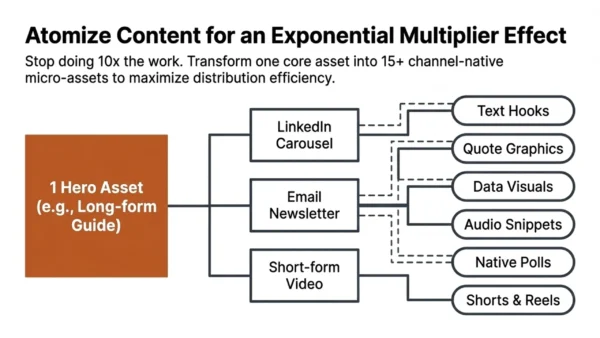
Do not copy the same introduction and link into every channel. Extract the most useful ideas and reshape them for the context.
A detailed guide could become a newsletter explaining one practical implication, a short video answering a common question, a professional-network post presenting a clear argument, a visual explanation of a process and a live discussion about implementation. Each version should offer value on its own while retaining consistent facts and positioning.
Native formats deserve testing, but avoid treating any platform claim as a universal rule. A link post may suit one audience, while a self-contained post, document or video may work better for another. Measure actual consumption and downstream action instead of relying on assumptions about platform algorithms.
AI can help with repetitive adaptation and campaign administration, but it should not replace editorial judgement. CMI found that 87% of marketers using AI for content creation reported improved productivity, while 39% reported improved content performance. Producing more variations is not the same as producing better ones.
Involve Experts, Partners and Employees
People can add both credibility and distribution, provided their involvement is genuine. Subject-matter experts can contribute experience, customers can explain outcomes, partners can add a complementary perspective and event organisers or trade publications can provide access to a relevant audience.
Avoid making participation a compulsory sharing exercise or reducing partnerships to backlink exchanges. The contribution should improve the content or make it more useful to the other party’s audience.
Employee expertise is often underused. In CMI’s 2026 research, 37% of respondents said fewer than 5% of employees with specialist knowledge actively contributed to thought leadership. A practical response is to make participation easy: provide a clear briefing, offer adaptable material and allow experts to express the idea in their own voice.
Build a Promotion Schedule with Clear Ownership
Amplification should be planned before publication, not added as an afterthought. The working schedule should connect each adaptation with its audience, channel, publication date, owner, approval requirements, campaign identifier, destination and review date.
Separate launch activity from follow-up. The first announcement may introduce the asset, while later activity can answer objections, highlight a different finding, support a sales conversation or refresh the idea when new evidence appears.
This also prevents disconnected activity between marketing, sales and subject experts. Robert Rose’s advice, cited in CMI research, is to coordinate creation, publishing, consumption and measurement through shared workflows and standards. That is more useful than producing a calendar full of activity that nobody owns.
Test Paid Amplification with a Clear Hypothesis
Paid promotion should answer a defined question. For example, a business might test whether a particular case study attracts qualified visitors from a specific audience at an acceptable cost.
Set the audience, creative, destination, budget and success measure before launching. Assess the quality of resulting visits, registrations or enquiries rather than celebrating inexpensive clicks alone.
Organic engagement can help identify promising material, but it should not be treated as an absolute requirement. Paid and organic activity may reach different audiences, so a small, controlled test can be reasonable when the commercial hypothesis is clear.
CMI’s 2025 research found that 84% of respondents used paid channels. Among those users, social advertising was widely adopted, while search advertising was most often identified as producing the best results. These findings support testing paid activity, not declaring one channel universally superior.
Measure Business Outcomes and Improve the System
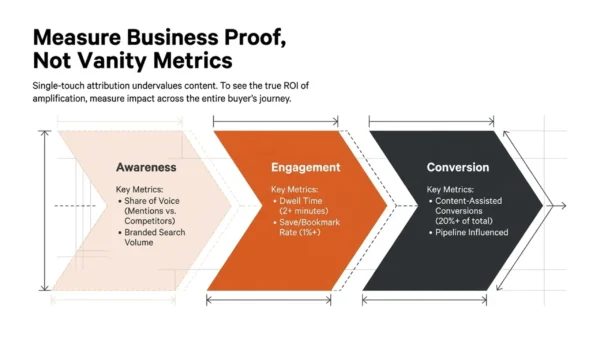
Measurement should move from exposure to commercial contribution. Start by checking whether the intended audience had an opportunity to encounter the content. Then examine meaningful engagement, such as useful replies, attendance, return visits or substantial consumption. Next, track actions including subscriptions, registrations, enquiries and trials. Finally, assess qualified opportunities, pipeline influence, retained customers and efficiency.
Include the full investment. Advertising is only one cost. Internal staff time, agency work, design, video production, expert input and distribution effort also affect whether the result was worthwhile.
Attribution requires care. A prospect may discover a business through a professional-network post, discuss the topic privately with a colleague, return through an email and convert after speaking with sales. Last-click reporting may credit only the final visit. Use campaign identifiers, analytics, CRM records and sales feedback to understand the wider sequence, while avoiding the claim that every influenced sale was caused by the campaign.
CMI found that 63% of respondents measured thought-leadership success through business impact such as leads and pipeline influence. Its earlier research also found that 56% struggled to attribute return on investment and the same percentage struggled to track customer journeys. These limitations make a balanced measurement model more credible than an artificially precise claim.
Account for Search and AI Discovery
Amplification can expose content to people who may independently reference, discuss or link to it. That is different from claiming that paid reach, social engagement or a high number of placements directly improves Google rankings.
Google says its existing search fundamentals remain relevant to AI Overviews and AI Mode. Pages need to be indexed and eligible to appear in search, important information should be available as text and structured data should match visible content. There is no special file or guaranteed process for securing inclusion.
The practical priority is to publish clear, original answers supported by real expertise and make them accessible across relevant channels. Do not create mass variations simply to increase volume. “Automate the workload, not the judgement” is a useful principle for AI-assisted amplification.
Search visibility and website traffic should also be measured separately. A 2025 Pew Research Center observational study found that users clicked a traditional Google result in 8% of visits when an AI summary appeared, compared with 15% when one did not. A link within an AI summary was clicked in 1% of visits to pages containing a summary. The study covered 900 US adults and does not establish a universal click-through benchmark, but it reinforces the need to track visibility, visits and business actions as different outcomes.
A successful strategy is therefore a repeatable learning system. It starts with a commercially relevant question, turns genuine expertise into a useful asset, distributes that asset where the audience can find it, and uses evidence to decide what should be improved, repeated or stopped.
Research Insights
| Topic / Area | Key Finding | Business Impact | Why It Matters |
|---|---|---|---|
| Strategy effectiveness | 61% reported improved effectiveness | Refinement may outperform volume increases | Improve the system before publishing more |
| Desired audience action | 40% cited action-oriented content as a top challenge | Weak conversion paths waste reach | Amplification needs a suitable next step |
| Thought-leadership channels | LinkedIn, newsletters and webinars led usage | Supports a focused channel mix | Channel fit matters more than channel count |
| Commercial measurement | 63% measured business impact | Connect attention with pipeline influence | Engagement alone is insufficient |
| AI search behaviour | Traditional result clicks fell from 15% to 8% | Visibility and traffic can diverge | Track search exposure separately |
Sources
- Content Marketing Institute – B2B Content Marketing Trends Research
- Pew Research Center – Google Users Are Less Likely to Click on Links When an AI Summary Appears
Frequently Asked Questions
How often should the same content be amplified?
There is no useful universal posting frequency. Reuse an asset when it remains accurate and relevant, but change the angle, format or audience context. Refresh it when customer questions, evidence or the underlying service changes, rather than repeating identical promotional messages.
Should every piece of content receive paid promotion?
No. Paid support should be tied to a clear audience, hypothesis, budget and success measure. Organic response can help identify promising assets, but a small paid test may also be justified when the content serves a clear commercial purpose and the audience is well defined.
What should a small business do without a large email list?
Start with a strong owned destination, then use one or two relevant platforms, expert participation, partnerships and carefully chosen earned opportunities. Build permission-based relationships over time rather than depending entirely on social platforms whose reach and distribution conditions can change.
How can a small team manage content amplification?
Choose fewer channels, create a reusable campaign workflow and assign one owner for each activity. Templates and AI can help with formatting, administration and first drafts, but a knowledgeable person should check accuracy, usefulness, tone and audience relevance before publication.
How can amplification influence be separated from direct attribution?
Use campaign identifiers, analytics and CRM records to connect touchpoints with enquiries and opportunities. Review first-touch, last-touch and assisted interactions alongside sales feedback. Report influence as evidence of contribution, not as proof that every associated sale was caused by the campaign.
