
Summary
Content amplification differs from content distribution because distribution gets content published, while amplification deliberately extends the reach and commercial impact of your best-performing content. Businesses that combine both are far more likely to increase visibility, authority, leads, and AI citations than those relying on publishing alone.
Key Takeaways
- Content distribution is the infrastructure that makes content available across channels – content amplification is the deliberate strategic force applied to high-potential content to extend its reach, frequency, and commercial impact.
- Not every piece of content deserves amplification. Prioritize assets that carry original insight, early engagement signals, and a clear conversion path.
- The Seed, Validate, Scale, and Recycle workflow helps B2B teams spend amplification budget on proven messages – not assumptions.
- In the AI era, amplification now includes discoverability in AI-generated search experiences, not just social reach or paid impressions.
- West Pro Media Services offers multicasting solutions that help B2B teams move content beyond their existing audiences and into the channels where buying decisions actually happen.
Most B2B marketing teams distribute content. Far fewer actually amplify it. The gap between those two activities is where most content investment quietly disappears – published, shared once, and forgotten before it ever reached the people it was built for.
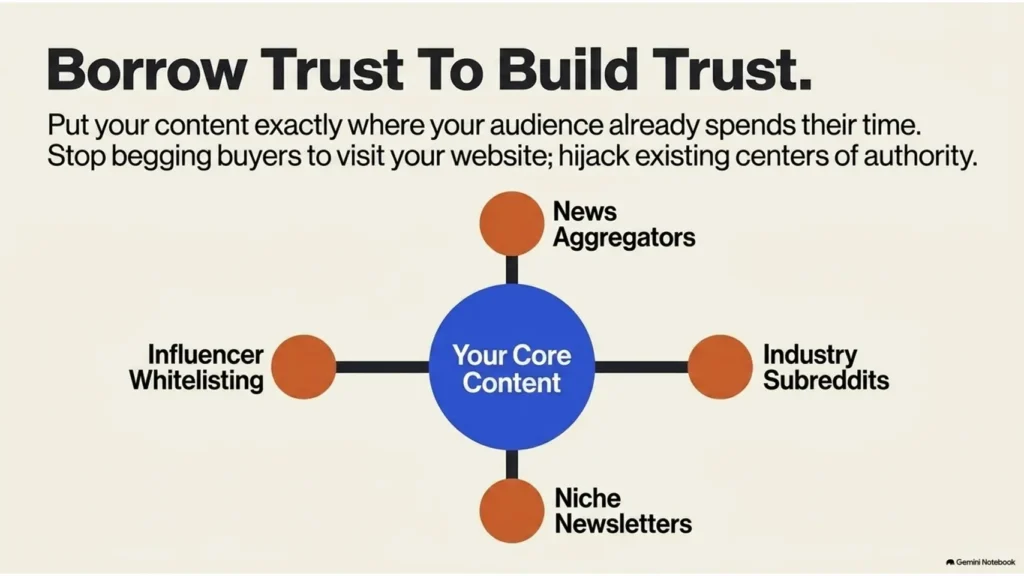
Two Terms, One Critical Difference
Content distribution is the system that makes content available. It covers the channels, workflows, formats, timing, and infrastructure used to publish and deliver content to an audience. Think of it as the road network – it determines where content can travel.
Content amplification is something different. It is the strategic force applied to content that has already shown potential – deliberately extending its reach, frequency, and commercial impact beyond what organic distribution alone would achieve. If distribution is the road network, amplification is deciding which vehicles get fuel, which routes get priority, and which destinations actually matter.
The practical distinction: distribution answers “Where and how will this content be published?” Amplification answers “How do we increase the reach and commercial impact of this specific asset?” Both matter. Conflating them leads to one of the most common – and costly – failures in B2B content marketing. The team at West Pro Media Services works with this exact challenge, helping businesses move beyond one-time publishing events toward deliberate, structured content reach strategies.
Distribution: The Infrastructure Layer
Owned, Earned, and Paid Channels
A complete distribution system spans three channel types. Owned channels include the company blog, email newsletter, social profiles, resource hub, podcast, sales sequences, and community. These are fully controlled and form the foundation of any content programme. Earned and shared channels involve third-party amplification – employee advocacy, partner features, industry publications, guest appearances, and community participation. Paid channels cover sponsored social, search advertising, retargeting, native placements, and account-based advertising.
According to Content Marketing Institute’s 2025 technology-marketer research, 93% of technology marketers use a corporate blog, 90% use organic social, and 80% use email newsletters for distribution. The most-used channels are not automatically the most effective – in-person events (52% effectiveness rating), webinars (51%), and email (42%) each outperformed their usage share in effectiveness ratings. That gap is worth paying close attention to.
The ‘Publish and Pray’ Trap Too Many Teams Still Fall Into
Here is the uncomfortable reality: 58% of B2B marketers say their content strategy is only “moderately effective,” and 56% struggle to attribute ROI to their content efforts. The “publish and pray” pattern – where content goes live across standard channels and receives no strategic follow-through – remains the dominant operating model for too many teams.
Organic reach has also eroded sharply. LinkedIn company pages have experienced over a 60% drop in organic reach over three years. Publishing to existing followers, without amplification, reaches a shrinking fraction of the intended audience. Distribution infrastructure alone cannot close that gap.
Amplification: The Strategic Force
What Makes Content Amplification-Worthy
Not every asset earns amplification investment. The strongest candidates share a few common traits:
- Original insight: proprietary data, practitioner frameworks, contrarian but defensible perspectives, or expert interviews that cannot be found elsewhere
- Early quality signals: strong click-through rate, high scroll depth, saves, replies, email clicks, or direct sales team usage
- A clear conversion path: content that leads somewhere useful – a newsletter subscription, a template, a webinar registration, a relevant case study, or a consultation
- A conversation hook: a statistic, visual model, or benchmark that someone else would plausibly quote, share, or reference
CMI’s 2025 survey reinforces this point: top-performing technology content marketers most commonly attributed success to deep audience understanding (85%) and high-quality content (85%). Amplification cannot rescue weak content – it only scales what is already there.
Amplify the Insight, Not Just the URL
One of the most persistent amplification mistakes is leading with a bare link. A social post, partner pitch, or paid creative that only says “we published something – here’s the link” gives neither people nor algorithms a reason to engage. The stronger approach: lead with a self-contained useful idea – a data point, a reframe, a clear observation – and let the source article provide depth and proof. Amplify the insight. The URL is just the door.
Side-by-Side: Distribution vs. Amplification
Dimension Content Distribution Content Amplification Primary question “Where and how will this content be published?” “How do we increase the reach and commercial impact of this content?” Scope Full channel system: formats, workflows, timing, ownership Strategic layer focused on scaling visibility and engagement Audience Existing subscribers, followers, searchers, customers New, higher-value, or under-reached ICP accounts and buying groups Time horizon Ongoing operating model for every asset Campaign or promotion sequence that extends an asset’s useful life Common failure “Publish and pray” – no follow-through after publishing Paying to boost weak, generic, or non-converting content Success measures Publishing coverage, reach, traffic, subscriber growth Incremental reach, qualified engagement, pipeline influence, assisted conversion
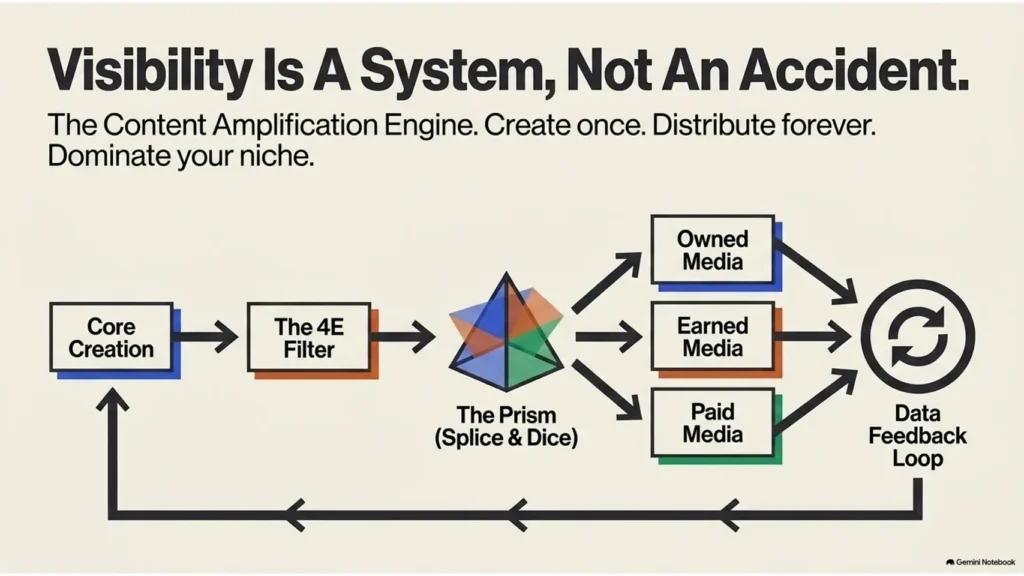
The Seed, Validate, Scale, and Recycle Workflow
A structured amplification workflow separates early audience learning from paid scale – which is exactly where most budget gets wasted. The four-phase model below provides a repeatable decision system.
Seed: Reach Who Cares First
Before spending anything, deploy the asset to the people most likely to care: existing email subscribers, internal subject matter experts, relevant communities, and organic social posts. The goal here is meaningful engagement, not raw impressions. Replies, saves, and direct feedback reveal whether the core message resonates before a dollar of paid budget is committed.
Validate Before You Spend
Once the seed phase generates initial signals, test headlines, hooks, creative formats, and audience segments in a controlled way. If quality engagement and downstream actions – clicks to a relevant next step, email sign-ups, sales usage – justify further investment, move forward. If they do not, the content either needs refinement or simply is not amplification-worthy yet. This step exists to prevent spending budget on a message that has not earned evidence of relevance.
Scale and Recycle for Compounding Value
With a validated message-audience combination in hand, expand reach through paid social, retargeting, sponsorships, creator partnerships, and partner emails. Put budget behind what is working – not behind assumptions. Then build an evergreen promotion calendar: refresh facts, add new examples, reshare on a timely hook, and link from newly published content. Strong assets can be reintroduced whenever a relevant industry development, new data point, or seasonal angle creates a fresh reason to surface them.
Amplification in the AI Era
Why AI Search Visibility Is Now an Amplification Signal
Amplification used to mean reach on social platforms and traffic from search. That picture has changed. Approximately 60% of searches now conclude without a click to a website, as generative AI tools surface answers directly in the results experience. B2B buyers are also increasingly using AI to accelerate research across an average of 9-11 assets consumed before a decision is made.
Google’s May 2026 guidance confirmed that standard SEO practices remain foundational for visibility in generative search features, with specific emphasis on “valuable, unique, non-commodity content.” That means amplification now includes making content citation-worthy for AI systems: clear definitions, concrete examples, named expertise, original research, well-structured topic coverage, and a distinctive human perspective. Many B2B marketing leaders cite AI visibility as a priority – yet many are still optimizing for outdated signals rather than the authority and specificity that AI answer engines now favor.
The practical implication: create content designed to be summarized credibly. If an AI system cannot identify a clear claim, a supporting example, and a credible source within an article, that article will not be cited – regardless of how many times it is promoted.
Measure Commercial Impact, Not Vanity
Visibility and Attention Metrics
Reach and impressions are inputs, not outcomes. Useful visibility metrics include share of voice, branded search volume, earned mentions, and AI citations where measurable. Attention metrics go a layer deeper: qualified landing-page sessions, scroll depth, video completion rates, saves, shares, and returning visitors. These signals reveal whether the right market is not just seeing content – but finding it worth consuming.
Pipeline and Revenue Contribution
The metrics that ultimately justify amplification investment are commercial: qualified leads generated, ICP accounts engaged, opportunities created or influenced, deal velocity, and revenue attributed. CMI’s 2025 survey found that 62% of technology marketers cite difficulty attributing ROI to content, and 58% struggle to track the customer journey – which is why combining platform analytics with CRM data and direct sales feedback is necessary. Ask buyers which content influenced their shortlist. That qualitative evidence often reveals what the dashboard misses.
A lower click-through-rate placement that reaches senior decision-makers and generates assisted pipeline will frequently outperform a high-CTR campaign driving irrelevant traffic. Optimize for commercial contribution, not activity volume.
Costly Amplification Mistakes to Avoid
- Amplifying everything equally. Low-differentiation content rarely improves with more impressions. Allocate based on strategic value, early signals, and conversion potential.
- Leading with a bare link. Give people a useful idea first. The link is the destination, not the reason to engage.
- Copying the same post across channels. Retain the core idea but adapt the hook, format, evidence, and call to action to each platform’s context and audience behavior.
- Boosting before validation. Spend amplification budget only after organic signals confirm message-audience fit. Test small; scale what works.
- Chasing impressions and follower counts. Pair awareness indicators with engagement quality, ICP reach, conversion behavior, and sales feedback.
- Ignoring conversion readiness. Every amplified asset should lead somewhere useful. Readers at the awareness stage may be ready to subscribe or download a checklist – not book a demo. Match the call to action to actual intent.
- Using clickbait framing. Google’s February 2026 Discover core update explicitly targeted sensational and clickbait content while favoring original, in-depth material from topic specialists. Compelling headlines should accurately represent strong content – not manufacture curiosity.
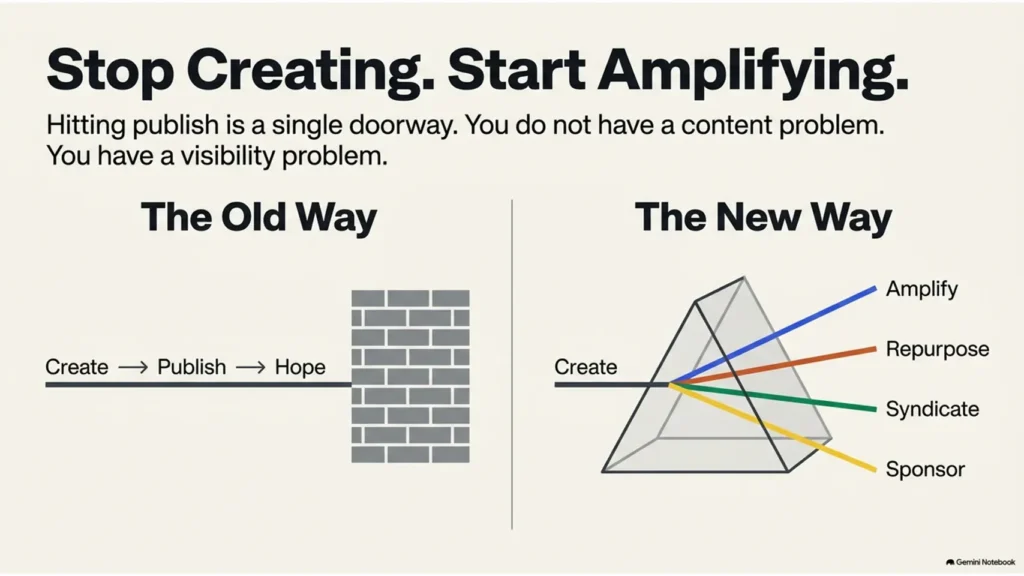
Plan Amplification Before You Hit Publish
The most effective amplification programmes do not start after content goes live – they start at the brief. Distribution and promotion requirements belong in the content plan from the beginning: target audience segment, desired action, content derivatives, channels, owners, timing, partner outreach targets, budget hypothesis, and measurement framework.
Creating fewer assets with more proof and more planned reuse consistently outperforms high-volume, low-differentiation publishing. Original research, real practitioner experience, expert interviews, and case studies are the formats most likely to earn organic shares, credible third-party mentions, links, and AI-search citations. Case studies and customer stories were rated the most effective content type by 62% of technology marketers in CMI’s 2025 research – ahead of research reports, video, and white papers.
Distribution makes content present. Amplification makes it travel, get discussed, and contribute to demand. Building both into the same operating system – from the brief stage, not as an afterthought – is what separates programmes that compound in value from those that produce activity without impact.
| Topic / Area | Key Finding | Business Impact | Why It Matters |
|---|---|---|---|
| Distribution versus amplification | Distribution publishes; amplification scales proven content | Focuses effort beyond one-time publication | Prevents valuable assets being quickly forgotten |
| Channel effectiveness | Email, webinars and events outperform many high-use channels | Prioritise channels that create meaningful engagement | Popular channels are not always highest-performing |
| Organic reach pressure | Company-page organic visibility has materially weakened | Budget for advocacy, partnerships and paid testing | Existing followers alone may not deliver reach |
| Validation before scale | Test hooks, audiences and conversion actions first | Reduces spend on unproven messages | Early signals identify content worth amplifying |
| AI-search readiness | Unique, valuable, non-commodity content is emphasised | Builds visibility beyond clicks and social impressions | Strong claims and evidence improve citation potential |
Sources
Frequently Asked Questions
What is the main goal of content amplification?
Content amplification aims to extend the reach and business value of content that has already shown promise. Rather than promoting every asset equally, it prioritises proven ideas to generate qualified attention, stronger engagement, pipeline influence, and longer-term brand visibility.
When should a business amplify content instead of simply publishing it?
Amplify content after it demonstrates early evidence of relevance, such as strong email clicks, saves, replies, meaningful on-page engagement, or use by the sales team. A clear next step—such as a webinar, case study, template, or consultation—should also be in place.
Which channels work best for B2B content amplification?
The best channels depend on the audience and buying stage, but commonly include paid search, LinkedIn promotion, retargeting, partner newsletters, industry sponsorships, webinars, and employee advocacy. Technology marketers particularly rate webinars, in-person events, corporate blogs, and email as effective distribution routes.
How can content amplification improve visibility in AI search?
Amplification can increase the likelihood that original, useful content is discovered, referenced, and discussed across credible sources. For AI search visibility, focus on distinctive expertise, clear claims, supporting evidence, crawlable pages, and content that adds insight beyond generic summaries.
How do you measure whether content amplification is working?
Measure outcomes in layers: incremental reach among target accounts, qualified engagement, branded search growth, conversion actions, assisted opportunities, and revenue influence. Avoid judging success by impressions alone; a smaller campaign that engages decision-makers can be commercially more valuable than high-volume, low-quality traffic.
West Pro Media Services helps B2B organizations build the distribution and amplification infrastructure needed to move content beyond existing audiences and into the conversations that drive commercial results – visit westpromediaservices.com to find out how.
