
Summary
Most businesses create valuable content once and then leave it to fade. Repurposing transforms one high-quality asset into multiple formats that reach different audiences, extend its lifespan and significantly increase return on investment without constantly creating content from scratch.
Key Takeaways
- Repurposing content means strategically transforming a proven idea into new formats for new contexts – not copying and pasting it across channels.
- A single high-quality asset can serve awareness, consideration, and decision stages of the buyer journey when mapped deliberately to each.
- 94% of marketers who repurpose content say it increases the ROI of their content, according to the Semrush Content Repurposing Study 2026.
- AI can dramatically speed up the repurposing process, but human editorial judgment determines whether the output actually earns trust and converts.
- The duplicate content risk is real but avoidable – transformation, not syndication, is the key distinction that keeps SEO intact.
Marketing managers are under more pressure than ever to produce content that performs across more channels, more formats, and more audience segments – often with the same or smaller teams. The answer isn’t hiring faster. Thinking smarter about the content already created is where the real opportunity lies.
More Content Expected, Fewer Resources to Deliver It
HubSpot’s 2026 State of Marketing survey, covering more than 1,500 marketers, found that 83.5% of marketing professionals are expected to produce more content in 2026, while workload rose significantly or moderately for 73.1% of respondents. That gap between expectation and resource isn’t a staffing problem – it’s a distribution problem.
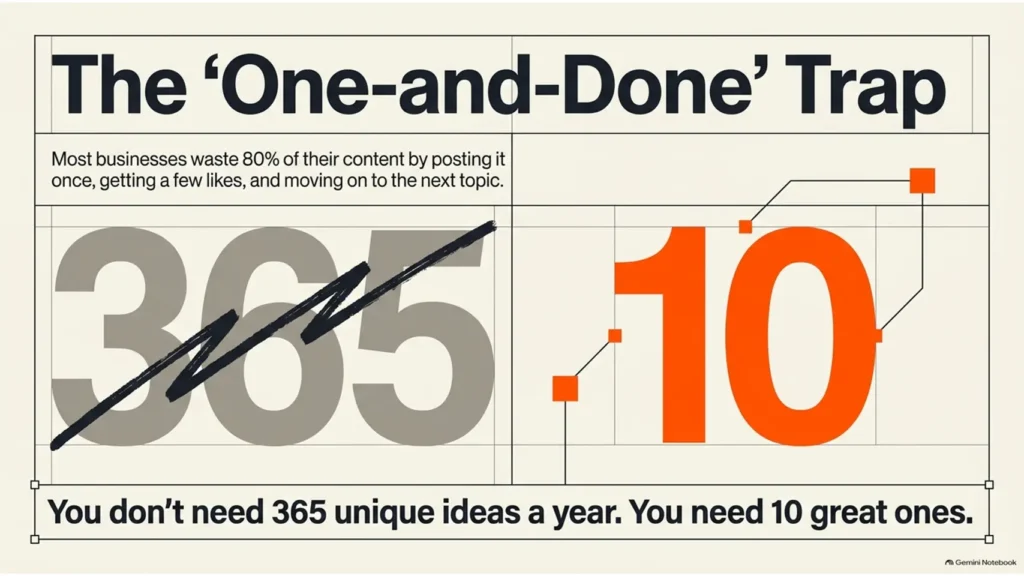
Most content gets published once, receives a short burst of promotion, and then quietly disappears. The research behind it, the expert insight embedded in it, and the production investment that funded it all go with it. For teams already stretched thin, that’s an expensive habit. Strategic content repurposing is the operational fix: extract more useful reach from every original idea without starting from scratch each time.
Teams looking to build a structured approach to this can visit West Pro Media Services’ multicasting solutions, which are built around the principle of adapting content deliberately for multiple channels rather than simply duplicating it.
Repurposing vs. Reposting: A Critical Distinction
What Strategic Adaptation Actually Means
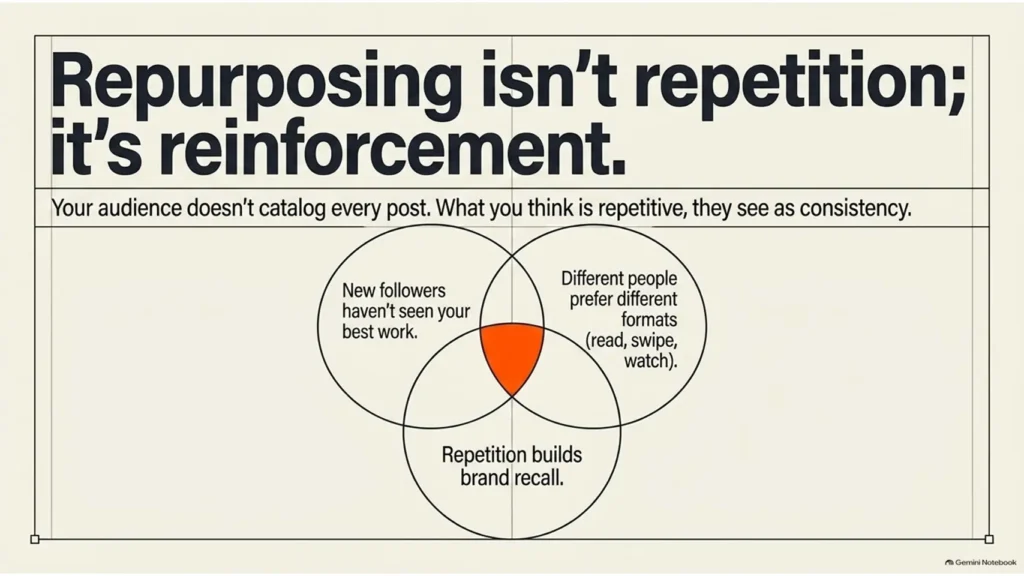
Repurposing isn’t copying a blog post and pasting it into LinkedIn. Strategic adaptation means taking the core insight of an original asset and rebuilding it – adjusting the format, depth, tone, proof points, call to action, and context – so it genuinely fits the audience and channel it’s landing on. The idea travels. The execution doesn’t.
A research-led article might become a short video explaining the business case, a LinkedIn carousel breaking down the key findings, a three-email nurture sequence, and a downloadable checklist – each one standing on its own, each one serving a distinct purpose. None of them feel like clipped fragments of the original.
Why Simple Cross-Posting Leaves Performance Behind
HubSpot’s 2026 survey found that 49.4% of marketing teams reuse the same content across platforms, while only 39.5% tailor it to each platform. That gap is exactly where performance gets left behind. Audiences on different channels have different expectations, different attention spans, and different reasons for being there. A technical white paper dropped into a social feed without adaptation doesn’t fail because the content is bad – it fails because the delivery ignores the context entirely.
The Real ROI Case for Repurposing
Extending the Life of Original Expertise
Every strong asset – a webinar, a customer interview, an original research report – represents a significant investment of time, expertise, and budget. Most of them are used once. Repurposing is the mechanism that recovers more value from that investment over time, not by diluting the original but by making it accessible in the formats people actually use.
According to the Semrush Content Repurposing Study 2026, 94% of marketers who repurpose content say it increases the ROI of their content. That figure reflects something straightforward: good ideas, in the right format, for the right audience, keep working long after the publish date.
Reaching Audiences With Different Content Preferences
Prospects don’t all discover or evaluate content the same way. A time-pressed executive may engage with a 60-second video or a LinkedIn carousel. A buyer actively evaluating vendors wants a case study or a comparison guide. An existing subscriber responds to a concise email series. One original piece of thinking can serve all of them – but only if the derivative assets are built with those specific people in mind.
Short-form video was named the highest-ROI media format by 48.6% of HubSpot respondents in 2026, ahead of long-form video at 28.6% and live-streaming video at 25.1%. The format decision should be driven by where the audience actually is and what they’re ready to do there – not by a blanket assumption that one format fits all.
The Pillar-to-Derivative Framework
Mapping One Asset Across the Full Buyer Journey
The most effective repurposing systems start with a single strong pillar asset – one that contains the evidence, point of view, and narrative – and then build derivative assets that carry that value to different stages of the buyer journey.
Journey Stage Repurposed Asset Type Purpose Awareness Short video, quote card, social post Create recognition, prompt curiosity Problem Exploration Article, podcast clip, webinar segment Establish expertise, frame the problem Evaluation Checklist, FAQ, comparison guide Help prospects assess their options Decision Case study, demo clip, sales email Reduce risk, drive action Retention Onboarding guide, customer webinar Help customers succeed and advocate
A Worked B2B Example
A 2,000-word guide on procurement process optimization – built around original client data and expert commentary – becomes the pillar. From there, the derivative map looks like this:
- 60-second video: The core business case, formatted for LinkedIn or YouTube Shorts
- LinkedIn document carousel: Five signs your procurement process is costing you money
- Three-email nurture sequence: One insight per email, leading to a consultation CTA
- Downloadable audit checklist: A practical tool that captures leads at the evaluation stage
- Sales enablement one-pager: A concise proof asset for the commercial team
Each of these makes sense independently. None of them require producing new research. All of them serve a buyer at a different point in the journey.
AI Accelerates Repurposing – But Doesn’t Replace Judgment
86.4% of marketing teams now use AI in at least some marketing areas, according to HubSpot’s 2026 data. For repurposing, AI is genuinely useful – handling transcription, first-draft generation, summarization, caption formatting, and content clipping at a speed no human team can match at scale.
AI speeds up the process. It doesn’t decide what the process should produce. The strategic decisions – which assets are worth repurposing, which formats will actually connect, what needs updating before it goes back out – still require editorial judgment, audience knowledge, and commercial awareness. Teams that hand those decisions entirely to AI tend to produce high volumes of generic derivatives that undermine trust rather than build it. HubSpot’s guidance is explicit: human review and approval processes should remain part of any AI-assisted workflow.
Repurposing and SEO: Avoiding the Duplicate Content Trap
Transformation vs. Syndication
Repurposing and syndication are not the same thing, and conflating them creates real SEO risk. Repurposing transforms an idea into a genuinely different format, angle, or audience-specific asset. Syndication republishes substantially the same article on another site or URL.
When two pages are near-identical, search engines cluster them and select one canonical version to rank – which means the other effectively disappears from results. Google’s current canonicalization guidance notes that pages in a duplicate cluster need clear, significant differences to be treated as separate. It also specifies that for third-party syndication, the most effective solution is for the partner to block indexing of the syndicated copy – not to rely on a rel=canonical tag, which Google no longer treats as a reliable fix across domains.
What Google Actually Penalizes
Google doesn’t penalize duplicate content in the traditional sense – it consolidates ranking signals onto what it considers the canonical version, suppressing the rest. The practical result is the same: thin or near-identical derivatives don’t rank. Genuine transformation – turning a blog post into a video script, a data report into a sector-specific FAQ, a webinar into a structured article – creates new, indexable value. Minor rewrites with the same structure and the same information do not. Google’s 2026 guidance also reinforces that standard SEO fundamentals haven’t been replaced: valuable, unique, non-commodity content remains the foundation for visibility, including in AI-generated search features.
Common Mistakes That Undermine the Strategy
- Repurposing weak source material. More versions of an outdated or underperforming asset don’t create value. Refresh the facts, examples, and positioning first.
- Treating transcripts as finished content. Pasting a raw webinar or podcast transcript into a blog post produces sprawling, unfocused content that damages both SEO and reader trust.
- Forcing every asset onto every channel. A technical white paper shouldn’t automatically become a short-form video. The medium should match the asset’s real value and the audience’s expectations.
- Measuring vanity metrics alone. Views and impressions matter for awareness, but the real test is qualified engagement, assisted conversions, pipeline influence, and sales utility.
- Letting the original asset stagnate. Derivatives that point back to an outdated pillar page undermine the whole system. The source content needs to be maintained.
- Ignoring rights and permissions. Imagery, guest contributions, customer quotes, and licensed data all have specific terms. Confirm ownership before reuse.

One Proven Asset, Three Distinct Derivatives: Start Here
The fastest way to build confidence in this approach is to start small and measure deliberately. Identify one piece of existing content that has already demonstrated value – sustained organic traffic, strong engagement, qualified leads, or direct sales team use. Then create three genuinely distinct derivatives, each with a defined audience, a specific format appropriate to the channel, and a clear success metric.
Don’t measure output. Measure outcome quality: did the LinkedIn carousel generate profile visits from the right job titles? Did the email sequence improve click-through rates compared to standard newsletters? Did the checklist convert downloads into demo requests? That comparison – between what the original achieved alone and what the system achieves together – is the real ROI case for strategic adaptation over duplication.
Repurposing is a value-extraction system. Build it deliberately, measure it honestly, and the case for scaling it becomes obvious fast.
| Topic / Area | Key Finding | Business Impact | Why It Matters |
|---|---|---|---|
| Cross-channel repurposing | 35.08% of teams prioritise repurposing across channels | Extends value from existing content investment | Reduces reliance on constant net-new production |
| Platform adaptation | 49.4% reuse content; 39.5% tailor it | Tailored assets can improve channel relevance | Copy-pasting often misses audience expectations |
| AI-assisted production | AI supports drafting, clipping, transcription, and formatting | Faster production capacity for lean teams | Editorial review protects quality and brand voice |
| ROI measurement | 94% of repurposers report higher content ROI | Strengthens the case for systematic reuse | Track leads, pipeline influence, and sales usage |
| SEO and syndication | Similar pages may be consolidated into one canonical | Poor adaptation can reduce search visibility | Transform intent and format; control syndicated copies |
Frequently Asked Questions
How do I choose which content to repurpose first?
Start with assets that have already shown evidence of value: sustained organic traffic, strong engagement, qualified leads, useful sales conversations, or proprietary expertise. Refresh any outdated facts first, then select formats and channels that match a specific audience and business goal.
Can AI repurpose content without making it sound generic?
AI can quickly create transcripts, draft social posts, extract themes, and suggest content angles, but it should not be the final editor. Add human expertise, relevant examples, a distinctive point of view, and platform-specific context before publishing to protect trust and brand quality.
How many pieces of content can one pillar asset become?
There is no fixed number. A substantial webinar, guide, interview, or research report might support a video, carousel, email sequence, FAQ page, checklist, sales one-pager, podcast clip, and follow-up article. Stop when a format no longer adds distinct audience value.
Does repurposing content hurt SEO or cause duplicate-content issues?
Not when the new asset is genuinely transformed. Google groups pages that are too similar and may select only one canonical version, so avoid publishing lightly rewritten copies at multiple URLs. Change the format, audience, intent, structure, evidence, or angle to create original value.
What metrics prove that content repurposing is working?
Track more than output and impressions. Compare production time and cost against creating from scratch, then measure qualified engagement, email clicks, lead downloads, assisted conversions, sales-team use, pipeline influence, and revenue. Each derivative should have one defined outcome linked to its buyer-journey stage.
To learn more about how West Pro Media Services helps businesses distribute content strategically across multiple channels, visit westpromediaservices.com.
