
Summary
Many businesses treat Digital PR and content distribution as competing strategies, but they deliver different forms of value. Digital PR earns authoritative editorial backlinks that strengthen long-term search visibility and credibility, while content distribution ensures those assets reach the widest possible audience and continue generating leads. The strongest results come from combining both, using Digital PR to build authority and content distribution to amplify its commercial impact.
Key Takeaways
- Editorial backlinks from credible publications act as compounding authority signals – they keep working long after a campaign ends, unlike paid distribution that stops the moment the budget does.
- Content distribution excels at predictable reach and demand generation, making it a vital amplification layer. While it can contribute to domain authority when strategically executed with proper attribution and high-authority placements, it generally does not build domain authority as directly or powerfully as earned editorial backlinks.
- The most effective strategy combines both: earn third-party validation through Digital PR, then systematically distribute and repurpose that asset to grow an addressable audience.
- An integrated approach – where one strong content asset is both pitched to media and distributed across owned channels – is where the real ROI compounds. The multicasting model from West Pro Media Services is one example of how that sequencing can be operationalized.
- Companies that integrate PR and content strategy report significantly higher ROI than those that treat them as separate functions – keep reading to see exactly why, and how to build your own playbook.
Most marketing budget debates eventually land on the same question: build authority or build reach? The instinct is to pick one. That framing creates a false choice – and one that quietly drains ROI from teams that could be doing both, better.
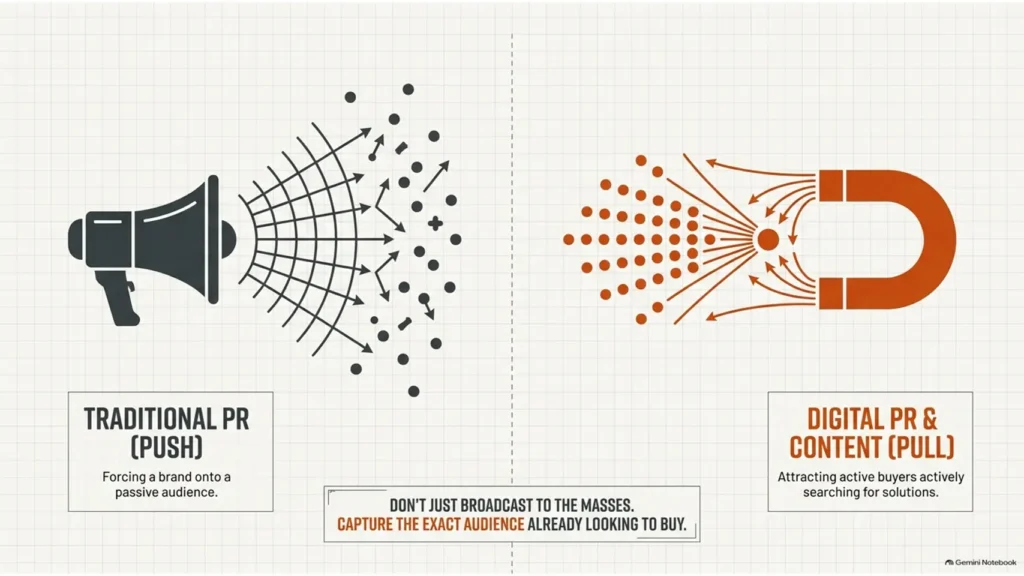
Two Different Authority Engines
Digital PR and content distribution are not competing tactics. They are different machines built to do different jobs. Understanding what each one actually does – mechanically – is the starting point for using them well together.
Digital PR: Borrowed Trust That Compounds
Digital PR earns editorial coverage from journalists, editors, and credible third-party publishers. When a respected outlet covers a brand’s original research or expert commentary, that coverage produces something content distribution rarely can: a permanent, editorially given backlink from a domain with real authority.
Search engines treat these links as votes of confidence. The more credible and relevant the source, the heavier the vote. Industry reporting on digital PR campaign benchmarks suggests that campaigns consistently earn links from dozens of unique referring domains at high average authority scores, with a significant share being dofollow. That is not a traffic spike – that is a compounding authority asset.
The key word is earned. A journalist links to a brand because the story was worth covering – not because a budget was spent. That editorial independence is precisely what gives the link its weight.
Content Distribution: Repeatable Reach You Control
Content distribution works differently. It deliberately repurposes and promotes owned assets across channels – email newsletters, LinkedIn, paid social, webinars, partner networks, and syndication. Enterprise content marketing research consistently shows that the vast majority of large-scale programs rely on organic social, corporate blogs, email newsletters, and paid distribution as core operational channels.
That ubiquity tells a clear story: distribution is a core operational capability, not a nice-to-have. It builds subscribers, nurtures known audiences, captures demand from people already in the funnel, and drives repeatable pipeline. Content distribution, particularly when relying on syndicated networks without proper canonicalization or attribution, may not reliably build the kind of domain authority that significantly changes organic search rankings due to potential nofollow or duplicate-content links. However, strategic syndication with clear attribution and proper technical handling can contribute to brand visibility and, in some cases, domain authority.
Why Editorial Placements Win the Long Game
High-Authority Backlinks as Ranking Signals
Google treats external links from reputable sources as one of its most influential ranking inputs. A single editorial placement in a publication with a high domain rating can do more for search visibility than dozens of syndicated content drops. Digital PR routinely earns placements in outlets operating at that level – Bloomberg, TechCrunch, trade publications, and sector-specific media that a brand’s buyers actually read.
Consistent quarterly digital PR efforts have been documented to produce substantial growth in referring domains, meaningful lifts in organic traffic, and measurable conversion improvements over a 12-to-24-month period. Those results do not come from distribution alone.
Third-party metrics like Domain Rating are proxies, not direct Google inputs. But they reflect something real: a site earning links from authoritative, relevant sources is building exactly the kind of trust that search systems reward over time.
E-E-A-T and Third-Party Validation
Google’s E-E-A-T framework – Expertise, Experience, Authoritativeness, and Trustworthiness – rewards brands that can demonstrate independent credibility. Editorial coverage does that in a way owned content simply cannot. A brand can claim expertise on its own website; a respected trade publication citing that brand’s research is an external validation that carries a different kind of weight.
High-quality digital PR aligns directly with E-E-A-T because it produces credible brand mentions, expert attribution, and consistent topical signals across authoritative sources. As AI-driven search surfaces become more prominent, that evidence footprint – original data, named experts, traceable methodology, third-party citations – becomes an increasingly important factor in how brands appear in search experiences of all kinds.
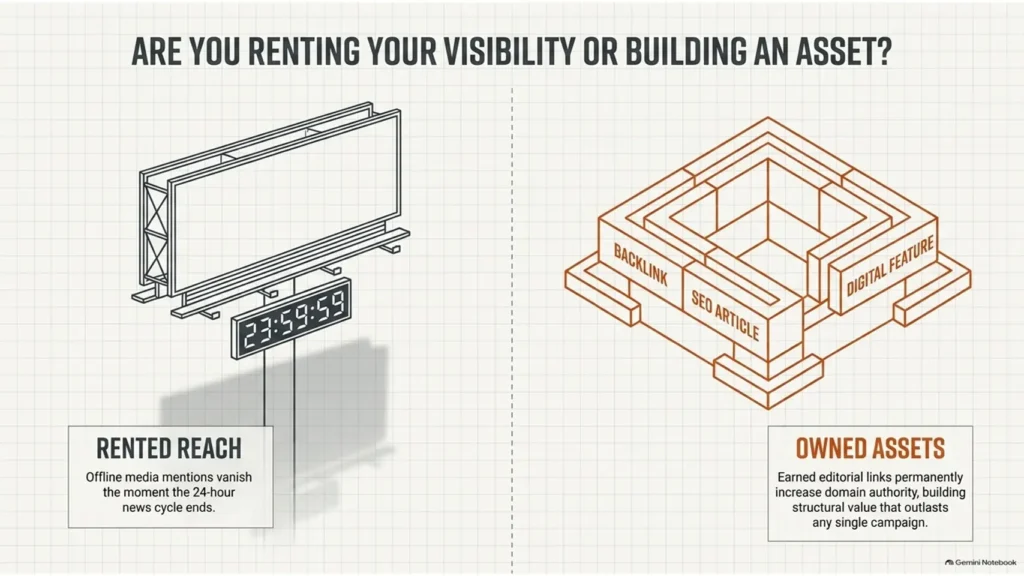
Where Distribution Has the Clear Edge
Predictable Demand Generation
No serious content strategy operates without distribution. Digital PR earns coverage in bursts – a campaign launches, coverage lands, referral traffic spikes, and then organic value compounds slowly over months. Distribution fills the gaps. It keeps a brand present in the inbox, the feed, and the search result between PR campaigns. It converts awareness into action through consistent touchpoints.
Paid distribution channels are particularly effective for lead generation, directing targeted traffic to landing pages and gated content where intent is high and conversion paths are direct. That is a job digital PR does not do – and should not be asked to do.
Audience Ownership vs. Rented Reach
The most durable distribution asset is not a social following – it is an email list. Owned channels (email, owned communities, branded content hubs) give a brand direct access to an audience that does not disappear when an algorithm changes or a paid campaign ends. Distribution, done well, builds that asset over time. It is the difference between renting reach and owning an audience.
As AI-generated answers reduce clicks for simple informational queries, the value of first-party audience relationships only increases. Distribution creates the conditions for those relationships; PR creates the credibility that makes people want to follow in the first place.
The Mistakes That Kill Both Strategies
Digital PR Pitfalls
- Treating a press release as a PR strategy. A press release is a format. Digital PR requires a story an independent editor genuinely wants to publish – original data, a counterintuitive finding, a relevant expert voice.
- Chasing placements over relevance. A link from a tangentially related high-authority site is worth less than a dofollow mention in a respected trade publication your buyers actually read.
- Buying links instead of earning them. Google’s spam guidance is explicit: paid links intended to pass ranking credit violate its policies. Sponsored placements require proper disclosure and appropriate link attributes.
- One-and-done campaigns. A single campaign earns a burst of coverage. A quarterly cadence builds a compounding authority foundation.
Distribution Pitfalls
- Indiscriminate reposting. Copy-pasting identical content across channels creates duplication issues, weak attribution, and audience fatigue – not reach.
- Chasing impressions over pipeline. Raw reach metrics hide whether the right people are engaging. Target-account visits, qualified leads, and influenced revenue are the metrics that matter.
- Ignoring syndication rules. Google’s guidance for syndicated content emphasizes proper handling to avoid duplicate content issues. While canonical tags are often recommended to signal the original source, they can be misimplemented. Blocking the indexing of partner copy can be a more reliable strategy when canonical tags are not implemented correctly. Set attribution and indexation rules before a piece goes live.
The Integrated 80/20 Playbook
Build One Asset Worth Both Pitching and Distributing
The most efficient approach starts with a single, high-value content asset – an original industry survey, a proprietary data analysis, an expert-led benchmark, or a substantive decision framework. Make the methodology transparent. Build it with enough substance that a journalist would want to cover it and an email subscriber would want to download it.
From that one asset, create a full ecosystem:
- A complete, indexable version on the brand’s own domain
- A press angle tailored to each relevant media segment
- An executive summary for LinkedIn and newsletter audiences
- A webinar or expert discussion interpreting the findings
- Sales and partner collateral to continue the conversation further down the funnel
This approach makes one strong idea do more work across more channels simultaneously – without producing content for the sake of volume.
Use PR to Earn, Distribution to Compound
The sequence matters. Publish the full asset on an owned domain first. Build media angles around the genuinely distinctive findings – not the brand. Pitch a short, relevant list of journalists with personalized context. Then amplify coverage through owned social, email, executive accounts, and relevant professional communities. Convert attention with topic-matched calls to action rather than generic contact forms. Finally, refresh the asset when new market events or press commentary create a new angle – and redistribute.
This sequencing makes PR and distribution mutually reinforcing. The campaign earns third-party authority; distribution extracts ongoing commercial value from it. Companies that integrate these functions report significantly higher ROI than those that run them as separate budget lines.
Measuring across multiple time horizons matters here. In the first 30 days, track pitch response rates, placement quality, and referral visits. Between one and six months, watch referring domain growth, branded search trends, and ranking movement. Beyond six months, the question becomes whether the authority is compounding – through recurring journalist relationships, organic citations, and resilient search visibility that survives algorithm updates.
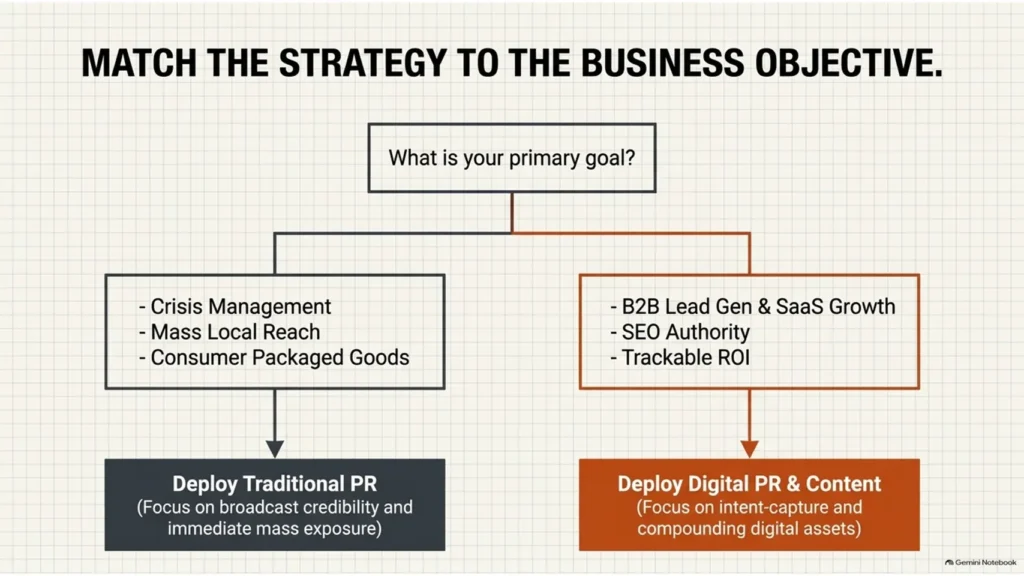
The Strongest Strategy Combines Both – Here Is Where to Start
The question is not which channel wins. It is which approach fits where the brand currently sits:
- New or low-authority brand: Prioritize digital PR to establish credibility and earn discovery, supported by foundational distribution to owned audiences.
- Established brand with an audience but limited search visibility: Lean into distribution and lifecycle email, with selective PR campaigns to build domain authority in targeted topic areas.
- Competitive B2B category: Build quarterly original-research assets designed to earn media coverage, then run an always-on distribution program to extract consistent pipeline value from each one.
The brands that win the long game are not choosing between earned authority and consistent reach. They are building systems where each investment makes the other more effective – earning trust through editorial validation, then activating it through distribution that reaches the right audience at the right time.
| Topic / Area | Key Finding | Business Impact | Why It Matters |
|---|---|---|---|
| Earned-link quality | Editorial relevance outweighs raw placement volume | Builds durable authority in commercially relevant topics | Supports visibility where prospective buyers research |
| Paid distribution adoption | 91% of technology marketers used paid channels | Creates predictable reach beyond existing audiences | Useful for accelerating demand around priority assets |
| Paid-channel effectiveness | SEM/PPC led effectiveness among paid technology channels | Captures higher-intent traffic and measurable conversions | Links distribution spend more directly to pipeline |
| Link-policy compliance | Paid ranking links breach Google’s spam policies | Incorrect tagging can create avoidable search risk | Use sponsored or nofollow attributes for paid placements |
| Asset-led integration | One original research asset supports PR and distribution | Reduces production duplication while extending campaign lifespan | Combines earned credibility with repeatable audience activation |
Sources
Frequently Asked Questions
Is digital PR still worthwhile if AI search results reduce organic clicks?
Yes. Digital PR can make a brand more visible in AI-led search by creating credible third-party references, expert quotes and original data points that others can cite. Its value is not limited to clicks; it builds recognition, trust and a stronger evidence footprint.
Can content distribution improve SEO without earning media backlinks?
It can support SEO indirectly by increasing content discovery, branded searches, engagement and opportunities for natural links. However, distribution alone usually cannot replicate the authority impact of relevant, editorially earned backlinks from respected publications and industry websites.
Which should a small business invest in first: digital PR or distribution?
Start with the constraint holding growth back. If few people know or trust the business, invest in a focused digital PR asset. If strong content already exists but is underperforming, prioritise distribution to build audience, leads and insight before scaling PR.
How do you measure the long-term ROI of digital PR and content distribution?
Use different measures at different stages. Track placements, referring domains and referral visits initially; then assess branded search, ranking visibility and organic traffic. For distribution, measure subscriber growth, qualified leads, conversion rates, pipeline influence and repeat engagement over time.
Does syndicated content create duplicate-content problems for my website?
Not automatically, but unmanaged syndication can confuse search engines about which version should rank. Publish the original on your own site first, ensure partners clearly credit and link to it, and agree indexation or canonical-tag arrangements before the content is republished.
For teams ready to build that kind of integrated system, West Pro Media Services helps brands develop and execute content strategies that combine earned media credibility with scalable multichannel distribution.