
Summary
Content brief templates become far more effective when they include clear acceptance criteria that define exactly what “done” looks like. Rather than relying on subjective opinions about quality, structured criteria covering fact-checking, information gain, audience alignment, brand voice, SEO and AEO requirements, and accessibility help writers produce consistent, strategically aligned content while reducing unnecessary revision cycles.
Key Takeaways
- Acceptance criteria transform a content brief from a loose set of suggestions into a clear, testable definition of “done” – reducing revision cycles and writer confusion.
- Six fields – fact-checking, information gain, persona alignment, brand voice, SEO/AEO implementation, and accessibility/delivery – are proposed as a strong working set for defining content completeness, aligning with widely recognized best practices for content quality.
- A pre-submission writer checklist built from those six fields acts as a quality-control gate before content ever reaches an editor’s desk.
- The line between useful direction and stifling over-prescription matters – knowing which brief fields actually change output is what separates strategic templates from bureaucratic ones.
Most content briefs are full of good intentions and short on clear finishes. They tell writers what to write about, sometimes how long to write it, and occasionally who they’re writing for – then leave everyone to guess what “good” actually looks like when the draft lands. That gap is where revision cycles are born.
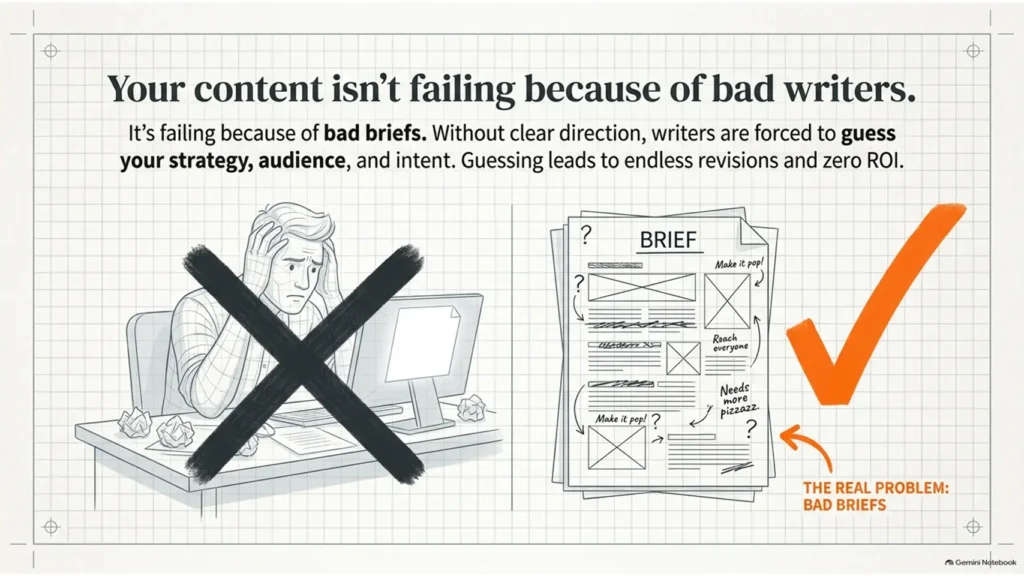
No Acceptance Criteria Means No Definition of ‘Done’
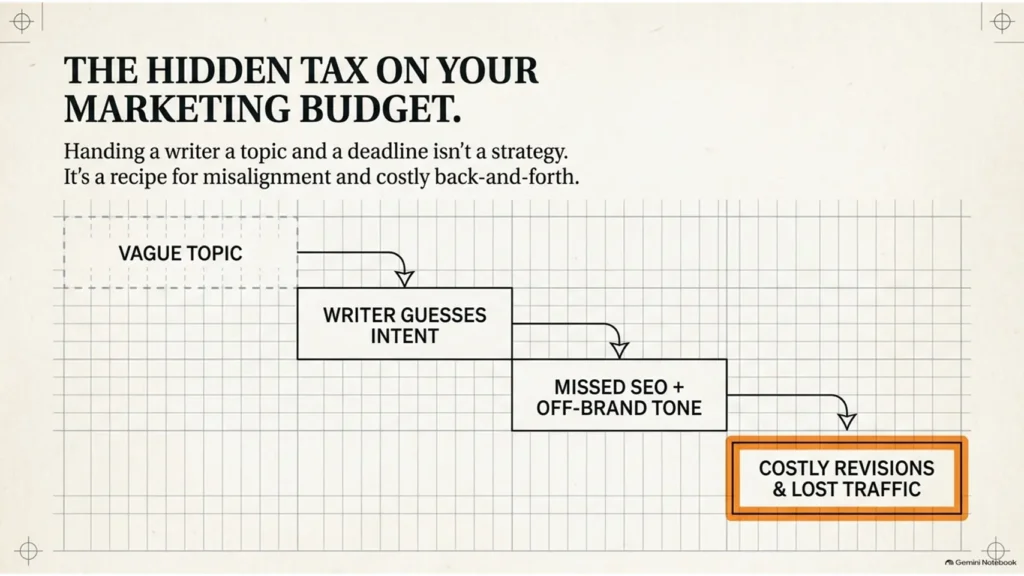
“Write a high-quality article” is not an instruction. Without explicit acceptance criteria baked into a content brief template, there is no shared standard for what the finished piece needs to achieve – and every stakeholder ends up evaluating the draft against a different mental benchmark.
This is the root cause of most revision loops. The writer thought they were done. The editor thought something was missing. The content manager thought the tone was off. None of them were working from the same definition of complete.
Acceptance criteria solve this by converting vague quality expectations into pass/fail conditions – the same logic used in software development to define when a feature is actually finished. Applied to content, they give writers a clear finish line and give editors a consistent review standard. According to West Pro Media Services, their teams use exactly this approach when building content workflows – treating the brief as a quality-control system, not just an assignment sheet.
What Acceptance Criteria Actually Do
Understanding the mechanics behind acceptance criteria makes it easier to write ones that actually work.
Pass/Fail, Not Preference
Effective acceptance criteria are testable conditions, not editorial opinions. “The article must include at least two sources published within the last two years” is testable. “The article should feel authoritative” is not. That distinction removes subjectivity from the review process. When a criterion can be checked like a box, the review becomes faster, fairer, and far less likely to stall in back-and-forth.
The Strategic Alignment Payoff
Acceptance criteria also keep individual pieces of content connected to broader marketing goals. Without them, a writer optimizes for what sounds good. With them, the writer optimizes for what the strategy actually needs – the right persona, the right search intent match, the right conversion action. Systematic briefing of this kind is widely regarded as the most reliable way to prevent content from being well-written but strategically useless.
The Acceptance-Criteria Fields Every Template Needs
Six fields cover a strong working definition of “done” for almost any content type.
Fact-Checking and Source Citations
Every factual claim in the piece must be traceable to a named, verifiable source. The criteria here should specify: what types of sources are acceptable (industry publications, peer-reviewed research, first-party data), how recent sources must be, and whether the writer or editor is responsible for verification. This field also covers prohibited claim types – anything that requires legal sign-off or makes competitive comparisons without supporting evidence.
Example criterion: All statistics must be cited inline with a hyperlink to the original source. No claims may be made about competitor products without a direct, verifiable reference.
Demonstrated Information Gain Over Competitor Content
Google’s people-first content guidance asks explicitly whether a page provides original information, analysis, or insight beyond what is already available. This is a brief field, not an abstract ideal. The template should require writers to identify at least one element that competing content does not contain: a proprietary framework, a contrary perspective, a decision tool, a customer example, or data unavailable elsewhere.
Without this field, the default is a competent summary of what everyone else already said – commodity content rather than genuine information gain.
Persona and Target Audience Alignment
This field goes further than listing demographic information. Jobs-to-be-Done (JTBD) persona mapping offers a highly effective approach: “When [circumstance], I want to [action], so I can [outcome].” A brief that defines the reader’s situation, trigger, and desired result gives the writer the context to find the right angle – not just the right topic.
The acceptance criterion here might read: The piece must address the situation of a content manager who is scaling production and experiencing inconsistent draft quality – and resolve a specific, named pain point for that reader.
Brand Voice and Tone Consistency
Voice and tone criteria need to be specific enough to be testable. “Friendly” or “professional” alone will not do it. Effective criteria include: reading level targets, active vs. passive voice preferences, terminology that must or must not appear, and examples of on-brand sentences the writer can reference. Linking to a live style guide within the brief turns this criterion from a judgment call into a direct comparison.
SEO and AEO Implementation
SEO criteria in the brief should function as guardrails, not a keyword-stuffing formula. The fields that actually change output include: primary topic and related entities, internal link targets with suggested anchor text, metadata guidance (title and meta description direction), and structural elements like whether a comparison table, FAQ section, or step-by-step list is required.
On the AEO side – content optimized for AI answer engines like Perplexity or Google’s AI Overviews – the brief should specify answerable units: concise definitions, direct Q&A blocks, and source-supported claims that an AI system can parse, quote, and attribute. This is a readability standard that benefits human readers just as much as it benefits machine interpretation. Detailed briefs matter especially for AI-assisted drafting, where generic prompts reliably produce generic output.
Accessibility, Format, and File Delivery
This field covers the operational finish line. It includes: heading hierarchy requirements, alt text for all images, minimum contrast or readability standards, required file format (Google Doc, Word, CMS draft), image sourcing and naming conventions, and where the completed file should be submitted. Small in scope, but the number of content pieces that stall because a writer submitted the wrong format or forgot to request images makes this field worth the two lines it takes to write.
The Pre-Submission Writer Checklist
Acceptance criteria only work if writers actually check them before submitting. The most practical way to ensure this is to convert the six fields into a short checklist embedded directly in the brief template – something a writer can tick through in under five minutes.
- All facts are cited with a link to a named, verifiable source
- At least one element of information gain is present and clearly identifiable
- The piece addresses the named persona’s specific situation and desired outcome
- Terminology and tone match the style guide; no prohibited terms appear
- Internal links are included with the specified anchor text
- All required structural elements (tables, FAQs, lists) are present
- Alt text is written for every image; headings follow the correct hierarchy
- File is in the correct format and submitted to the correct location
When writers self-check before submitting, editors spend review time on judgment calls – usefulness, narrative flow, conversion alignment – rather than catching missing citations and wrong file names. That shift in where editorial effort goes is meaningful.
Direction vs. Discretion: Where to Draw the Line
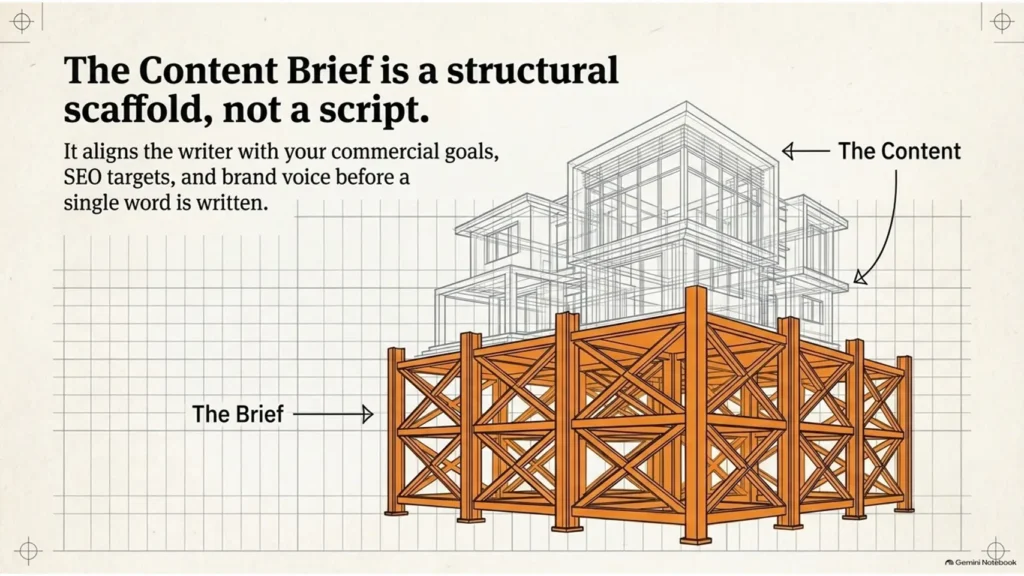
Acceptance criteria are not a license to script every sentence. The brief should define what the piece must achieve, not how the writer must achieve it. Giving a writer the persona, the required claims, the structural skeleton, and the finish-line conditions is direction. Dictating exact phrasing, mandating a rigid heading structure with no room to improve, or specifying paragraph order down to the word produces technically compliant but creatively hollow content.
A useful sentence to include directly in the template: Preserve the strategic requirements in this brief, but improve the order, wording, examples, and transitions wherever doing so makes the article clearer and more useful to the reader. That signals the brief is a framework, not a mechanical script.
Brief Fields That Change Output vs. Those That Don’t
A practical filter for keeping templates lean: if a field does not change a writer’s research, framing, structure, evidence, or final CTA, it is probably administrative rather than strategic. Fields like persona definition, information gain requirement, internal link targets, and source standards all change what the writer produces. Fields like internal job codes or CMS page IDs are useful operationally but have no effect on the draft itself. Keep both, but do not confuse one for the other when evaluating whether a brief is working.
Briefs as Diagnostic Tools When Content Fails
When a piece of content underperforms – low organic traffic, high bounce rate, poor conversion – the instinct is often to blame the writing. The more useful question is: what did the brief specify, and was it followed?
A content brief with clear acceptance criteria turns a vague quality complaint into a specific process failure. If the piece does not rank, check whether search intent was defined in the brief and matched in the content. If it does not convert, check whether the CTA and funnel stage were specified. If it got flagged for inaccuracy, check whether the fact-checking criterion was met. The brief becomes an audit trail – one that makes content operations improvable rather than just frustrating.
Without acceptance criteria, every failure looks like a mystery. With them, most failures have a named cause and a fixable source.
Six Defined Fields. Fewer Revisions. Better Content.
The six acceptance-criteria fields – fact-checking and source citations, demonstrated information gain, persona alignment, brand voice consistency, SEO and AEO implementation, and accessibility plus delivery – cover a strong working definition of done for almost any content type. They do not replace writer judgment; they give that judgment a clear target to aim at.
A template built around these fields reduces the ambiguity that creates revision cycles, connects individual pieces to strategic goals, and gives editors a consistent standard to review against. More importantly, it makes quality measurable – and anything measurable can be improved.
| Topic / Area | Key Finding | Business Impact | Why It Matters |
|---|---|---|---|
| Clear goals and criteria | Nearly half cite unclear goals as a strategy weakness | Fewer misaligned drafts and approval delays | Gives writers a shared definition of success |
| Resource constraints | 54% of B2B marketers report resource shortages | Pre-submission checks protect editor capacity | Prevents expensive rework in lean teams |
| Content measurement | 47% struggle to measure content results | Criteria can link briefs to trackable KPIs | Connects output quality with commercial performance |
| Original information | Google prioritises useful, original, people-first material | Differentiated content can earn stronger visibility | Stops briefs producing interchangeable competitor summaries |
| Accessibility controls | Meaningful alt text and descriptive headings improve access | Reduces publishing risk and improves usability | Makes content clearer for people and machines |
Sources
Content Marketing Institute — B2B Content Marketing: 2025 Benchmarks & Trends
Google Search Central — Helpful, Reliable, People-First Content
Frequently Asked Questions
How detailed should acceptance criteria in a content brief be?
Acceptance criteria should be specific enough to verify, but not so detailed that they prescribe every sentence. Define the required outcomes—such as evidence standards, audience need, structure, links and CTA—then leave writers free to choose the strongest wording, examples and narrative flow.
What is the difference between a content brief and a writer checklist?
A content brief sets the strategic assignment: audience, search intent, angle, information gap and business objective. A writer checklist is the final quality-control step, confirming that the finished draft meets those requirements before editorial review. Together, they reduce preventable revisions and missed requirements.
Should content briefs include requirements for AI Overviews and answer engines?
Yes, but treat these as clarity requirements rather than a separate optimisation trick. Specify the questions the page should answer, require concise direct responses, clear headings, visible supporting evidence and accurate internal links. Google states that standard SEO fundamentals and helpful, reliable content remain the basis for visibility in its AI features.
How can a writer demonstrate information gain in an article?
Require one genuinely additive element that a competing page is unlikely to offer: first-hand experience, original analysis, a practical decision framework, proprietary data, a worked example or a clearly evidenced contrarian view. Google’s guidance explicitly prioritises original information, research, analysis and value beyond simply rewriting existing sources.
Which content-brief requirements should be mandatory before publication?
Make the non-negotiables mandatory: factual claims checked against credible sources, the intended reader and search intent addressed, required links and CTA included, brand style followed, headings and images accessible, and all agreed formats delivered. These are measurable requirements; subjective editorial improvements can remain part of the review discussion.
For content managers looking to put this kind of structure into practice, West Pro Media Services works with teams to build content systems that are both strategically rigorous and practically usable.