
Summary
Choosing the right content distribution platforms means selecting the channels where your audience is most likely to engage and take action, rather than trying to be everywhere at once. By combining owned, earned, shared and paid media with a structured selection process, businesses can maximise visibility, strengthen authority and generate better long-term marketing results.
Key Takeaways
- Popularity is not a strategy – the most-used platforms in B2B content marketing are rarely the most effective ones.
- Treat content distribution as a portfolio decision, balancing Paid, Earned, Shared, and Owned (PESO) channels rather than betting everything on one platform.
- Five filters – audience fit, objective alignment, format fit, ownership risk, and execution economics – cut through the noise and make platform selection defensible.
- A weighted scorecard turns platform selection from guesswork into a repeatable, evidence-based process (covered in detail below).
- West Pro Media Services Ltd offers multicasting services that help B2B teams extend their content’s reach across multiple channels without multiplying workload.
Usage Does Not Equal Effectiveness: The Channel Trap Costing B2B Marketers Results
There is a stubborn gap sitting at the centre of most B2B content strategies – the gap between where teams publish and where buyers actually act. According to Content Marketing Institute’s B2B benchmark research, 89% of B2B marketers used organic social media and 84% maintained a corporate blog. Yet when those same marketers were asked which channels delivered the best results, in-person events (52%) and webinars (51%) ranked above organic social (42%) and blogs (41%). The channels receiving the most time and budget were not the ones generating the most value.
That is the channel trap. Teams default to what is familiar, what is measurable by volume, or what a competitor appears to be doing – and mistake activity for outcomes. The fix is not to abandon blogs or social media. The fix is to stop letting habit and assumption drive platform decisions.
Choosing where to distribute content should be as rigorous as choosing what to create. That means applying a structured set of filters to every candidate channel, and scoring platforms against the business goal – not their monthly active user count.
Treat Distribution as a Portfolio, Not a Single Bet
No single channel is reliable enough to carry an entire B2B content strategy. Algorithms shift, organic reach fluctuates, and audience behaviour evolves. The safest and most effective approach is to treat distribution as a portfolio, diversifying across channel types with intention.
Paid, Earned, Shared, and Owned: What the PESO Model Actually Covers
The PESO model – Paid, Earned, Shared, and Owned – provides a practical taxonomy for thinking about distribution. Owned channels (your website, email list, resource hub) give full control over the audience relationship. Earned channels (guest features, press mentions, podcast appearances) build trust through third-party credibility. Shared channels (LinkedIn, YouTube, community groups) extend reach through organic social and partnerships. Paid channels (search ads, social promotion, syndication) provide scalable amplification for validated messages.
Used together, these channel types reinforce each other. Owned media captures the audience that earned and shared channels attract. Paid media accelerates the reach of content that has already proven its value organically.
Why Most Teams Underinvest in Amplification – and How to Rebalance
A widely observed pattern in B2B content marketing is a heavy skew toward creation over distribution – with the bulk of budget and time going into producing content, and relatively little allocated to amplification and promotion. Many practitioners and strategists recommend a more balanced split between creation and distribution as a way to improve commercial results. Producing strong content and then barely distributing it remains one of the most common and costly inefficiencies in content marketing. Rebalancing does not always mean spending more; often it means reallocating time from production to promotion, repurposing, and channel management.
The 5 Selection Filters That Replace Gut Instinct
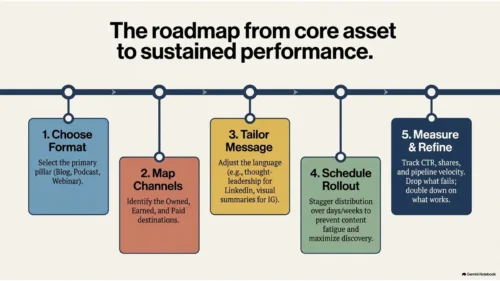
Once the portfolio mindset is in place, the next step is evaluating individual platforms. The following five filters turn platform selection from a subjective debate into a structured, repeatable process.
Filter 1: Audience Fit
The first question for any platform is simple: are the right people actually here, and are they here in the right context? A platform with hundreds of millions of users is irrelevant if decision-makers in a specific industry do not use it for professional research. Audience fit should be validated through customer interviews, CRM source data, social listening, and direct surveys – not assumed from general demographic reports. The goal is to find platforms where the target audience is already active and already in the right mindset to engage with relevant content.
Filter 2: Objective and Intent Alignment
Different platforms support different buyer actions. LinkedIn is strong for initiating expert conversations and building professional authority. YouTube supports deep-dive tutorials and product education. Email nurtures relationships with people who are not yet ready to buy. A platform earns a place in the mix when it naturally supports the next action a buyer should take – not just general awareness. Matching the channel to the commercial objective prevents the common mistake of using every platform as a link-sharing outlet with no clear intent.
Filter 3: Format Fit
According to Content Marketing Institute, the dominant B2B content formats are short posts and articles (92%), video (76%), and case studies (75%). The insight here is not that all three formats belong on all platforms – format-led platform decisions outperform channel-first ones. Video belongs where demonstration matters. Search-optimised articles belong where persistent questions are being asked. Webinars belong where complex education and trust-building are required. Forcing a format onto a platform where it does not behave naturally reduces both reach and engagement.
Filter 4: Ownership and Audience Risk
One of the most underweighted factors in platform selection is control. Social platforms are rented land. Algorithm changes, policy updates, and reach fluctuations can dramatically reduce a channel’s value overnight. That is why a website and a permission-based email list should anchor every distribution strategy – they are owned assets where the audience relationship is direct and durable. Social and third-party platforms are most valuable when they funnel people into owned properties, not when they are the only destination.
Filter 5: Economics and Execution Capacity
The most strategically sound platform is worthless if the team cannot maintain quality and consistency there. Execution capacity includes team time, budget, creative skills, and the ability to measure and respond. Before committing to a channel, it is worth calculating a realistic cost per qualified action – qualified visit, lead, or opportunity – and confirming that the team can sustain the required output. Overextending across too many platforms produces low-quality, inconsistent content that fails everywhere.
Score Every Platform With a Weighted Scorecard
The five filters become most powerful when combined into a weighted scorecard. Score each platform from 1 to 5 on each criterion, then apply weights that reflect the business model and current priorities. A practical formula looks like this:
Platform Score = (0.30 x Audience Fit) + (0.25 x Intent Alignment) + (0.20 x Format Fit) + (0.15 x Ownership Value) + (0.10 x Execution Efficiency)
The weights are not fixed. An early-stage B2B advisory firm should load more weight onto audience fit and buyer intent. A media brand building awareness may prioritise format fit and reach potential. The scorecard’s value is the discipline of making trade-offs explicit rather than defaulting to the loudest opinion in the room. A weighted decision scorecard can be applied to vendor selection, project prioritisation, and strategic planning across B2B environments, making it a versatile tool well beyond content distribution alone.
Distribute Smarter With the Hub-and-Spoke Model
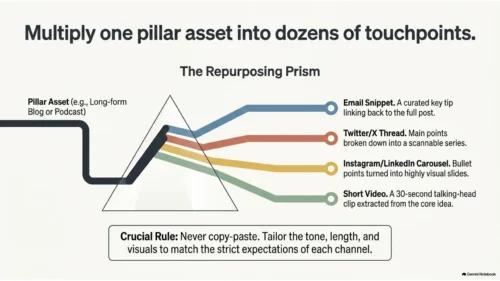
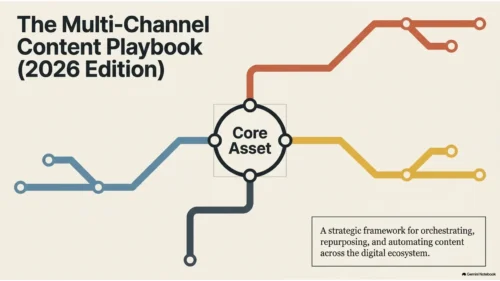
One of the most practical approaches to multi-channel distribution is the hub-and-spoke model. A single high-quality hub asset – a research-led guide, a detailed case study, a recorded webinar – becomes the source of multiple platform-specific adaptations. Each adaptation draws from the same core idea but is rebuilt for the native behaviour and audience expectations of its channel.
For example, a guide on reducing B2B customer churn could become: a searchable long-form article with email capture on the website, a LinkedIn post focused on one counterintuitive finding, a YouTube walkthrough of the retention framework, a newsletter with an applied checklist, and a paid retargeting campaign aimed at visitors who read the guide but did not subscribe. Each version earns its place because it respects how that platform’s audience consumes content – not because a link was pasted everywhere and left to perform on its own.
Measure What Drives Revenue, Not Just Reach
Distribution performance should always connect back to commercial outcomes. Impressions and follower counts are easy to report but rarely meaningful. The channels rated most effective in B2B research – events, webinars, and email – are precisely the ones that create the most direct path from content engagement to a business conversation.
A practical measurement hierarchy runs across five levels: Awareness (qualified reach, branded search volume, new relevant followers); Engagement (watch time, saves, shares, meaningful comments, return visitors); Acquisition (qualified site sessions, subscriber conversion rate, cost per subscriber); Revenue (pipeline influenced, customer acquisition cost, closed-won deals, renewals); and Efficiency (production time, cost per qualified action, content reuse rate). Tracking across all five levels – using UTM parameters, CRM source fields, and platform-native analytics – makes it possible to connect distribution activity directly to pipeline rather than stopping at surface metrics.
