
Summary
Consistent content publishing helps Warrington businesses build trust in AI search by creating a clear, current and verifiable record of what the business does, where it operates and the expertise behind it. Publishing useful answers to real customer questions, keeping business information accurate and supporting claims with reviews and other independent evidence gives Google and AI systems more reliable information to understand, trust and potentially cite.
Key Takeaways
- Consistent content publishing builds trust in AI search by creating a current, corroborated record of a Warrington business’s identity, offerings, service area and supporting proof
- Google confirms there are no extra technical requirements for a page to support AI Overviews or AI Mode beyond being indexed and eligible for a normal search snippet
- AI Overviews now appear in roughly one-third of UK Google searches, up from roughly one in five at the start of 2025, yet fewer than 5% of UK SMEs have optimised for this shift
- Publishing consistency works best as a system of accurate, updated, evidence-led content rather than a race to produce the highest volume of posts
- Warrington business owners can strengthen AI visibility by mapping real customer questions, keeping listings current, and pairing on-site content with independent corroboration such as reviews
Warrington business owners searching online today are increasingly met with AI-generated answers rather than a simple list of blue links. Understanding how those answers get built, and how a local business earns a place inside them, has become just as important as traditional search engine optimisation ever was.
Why AI Search Needs Proof, Not Posts
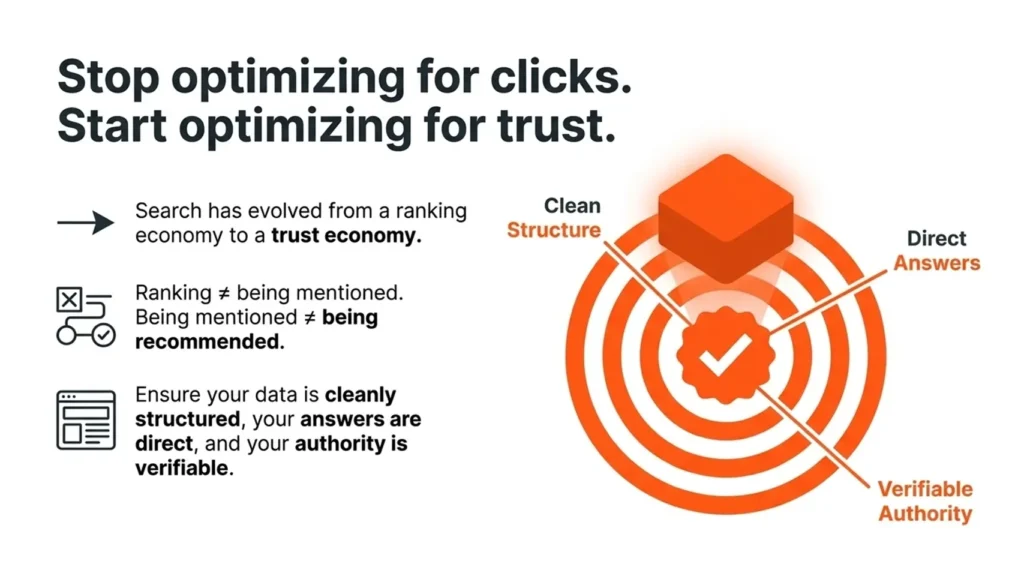
AI search systems look for evidence: facts that can be checked, details that stay consistent across different sources, and information that answers a genuine question clearly enough to be quoted with confidence. A Warrington plumber who publishes three well-researched, accurate guides a year will often be more useful to an AI system than one who churns out twenty thin, repetitive posts in the same period.
This is the heart of the matter for local firms trying to get noticed by tools such as Google’s AI Overviews, AI Mode, and Microsoft Copilot. A steady, accurate, locally grounded body of content earns trust because it becomes easier for these systems to find, understand, verify and eventually cite. Content creation services built around this principle focus on accuracy and topical depth rather than sheer output, which reflects the direction AI search appears to be heading.
For a Warrington business, this means content publishing should create a current, corroborated record of who the business is, what it does, where it operates, the problems it solves, and the evidence behind its claims. That record gives search engines and AI systems reliable material to retrieve, assess, and reference when a potential customer asks a question nearby.
What AI Systems Actually Check For
Google’s technical requirements for AI Overviews
Google has been fairly direct about this: there are no special technical hoops to jump through for a page to be picked as a supporting link in AI Overviews or AI Mode. A page simply needs to be indexed, eligible to appear as a normal search snippet, and meet the same standard technical requirements that have applied to search for years. In other words, the groundwork that has always mattered for good search visibility, such as crawlable pages, helpful and reliable content, accurate structured data, and an up-to-date Google Business Profile, remains the foundation for AI visibility too.
Three audiences: customers, engines, AI systems
Every piece of published content is really writing for three different readers at once, and each one has different expectations.
- Prospective customers need proof that a business is credible, local, capable and easy to reach, delivered through case studies, reviews, clear service details and genuine team expertise.
- Search engines need pages that are crawlable, indexable and well organised enough to satisfy the queries people type in.
- AI search systems need clear, factual, current passages that can support an answer or a recommendation without ambiguity.
Meeting all three needs at once is entirely possible, but it requires content that states things plainly, backs up claims with real detail, and gets updated when facts change.
AI Search Is Now Mainstream in the UK
Rising AI Overview usage, near 30% of search queries
AI-assisted search is no longer a niche behaviour reserved for early adopters. Industry reporting suggests AI Overviews now appear in roughly one-third of UK Google searches, up from roughly one in five at the start of 2025. Alongside this, UK usage of AI-powered search tools has been climbing steadily, with ChatGPT alone recording 1.8 billion UK visits across the first eight months of 2025 compared with 368 million during the same period the year before.
For a Warrington business, this shift matters because a growing share of local searches, whether for a solicitor, a builder, or a dental practice, may now be answered by an AI summary before a person ever clicks through to a traditional list of websites. Google describes AI Overviews as a way to help people quickly understand complex questions, while AI Mode is built for more nuanced comparison and discovery. Both can use something called “query fan-out,” running multiple related searches across subtopics, which is especially relevant to local service journeys where one question, such as finding the best way to plan a home renovation, might involve cost, planning permission, materials, and local reputation all at once.
Why most UK SMEs are unprepared
Despite this rapid change in how people search, most small and medium businesses across the UK have yet to adjust. Industry estimates suggest fewer than 5% of UK SMEs have optimised their content for AI search, even though AI tools have become a familiar part of everyday life for many UK adults. That gap represents a genuine opportunity for Warrington businesses willing to treat their published content as a serious asset rather than an afterthought, since competitors are largely leaving this space untouched.
Turning Publishing Into Verifiable Evidence
Building topical depth around real questions
A business that publishes one generic article each month may look active on the surface but still offers weak proof of real expertise. Stronger results tend to come from building a genuine topic cluster around the questions customers actually ask before they buy. A Warrington loft conversion company, for example, might build content around feasibility for different house types, planning permission versus permitted development, realistic cost drivers, and honest answers to disruption and timescale questions. Together, these pieces demonstrate working knowledge across an entire decision process rather than a single boastful claim.
Writing content that AI can retrieve and cite
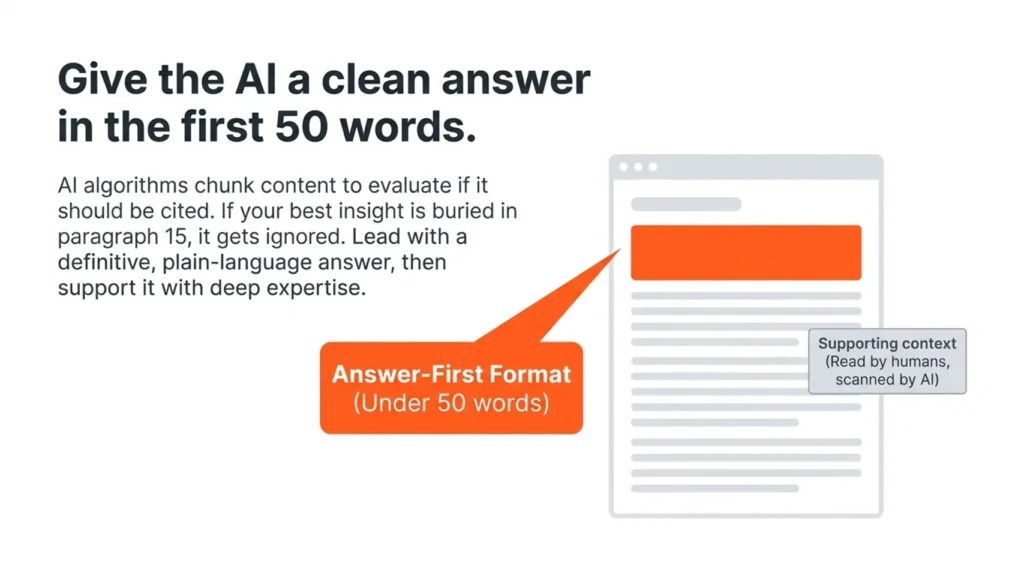
Clear writing helps both people and machines. A concise, defensible answer placed near the top of a page, descriptive headings that reflect the actual question being asked, and a clear separation between verified fact and general opinion all make content easier to interpret correctly. Vague marketing language such as claiming to be “the best roofing service in Warrington” offers little that an AI system can verify or quote. A more specific alternative, describing exactly what inspections involve and what a written quotation includes, gives both readers and AI systems something concrete to work with.
Keeping facts and listings current
Trust erodes quickly when information goes stale. A service page describing something no longer offered, a staff biography naming someone who left months ago, or opening hours that contradict a Google Business Profile listing all send mixed signals. A sensible approach reviews core service and trust pages every quarter, checks evergreen guides at least once or twice a year, and only publishes case studies or FAQs when there is genuine new evidence to share, rather than manufacturing content on an arbitrary schedule.
A Workflow for Trust-Led Publishing
1. Establish an accurate factual base
Before publishing anything new, it helps to audit the basics: business name, address, phone number, opening hours, services, credentials, insurance, accreditations, and review profiles. Any inconsistencies across these details should be resolved first, since AI systems are far less likely to trust a business whose facts contradict each other across different platforms.
2. Map genuine customer questions
Real questions from sales calls, email enquiries, Google Business Profile Q&As and even competitor gaps offer far better content ideas than guesswork. Grouping these questions by stage, from early awareness through to comparison and final decision, helps prioritise what gets written first.
3. Show first-hand local experience
Genuine project detail carries far more weight than generic claims. Original photographs, named specialists, honest explanations of limitations, and real outcomes from completed work all demonstrate the kind of first-hand experience that both readers and AI systems respond to.
4. Earn independent corroboration
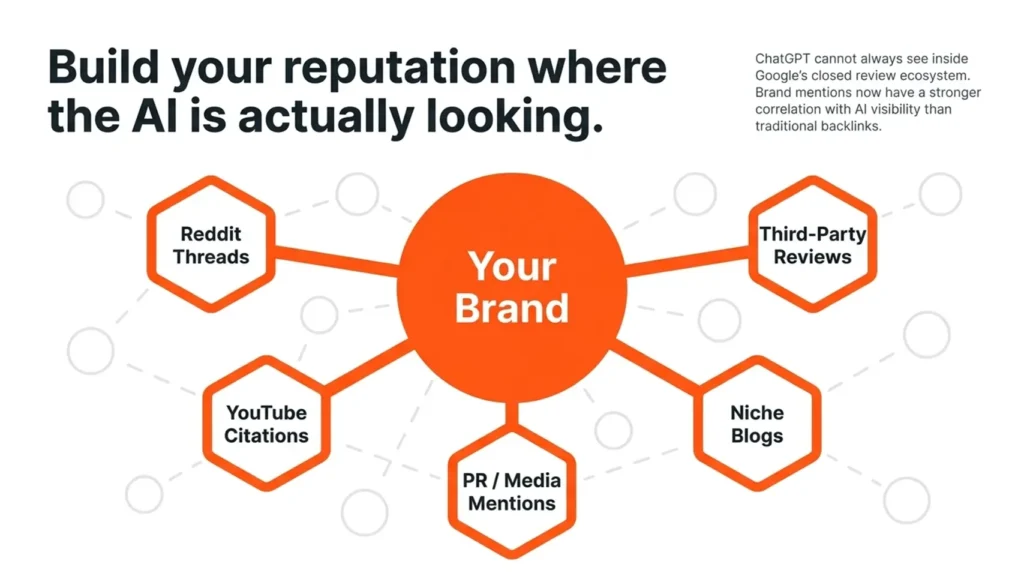
Content on a business’s own website is only half the picture. Authentic customer reviews, membership of relevant trade or professional organisations, and genuine local media coverage all provide the kind of external validation that neither Google nor Bing can find anywhere else, and that no amount of on-site content alone can replace.
Mistakes That Undermine AI Trust
Chasing volume over reliability
Publishing twenty low-value articles a month rarely builds trust; it more often creates duplication, factual drift, and a maintenance headache that never gets addressed. A sustainable publishing rhythm should prioritise reliable quality and a properly maintained archive over sheer quantity.
Mass-produced location pages
Creating near-identical pages for every nearby town or suburb, differing only in the place name, produces thin content that neither helps readers nor earns AI trust. Fewer, substantial pages backed by real service coverage and genuine local knowledge tend to perform far better.
Overclaiming guaranteed AI results
Phrases promising guaranteed citations in ChatGPT, a “number one” ranking in AI Overviews, or guaranteed AI visibility through schema markup alone should be treated with scepticism. Google has been explicit that the links and responses shown in its AI features can vary by system and by query, and no legitimate provider can promise a fixed outcome.
Measuring Whether Publishing Builds Trust
Judging whether a publishing strategy is actually working requires looking beyond simple traffic numbers. Google launched a dedicated Generative AI performance report inside Search Console during 2026, giving site owners visibility into how often their pages appear within AI Overview, AI Mode, and generative features in feed recommendations, broken down by page, country, device and date. Separately, Bing introduced its own AI Performance report, which tracks how often content gets referenced or shown as a source in AI-generated answers across Microsoft Copilot and related experiences.
Useful indicators to track alongside these reports include indexed page counts and crawl errors, impressions and clicks reported through Google Search Console, review volume and recency, and the proportion of priority pages that have been reviewed and kept accurate within a set period. None of these figures guarantee a particular AI outcome, but together they paint a much clearer picture than website visits alone.
Reliable Records Earn AI Recommendations
Warrington businesses that treat their published content as a maintained, factual record rather than a marketing afterthought put themselves in a far stronger position as AI-powered search continues to grow. The goal is to publish accurately, update promptly, and let genuine expertise show through in ways that both people and AI systems can verify. For a practical next step, consider building a structured content plan around the questions customers actually ask, keeping listings current, and letting real evidence do the talking.
| Topic / Area | Key Finding | Business Impact | Why It Matters |
|---|---|---|---|
| AI-feature eligibility | No special AI markup is required | Strengthen core SEO and crawlability | Existing search foundations remain commercially valuable |
| Content quality | Clear, factual answers improve retrievability | Better chance of relevant visibility | AI systems need reliable, unambiguous supporting information |
| Business-information consistency | Conflicting details weaken confidence | Maintain listings, services and contact details | Customers and systems need a dependable business record |
| AI visibility measurement | Search Console now reports AI-feature impressions | Identify pages appearing in AI results | Focus updates on visible, commercially important content |
| Measurement limitation | AI reports emphasise visibility, not outcomes | Combine data with leads and conversions | Impressions alone do not prove revenue impact |
Frequently Asked Questions
How often should a Warrington business publish content for AI search?
There is no fixed publishing target. Aim for a rhythm you can maintain while keeping every page accurate and useful. For many local businesses, one substantial piece each month plus regular updates to service pages, reviews and business listings is more valuable than frequent thin posts.
Do I need special schema markup to appear in Google AI Overviews?
No. Google says there are no additional technical requirements or special optimisations for AI Overviews or AI Mode. Your page must be indexed, eligible to appear with a normal search snippet, and meet standard Search technical requirements. Schema can clarify existing facts, but it is not a shortcut to citation.
What content is most useful for local customers using AI search?
Prioritise questions that help people make a decision: pricing factors, service availability, timescales, qualifications, common problems, local regulations and what happens during a job. Add specific, honest detail from your own work rather than publishing generic advice that could apply to any business.
Can customer reviews help a business appear more trustworthy in AI search?
Yes. Genuine reviews provide independent evidence that can reinforce claims made on your website, especially when they mention the service delivered, location, responsiveness or outcome. They should support—not replace—clear service information, accurate listings, case studies and demonstrable expertise on your site.
How can I tell whether my content is helping my AI-search visibility?
Track evidence rather than expecting a single “AI ranking” score. Monitor indexation, organic impressions, clicks, enquiries, review growth and updates to priority pages. Test the real questions customers ask, note which sources appear, and review whether your content offers clearer, better-supported answers than competitors.