
Summary
AI search tools such as ChatGPT, Google AI Overviews and Copilot are more likely to cite businesses that publish clear, specific and trustworthy information they can retrieve and verify. Improving citation opportunities means answering customer questions directly, keeping business information consistent across the web, allowing relevant crawlers access and supporting claims with reviews, third-party mentions and first-hand evidence.
Key Takeaways
- AI tools like ChatGPT, Google AI Overviews and Copilot cite sources that are retrievable, trustworthy, specific and genuinely useful when answering a question
- There is no fixed number-one spot in AI search results – citation visibility shifts depending on the question, location and freshness of information
- ChatGPT Search requires sites to allow the OAI-SearchBot crawler, which is a separate rule from the GPTBot crawler used for training data
- Pages cited within Google’s AI Overviews can earn noticeably more clicks than standard organic results, even though overall click-through rates on affected searches tend to fall
- West Pro Media Services notes that AI citation works best as an extension of established digital marketing habits rather than a separate shortcut
Getting a mention inside a ChatGPT answer or a Google AI Overview can feel like winning a raffle nobody explained the rules to. Some businesses seem to show up everywhere, while others with perfectly good websites never get a look-in. The reality behind this is far less mysterious than it appears, and understanding it can turn a confusing guessing game into a repeatable process.
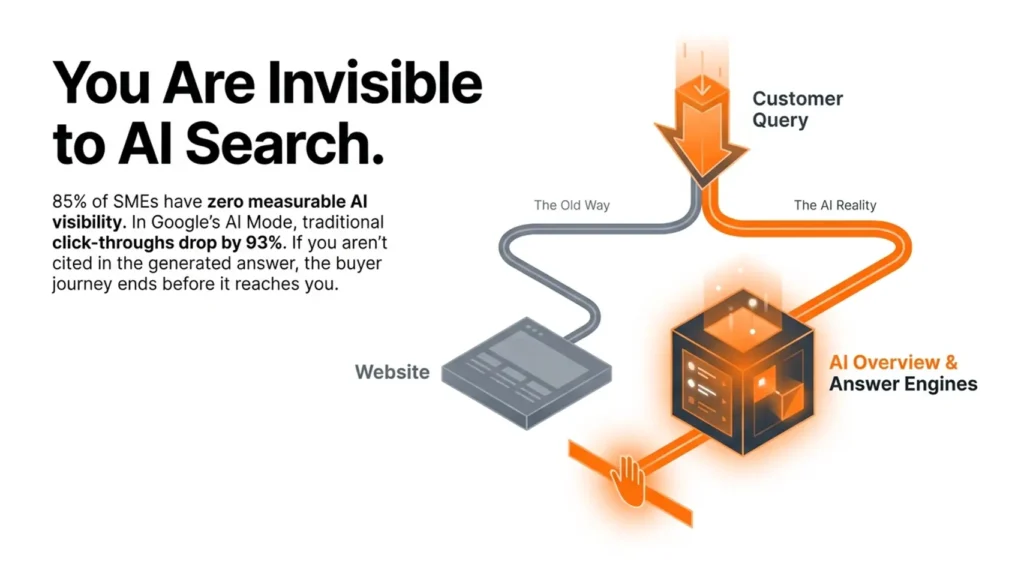
AI Rewards Trust, Not Rankings
Search engines used to work on a fairly simple idea: rank pages, show the best ones at the top, and let people click through. AI-powered tools such as ChatGPT, Google AI Overviews and Microsoft Copilot work differently. Rather than presenting a list of links for a person to sift through, they read across many sources, pull out the most useful facts, and write a direct answer, then choose which sources to show as supporting evidence.
That shift matters because a page can rank well in traditional search yet still be ignored by an AI system, simply because it does not meet the AI’s separate bar for clarity, verifiability and trustworthiness. Being findable is no longer enough on its own; a source now needs to earn its place inside someone else’s generated answer. West Pro Media Services works with businesses on exactly this shift, treating AI citation as a natural next step from sound content marketing and local search practice rather than a separate discipline to be bolted on.
This is why authority in the AI era gets defined differently. A source becomes trustworthy to an AI system when its information lines up consistently across several reliable places and can be reused without much risk of being wrong. That is a different test to ranking position, and it explains why some smaller, highly specific pages get cited over larger, more generic competitors.
How AI Systems Pick Their Sources
Before worrying about tactics, it helps to understand the mechanics behind an AI answer. Every citation starts with a process most people never see, running in the background between a question being typed and an answer appearing on screen.
The Retrieval-and-Grounding Process Explained
AI search tools commonly follow what is known as a retrieval-and-grounding process. A user asks a broad or conversational question, and the system expands it into several related sub-queries, a step Google refers to as query fan-out. From there, the system retrieves material it judges relevant, recent and authoritative, synthesises that material into a written answer, and finally selects the links used to support or verify what it has said.
This matters because a single search term rarely tells the whole story. A question like “best accountant for a small business in Bolton” might be broken down into sub-queries covering pricing, qualifications, reviews and local presence, each pulling in different evidence from different sources. A business that only answers one of those angles is less likely to be woven into the final answer than one that addresses several.
Why There’s No Permanent ‘AI Rank #1’
Because every answer is built fresh from a fan of sub-queries, there is no fixed leaderboard to climb. Citation visibility is probabilistic, tied to the exact wording of a question, and can shift with location, device, the freshness of competing content and even routine model updates. Bing has been explicit about this, describing citation activity as something shaped by evolving models, freshness, user demand, competing content and partner refresh cycles, rather than a stable ranking table.
That unpredictability can feel frustrating for anyone used to tracking a keyword position day by day. The more useful aim is building a body of trustworthy, specific content that keeps showing up across many different question variations, rather than chasing a single “winning” page.
The Factors Behind Citation Opportunity
No AI platform publishes a full formula for how it picks citations, but patterns are consistent enough across ChatGPT, Google AI Overviews and Copilot to draw out clear priorities.
Crawlability, Structure and Technical Access
A page cannot be used as evidence if the systems doing the retrieving cannot reach it in the first place. That means the basics of technical SEO still matter enormously: correct robots.txt settings, clean indexing, working sitemaps, and content that renders properly rather than hiding behind heavy JavaScript. Restrictive snippet controls, such as an accidental `nosnippet` tag or an overly tight `max-snippet` setting, can quietly block a page from ever being eligible, even when everything else about it is strong.
Structure plays a supporting role too. AI systems tend to favour content broken into clear, answer-led sections with descriptive headings, because that structure makes it far easier to extract a specific fact or explanation without misreading the context around it. Long, meandering paragraphs that bury the answer several sentences in are much harder for a retrieval system to use confidently.
E-E-A-T, Entity Consistency and External Validation
Trust signals that Google has talked about for years under the E-E-A-T banner (experience, expertise, authoritativeness, trustworthiness) carry directly into AI citation decisions. Named authors, visible credentials, accurate sourcing and consistent editorial standards all reduce the risk that an AI system takes on when it repeats a claim to a user.
Entity consistency is just as important. AI tools need confidence about who a business actually is: its name, location, services and credibility, and that confidence builds when the same details appear consistently across a business website, its Google Business Profile, review platforms and any trade directories it belongs to. External validation, in the form of independent reviews, editorial coverage or industry recognition, then acts as corroborating evidence that a business is genuinely who it says it is, rather than simply what it claims about itself.
Why ‘Citable’ Beats Merely ‘Optimised’
A page can be technically flawless and still fail to earn a citation if it says nothing an AI system could not already summarise from a dozen other similar pages. Generic “10 tips” content, written in a familiar template with no distinctive detail, is easy for a model to paraphrase without crediting any particular source.
Content becomes citable when it carries a clear, defensible contribution: first-hand experience, primary data, or a genuinely specific example that could not simply be recreated from common web knowledge. A tradesperson explaining the real cost drivers behind a job in their local area, backed by actual project figures, is far more useful to an AI system than a vague article repeating industry platitudes. This distinction between merely optimised and genuinely citable content is arguably the single biggest lever a business has control over.
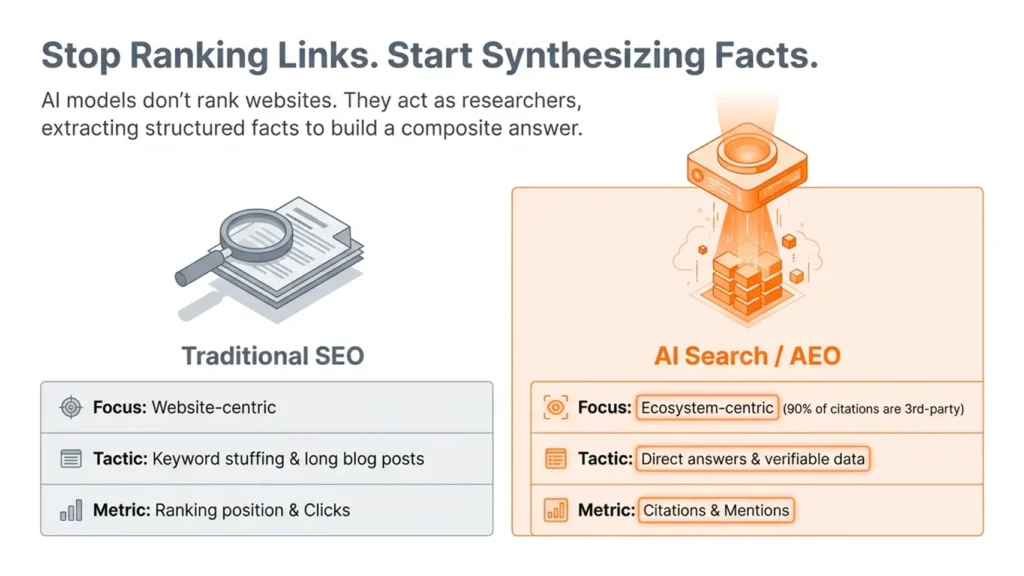
What Each AI Platform Actually Requires
General principles are useful, but each major AI search tool has its own technical quirks worth knowing before assuming a strategy will work everywhere at once.
ChatGPT Search and the OAI-SearchBot Rule
For ChatGPT Search, the most concrete technical requirement concerns crawler access rather than content style. OpenAI uses a crawler called OAI-SearchBot specifically to surface websites within ChatGPT’s search features, and sites that opt out of this crawler simply will not appear in search-grounded answers, even if they might still show up as a navigational link elsewhere. Importantly, this is a separate setting from GPTBot, which OpenAI uses for training its underlying models, so a business can choose to allow search visibility while still restricting how its content is used for model training.
Allowing OAI-SearchBot removes a barrier to eligibility, though it guarantees nothing on its own. ChatGPT can rephrase a user’s question into several targeted searches and draw on multiple sources depending on what the answer requires, so ongoing monitoring of how a business is represented matters more than a single successful test.
Google AI Overviews and AI Mode Eligibility
Google has been unusually direct about this one: there are no separate technical requirements or special AI-only markup needed for a page to appear in AI Overviews or AI Mode. A page simply needs to be indexed and eligible to show a normal search snippet, meaning the fundamentals of good SEO practice, crawlability, accurate structured data, mobile usability and clear content, continue to do the heavy lifting.
Google has also pushed back publicly against several popular shortcuts, stating that businesses do not need special AI markup files, forced content “chunking,” or artificially inflated numbers of long-tail pages to appear in its generative features. Structured data still carries its normal SEO value, particularly for rich results, but it functions as a supporting signal rather than a dedicated switch for AI citation.
Copilot’s Bing-First Citation Pipeline
Microsoft Copilot grounds its web answers in Bing’s search index, which makes visibility in Bing itself the non-negotiable first step; nothing else matters until a page is properly indexed there. Citations in Copilot appear as numbered inline references tied back to Bing search results, and selection happens at the level of individual content chunks rather than whole pages or overall site rankings.
Bing has also given site owners a genuinely useful new tool for tracking this. Bing Webmaster Tools launched an AI Performance report that shows where and how often content gets cited across Copilot, Bing’s AI-generated summaries and select partner experiences, breaking results down by Intents, Topics, Citation Share and period-over-period Compare data. Bing has been careful to describe Citation Share as an observational metric rather than a quality score or competitive ranking, which is a useful distinction to keep in mind when reading the report.
Why AI Traffic Converts Higher
The visitors who do click through from an AI answer tend to behave differently to typical organic search traffic. An analysis of AI citations and browsing sessions for B2B technology companies found that AI search traffic converted at roughly 14.2%, compared with 2.8% for traditional organic traffic – a gap wide enough to change how a marketing budget should be prioritised.
There is a sensible explanation behind that gap. Someone who reaches a website after an AI tool has already summarised several options, compared features and answered basic questions is usually further along in their decision-making than someone typing a first exploratory search term. They have effectively already done their initial research through the AI conversation, so a click at that stage tends to represent genuine, qualified interest rather than casual browsing. Overall organic click-through rates on AI-affected searches have fallen sharply as AI Overviews answer more queries directly on the results page, but pages that do get cited within those AI Overviews have been shown to earn noticeably higher click-through than standard organic listings, which helps explain why fighting for a citation is worth the effort even as overall traffic patterns shift.
Mistakes That Undermine AI Visibility
Even well-intentioned efforts to chase AI citations can backfire when they misread what these systems actually reward.
Treating Citation as a Hack, Not Strategy
Buying low-quality mentions, mass-producing near-identical pages, or stuffing content with “best” and “top-rated” language rarely produces lasting results. These tactics might create brief noise, but they do not build the kind of durable evidence an AI system needs before it trusts a source enough to cite it repeatedly. Google has specifically rejected inauthentic mention-building and high-volume page production aimed purely at manipulating generative results, treating both as tactics that undermine rather than support genuine visibility.
Confusing citation with endorsement is a related trap worth avoiding. Appearing in an AI answer does not automatically mean the AI is recommending a business; it may simply be one source among several, or referenced for a narrow supporting fact. Tracking how a brand is described, not just whether it appears at all, gives a far more accurate picture of AI visibility than counting citations alone.
Blocking Crawlers and Over-Investing in Schema
It is surprisingly common for businesses to unintentionally block the very crawlers they need. Overly broad security tools, restrictive CDN settings, or a misconfigured robots.txt file can quietly shut out OAI-SearchBot, Bingbot or Googlebot without anyone realising until visibility drops. Reviewing crawler access on a regular basis is a small task with an outsized payoff.
Schema markup deserves a similarly balanced view. It remains genuinely useful for normal search features and rich results, but it cannot make a thin, generic page suddenly authoritative, and neither Google nor other major platforms treat it as a dedicated AI-citation switch. Time spent perfecting schema on weak content is generally better redirected to strengthening what that content actually says.
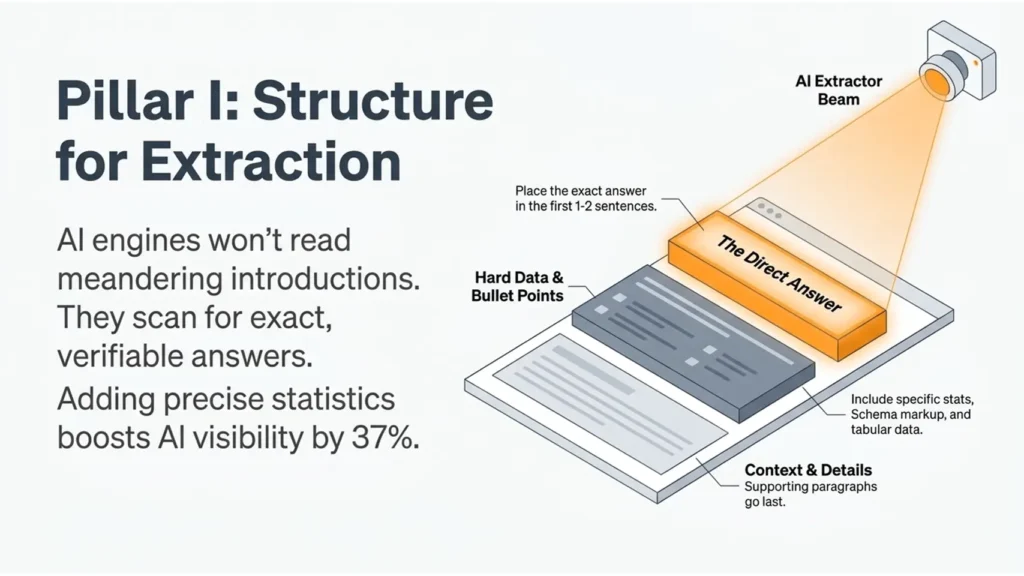
AI Citation Is Just Sound Marketing Extended
Stripped of the jargon, getting cited by AI search tools comes down to the same principles that have underpinned good digital marketing for years: be easy to find, be honest about what makes a business genuinely different, and give people, and now machines, real reasons to trust what is being said. None of the platform-specific rules covered here replace SEO, digital PR, local optimisation or authentic customer reviews; they simply add a new layer on top of habits that were already worth building.
Businesses that treat AI visibility as an ongoing extension of their existing marketing rather than a one-off technical fix tend to see steadier results over time, because the underlying work, clear content, consistent business information and real external validation, keeps paying off across every channel, not just inside an AI-generated answer. For a practical next step, reviewing how discoverable and verifiable a business currently appears across search and AI visibility services is a sensible place to begin closing any gaps.
| Topic / Area | Key Finding | Business Impact | Why It Matters |
|---|---|---|---|
| AI Overview click behaviour | Traditional-result clicks fall when AI Overviews appear | Informational traffic may decline despite strong rankings | Citation visibility becomes more valuable than rank alone searchengineland |
| Cited-page performance | Cited pages receive more clicks than uncited results | Prioritise pages answering high-intent customer questions | Citations can preserve qualified traffic in AI-led journeys searchengineland |
| ChatGPT search access | OAI-SearchBot access is required for ChatGPT Search inclusion | Audit robots.txt, CDNs and bot-blocking rules | A blocked crawler removes an otherwise strong eligibility route |
| Copilot measurement | Bing reports citations, cited pages and citation share | Track cited URLs, intents and content gaps monthly | Measurement turns AI visibility into a manageable programme blogs.bing |
| Citation versus rankings | Citation Share is not a quality or rank score | Avoid treating one appearance as lasting market leadership | AI visibility changes by query, freshness and user intent. |
Sources
Frequently Asked Questions
How can I check whether ChatGPT or Google AI Overviews mention my business?
Search for the questions customers would realistically ask, including your service, area and buying need—for example, “best loft conversion company in Bolton” or “accountants for small businesses in Bolton.” Record whether you appear, which sources are cited and how the answer describes you. Repeat periodically, because AI answers change.
Do reviews help my business get cited in AI search results?
Yes, but reviews are supporting evidence rather than a shortcut. A consistent pattern of detailed, genuine reviews can reinforce claims about service quality, location and customer experience. They work best alongside accurate business information, useful website content and independent mentions—not as a replacement for them.
Should I create separate pages for every question customers ask?
Create pages only where you can give a distinct, genuinely useful answer. Avoid producing dozens of thin pages that repeat the same information with slightly altered wording. Prioritise high-intent questions about costs, process, suitability, local considerations, results and common objections, backed by your own experience.
Is schema markup required for ChatGPT, Google AI Overviews or Copilot citations?
No. Schema can help search engines understand key information and may support rich-result eligibility, but it does not guarantee an AI citation. Clear page copy, crawlability, factual accuracy, first-hand evidence and trusted third-party validation remain more important than adding AI-specific markup.
How long does it take to start appearing in AI-generated answers?
There is no reliable timetable. Technical fixes may remove an immediate barrier, but earning citations often takes longer because platforms need to crawl, index and assess your content alongside external signals. Expect gradual progress as you publish stronger evidence and build credible mentions over time.