Summary
Yes, eligible UK businesses can now claim a business profile in ChatGPT through ChatGPT’s Business Hub, particularly online and ecommerce businesses where verification is supported. However, this is not yet a universal UK equivalent of Google Business Profile. Local shops and restaurants are currently restricted to existing US listings, and Business Agents remain limited to eligible US businesses. Claiming verifies ownership and enables profile management, but does not guarantee recommendations or higher placement.
Key Takeaways
- Eligible UK online and ecommerce businesses can apply through ChatGPT Business Hub.
- UK local shops and restaurants cannot generally create new local profiles at present.
- Verification may involve business email, telephone, DNS, Shopify and Persona identity checks.
- A verified profile does not guarantee recommendations, rankings, clicks or sales.
- Business Hub insights are aggregated and do not reveal individual customer prompts.
Eligible UK Businesses Can Claim a ChatGPT Profile, But Access Varies
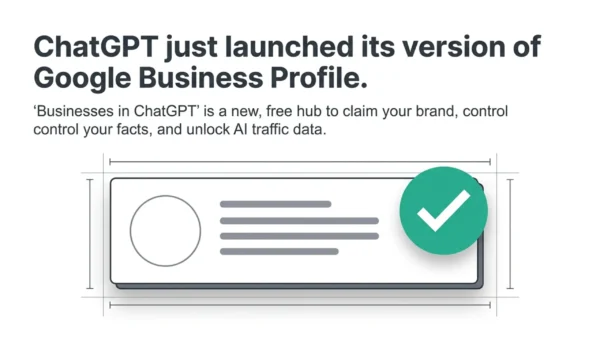
Yes, some UK businesses can now claim their business profile in ChatGPT through Business Hub. OpenAI introduced the feature in beta on 10 November 2026, creating an official process for owners and authorised representatives to claim eligible businesses.
That does not mean every UK company can claim a profile immediately. Eligibility depends on the type of business, its location and whether the required verification methods are available.
The current system should not be treated as a universal UK equivalent of Google Business Profile. OpenAI’s detailed guidance currently allows local shops and restaurants to claim existing US listings, but does not provide the same general local-profile access for UK businesses. Online and ecommerce businesses are the clearest UK beneficiaries of the initial rollout.
A business that cannot claim or add a profile today may therefore be affected by category restrictions rather than an error in its application. OpenAI says it plans to expand the service, but the available guidance does not provide a firm date for wider UK local-business access.
What does claiming a profile actually mean?
Claiming a profile means confirming that you own or are authorised to represent the business. Once the claim and relevant identity checks have been approved, the business can manage information shown through its ChatGPT business presence.
The profile may display a blue check after Persona identity verification has been approved. That check indicates that the profile has been claimed and verified. It is not an endorsement of the company’s quality, pricing, reputation or comparative standing.
This distinction matters because profile verification, appearing in a ChatGPT answer and being recommended to a customer are separate events.
Are Business Profiles and Business Agents the same thing?
No. A Business Profile allows an eligible company to manage approved information about itself. ChatGPT can still use other sources when answering questions, and its independent recommendations remain outside the business’s direct control.
A Business Agent is a separate experience in which an eligible company can provide a clearly labelled business conversation about products, services or policies. Business Agents are currently restricted to eligible US ecommerce and online-service businesses with a website. UK profile access does not mean that a UK company can publish an Agent.
How a UK Business Can Apply Through Business Hub
The process starts by signing in to ChatGPT on the web and opening Business Hub from the sidebar. The business can then be searched by name. If the correct listing is available, the applicant selects it and confirms which account will manage the profile.
For an eligible online business that does not appear, ChatGPT may offer an option to add it. If the profile is locked or has already been claimed, the applicant may need to contact OpenAI support or use the ownership-dispute process.
Which verification methods are available?
The available method depends on the business and what ChatGPT offers during setup. Verification may involve a code sent to a business telephone number, a code sent to an associated business email address, a TXT record added to the company’s website domain or a connected Shopify store.
These methods establish a connection between the applicant and the business. They are not necessarily a substitute for the later identity check.
After the claim process, Persona identity verification may be required to unlock publishing changes, product feeds and insights. This can involve government-issued identification, company registration details and evidence that the applicant is authorised to act for the business.
Submitting documents does not automatically mean the claim will be approved. OpenAI says review times vary, so businesses should not promise a fixed approval period to internal teams or clients.
Can an agency manage a client’s profile?
Yes, the administrator who claimed the business can add teammates and grant agency access where the relevant options are available. Each person should use their own ChatGPT account rather than sharing login credentials or forwarding personal claim invitations.
This makes agency access an authorised-user arrangement, not a transfer of ownership. The business should retain control of the primary administrator account and ensure that access is removed when a supplier’s work ends.
Businesses with several branches should also be careful. Claiming the main brand does not automatically claim every location. Separate brands and locations may need to be handled independently, depending on how they are represented in Business Hub.
What Information Can a Verified Business Manage?
Once the claim and identity verification process is complete, OpenAI says businesses can manage information such as their website, description, product or service category, logo and optional cover image.
Businesses may also be able to provide delivery, returns and other commercial policies. Retailers can connect product information through Shopify or a CSV feed that meets OpenAI’s requirements. Product feeds can provide information about prices and availability, but they do not create a Business Agent or guarantee that ChatGPT will recommend those products.
The information should be accurate, current and consistent with the business’s actual offering. Descriptions should explain what the company does, where it operates and any material restrictions. Claims about qualifications, prices, results, availability or delivery should be supported by evidence and kept up to date.
OpenAI reviews and publishes changes, so edits may not appear immediately. A profile update also does not automatically correct every ChatGPT answer. ChatGPT can continue to draw on websites and other sources when responding to questions about the company.
There is an additional publishing risk. OpenAI’s guidance says only unpublished draft profiles can be deleted. A published profile cannot necessarily be deleted, unpublished or hidden through a standard business setup or ownership request. Where Persona verification is used to create a new profile, approval automatically publishes it. Businesses should therefore review their information carefully before submitting it.
Does Claiming a ChatGPT Profile Improve Recommendations?
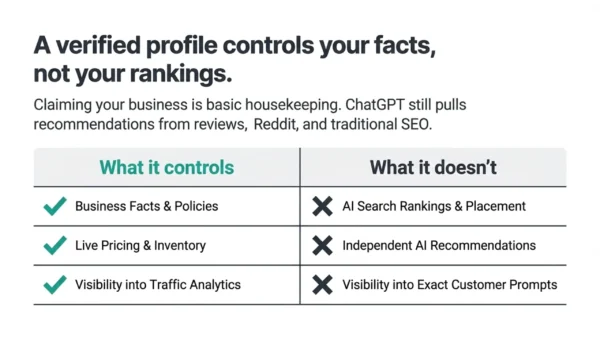
No. Claiming a profile, completing verification or connecting a product feed does not guarantee higher placement, more recommendations, increased traffic or sales.
OpenAI describes its search systems as trying to surface relevant and reliable information. It does not publish a complete formula showing how businesses are selected or ordered in every answer. Local results can also vary according to the user’s approximate IP-based location and, where enabled, more precise device location.
A business should therefore treat Business Hub as an information and measurement channel, not as a ranking purchase.
The company’s website remains important. OpenAI advises businesses to avoid unintentionally blocking OAI-SearchBot through robots.txt, hosting controls, firewalls or content delivery network settings. Allowing the crawler to access a website makes the site eligible for retrieval; it does not guarantee that ChatGPT will cite or recommend it.
Clear service pages, accurate location information, useful product details, transparent policies and evidence-backed claims can make a business easier to understand. These are sensible customer-information practices, but they should not be presented as a guaranteed algorithmic formula.
Independent research from Ahrefs has found relationships between ChatGPT visibility and some forms of off-site brand coverage. However, those findings are observational and do not prove that a particular mention type causes higher visibility. They also do not show that claiming a Business Hub profile produces an increase. Businesses should avoid buying arbitrary mentions or manufacturing online discussion in the hope of influencing ChatGPT.
How Should Businesses Measure Results?
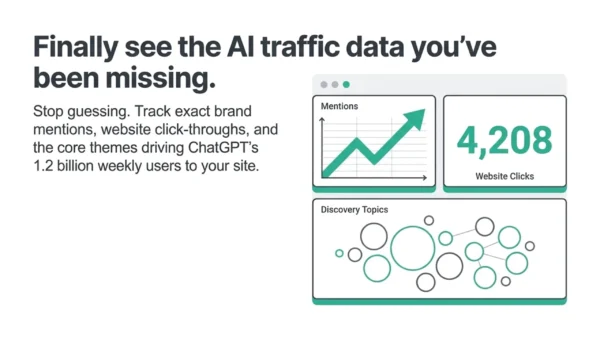
Business Hub provides aggregate engagement information rather than a record of individual conversations. Reporting covers activity over a rolling 28-day period and may include website references, clicks and broad discovery topics.
The meaning of “mention” depends on the type of business. For an online business, OpenAI defines it as ChatGPT referencing the business website. A plain-text mention of the brand without reference to the website may not count. For a local business, a mention can refer to ChatGPT showing a result for that location, even if the user does not open the listing.
Businesses do not receive individual customer prompts or private conversation transcripts. Metrics may also remain blank when activity has not reached the relevant reporting threshold, so a blank report should not automatically be interpreted as zero demand.
Internal reporting should distinguish between a business being named, a website being cited, a business being positively recommended, a website click and a resulting enquiry or sale. These are different outcomes. A third-party article that mentions a company is also not the same as ChatGPT citing the company’s own website.
For meaningful comparisons, businesses should record the prompt, date, location context, whether web search was used and the response evidence. Local results can change depending on where the user is located and how ChatGPT interprets the request.
What Should UK Businesses Do Now?
Online and ecommerce businesses should first check Business Hub rather than relying on older articles that say business claiming is unavailable. They should prepare a business email, telephone access, domain DNS access and company-registration information where applicable.
Before submitting a claim, the company’s name, contact details, service descriptions, policies, opening information and website content should be checked for accuracy. Product businesses should also review feed data, stock information, prices, product names and returns policies.
Website access should be checked so that OAI-SearchBot is not being blocked unintentionally. The business should also continue maintaining its wider web presence, because ChatGPT may use other sources and a verified profile does not replace independent evidence.
UK shops, restaurants and offline service providers should check their actual Business Hub eligibility rather than assuming that a profile can be created because the business operates in the UK. If the relevant option is unavailable, the sensible approach is to monitor official expansion and maintain accurate information on the company website and established business platforms in the meantime.
Research Insights
| Topic / Area | Key Finding | Business Impact | Why It Matters |
|---|---|---|---|
| Business Hub launch | Beta launched on 10 November 2026 | Claiming mechanism now exists | Older “not possible” advice is outdated |
| UK eligibility | Online businesses may claim where supported | Check category and verification access | Access is not universal across UK businesses |
| Verification | Phone, email, DNS and Shopify options | Ownership can be established | Persona approval may still be required |
| Business insights | Aggregate reporting covers 28 days | Tracks mentions, clicks and topics | Metrics do not reveal individual prompts |
| Recommendations | Claiming provides no placement guarantee | No assured traffic or sales | Profile control differs from ranking control |
Sources
OpenAI Help Centre – Setting up your business on ChatGPT
OpenAI – Introducing Businesses in ChatGPT
OpenAI Help Centre – ChatGPT release notes
OpenAI Help Centre – Searching the web with ChatGPT
Frequently Asked Questions
Do I need a ChatGPT Business subscription to claim a business profile?
Not necessarily. ChatGPT Business is a separate workspace product, and the claiming guidance does not say that an Ads account or Enterprise agreement is required. However, businesses should check the current Business Hub onboarding terms rather than assuming that every feature or access route is free.
What happens if somebody else has already claimed my business?
If another party has claimed the profile, use the ownership-dispute option available from the profile menu or contact OpenAI support if the listing is locked. You may need to complete Persona verification and provide evidence that you are authorised to represent the business.
Can a marketing agency claim a client’s profile?
The client should normally retain primary ownership, then invite the agency or its named staff through the available access controls. Agency users should use their own accounts. Sharing passwords or forwarding personal claim invitations can create avoidable ownership and security problems.
Why are my Business Hub metrics blank?
Business Hub reports aggregate activity and may apply reporting thresholds for privacy. A blank metric does not necessarily prove that there was no activity. Reporting also depends on the type of business and whether ChatGPT recorded a qualifying website reference, result or click.
What can a UK local business do if it cannot claim a profile?
Check Business Hub periodically because eligibility may expand. In the meantime, keep the company website, location details, opening information, services, policies and contact details accurate. Ensure the site remains accessible to relevant search crawlers and maintain reliable third-party business information.
