
Summary
FAQ Content is more likely to be understood and referenced when each question reflects a genuine customer need, the answer begins with a clear conclusion, and the passage remains accurate and self-contained. Place relevant FAQs on the pages where readers need them, use descriptive headings, make the content technically accessible, support important claims with evidence and measure citations separately from traffic and enquiries.
Key Takeaways
- Write each FAQ as a self-contained answer that makes sense outside the page’s wider context.
- Put the direct answer first, then add conditions, evidence and useful detail.
- Use real customer questions and place them on relevant service, product or guide pages.
- Do not treat FAQ schema, fixed word counts or accordions as guaranteed AI visibility techniques.
- Measure citations, visits, enquiries and accuracy separately because visibility does not automatically create business results.
Make Every FAQ a Self-Contained Answer Unit
FAQ content can help AI systems retrieve and understand a business’s expertise, but the format itself is not a shortcut to inclusion in AI answers. The useful principle is simple: make every question-and-answer pair valuable to a person and understandable when extracted from the page.
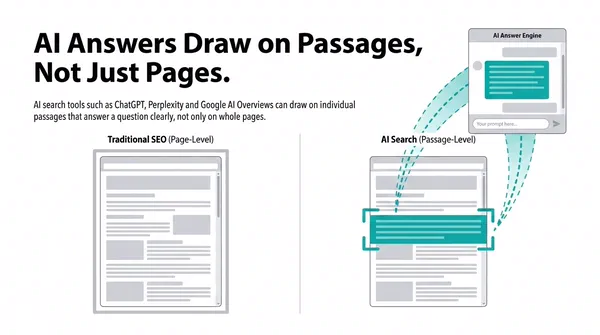
AI-powered search systems may retrieve specific passages rather than treating an entire URL as one indivisible block. A passage taken from the middle of a page therefore needs enough context to stand on its own. If an answer begins with “It depends” or refers to “the service mentioned above”, the extracted passage may be difficult to interpret accurately.
Put the conclusion immediately below the question
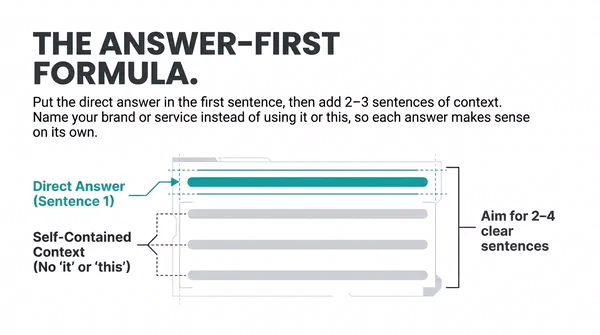
The first sentence should answer the question directly. The following sentences can explain conditions, exceptions, evidence or examples.
For example, a weak answer to “How long does a technical SEO audit take for an ecommerce website?” might begin with the agency’s history and general approach before eventually mentioning the timescale. A stronger answer begins by stating the expected duration, then explains that the number of product templates, technical complexity and size of the site can affect the work.
This answer-first structure helps readers scan the page and gives an answer engine a clear passage to interpret. It also prevents promotional language from obscuring the information the question actually requests.
The answer does not need to repeat the complete question awkwardly. It does need to name the subject clearly enough that the passage remains intelligible when separated from the heading.
Use specific entities instead of unexplained pronouns
Self-contained answers should identify the relevant business, service, product, location, tool or process where that information affects meaning.
“Our pricing includes this” is less useful than “West Pro Media Services includes initial content planning and distribution within the agreed MultiCasting scope.” The second version identifies the business, the service and the specific subject being discussed.
This does not mean inserting a brand name into every sentence. Excessive repetition makes content unnatural. The test is whether someone could read the answer without the surrounding page and still understand who or what it concerns.
Avoid phrases such as “our solution”, “this option”, “they usually”, “as explained above” and “the charge mentioned earlier” when they leave important meaning unstated. Explicit language also reduces the risk of an AI system attributing a general fact without connecting it to the correct business or service.
Do not force every answer into an arbitrary length
There is no confirmed universal word count that makes an FAQ answer eligible for AI citation. Short questions may need only a sentence or two. A more complex question may require a fuller explanation, a comparison or a link to a dedicated guide.
A concise opening followed by relevant supporting detail is a sensible editorial pattern. However, claims that every answer must contain 40–80 words, or that answers outside a particular range will be ignored, go further than the available platform guidance supports.
The right question is whether the answer is complete enough for the reader’s decision. If an answer needs several paragraphs to explain exclusions, legal limitations, pricing assumptions or technical requirements, compressing it merely to meet a supposed AI limit can make it less useful.
Choose Questions from Real Customer Needs
The quality of an FAQ section depends more on the questions selected than on the presence of the word “FAQ” or the use of structured data.
Start with the questions customers ask before choosing a provider, buying a product or taking the next step. These questions often reveal uncertainty about suitability, scope, price, timescales, risk, alternatives and what happens after purchase.
Mine the language customers already use
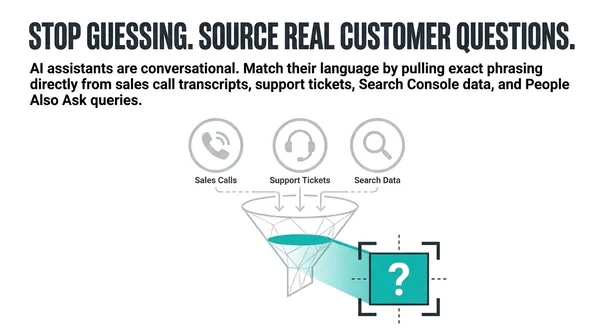
Useful sources include sales call notes, support tickets, enquiry forms, chat transcripts, customer interviews and internal site-search data. Search Console can reveal questions that already lead people to the website. Bing’s AI reporting may also provide sampled grounding queries associated with cited pages where that data is available.
Community discussions can reveal how people describe a problem in ordinary language, although those discussions should be checked against the business’s actual customers and expertise. The aim is not to copy every phrase people use. It is to understand the underlying information need.
A practical workflow is to collect questions, combine duplicates, remove questions that the business cannot answer reliably and assign the remaining questions to the page where they are most useful. This prevents the same generic FAQ from being copied across multiple service pages.
Make questions descriptive rather than artificially keyword-focused
A question should contain enough context to be understood on its own. “How long does it take?” is vague. “How long does a technical SEO audit take for an ecommerce website?” tells the reader and the retrieval system what the answer concerns.
Specificity is useful when it changes the answer. It is not useful to create separate pages for every minor wording variation, location variation or keyword permutation when the underlying answer is identical. Search systems can generally understand related meanings and synonyms without requiring businesses to publish repetitive question sets.
Avoid manufactured questions that exist only to promote the business. “Why are we the leading provider in our region?” is not a genuine customer information need unless customers actually ask it and the business can support the claim independently.
Cover the questions that help a decision
A strong FAQ section should do more than answer low-value factual queries. It should help a prospective customer decide whether the service is suitable and what they should expect.
For a service business, that might mean explaining who the service is for, what is included, what is excluded, how the process works, what affects the price, how long delivery usually takes and what information the customer needs to provide. A well-chosen question can remove an objection while also demonstrating the business’s knowledge.
This is where useful FAQ content becomes part of a broader authority asset. The objective is not simply to answer the questions people ask. It is to answer the questions that help them make a sensible decision.
Place FAQs Where Their Context Is Strongest
A large, disconnected FAQ page can be useful as a support resource, but it should not automatically be the main home for every question on a website.
A question about the suitability of a service belongs naturally on that service page. A question about implementation may belong in a technical guide. A question about delivery or aftercare may be most useful near the relevant process or pricing information.
Use page-specific FAQ sections for page-specific decisions
A focused group of questions can reinforce the subject of an existing page without replacing the main explanation. The page should still explain its service, product or topic properly; the FAQ section should address the additional questions that commonly arise around it.
There is no universal requirement for a particular number of questions. As an editorial starting point, a small group of highly relevant questions may be more useful than dozens of loosely connected ones. The research commonly identifies three to eight targeted questions as a practical range, but that is a planning guideline, not a ranking threshold.
A dedicated FAQ or help hub remains appropriate when visitors need a broad reference library. In that case, organise questions by subject and provide clear links to more detailed pages. Do not use a central hub as an excuse to remove useful context from service and product pages.
Plan for related searches without producing repetitive pages
Google describes query fan-out as a process in which related searches may be used to explore different aspects of a broad question. A person asking about a service may also need information about price, suitability, time, limitations and alternatives.
This supports building a coherent cluster of related answers. It does not support creating a separate page for every possible wording of the same question. The better approach is to cover meaningful subtopics within a logical information architecture and link between the pages where greater depth is needed.
Internal links help search systems and readers discover related information. They also make it easier to direct a reader from a concise FAQ answer to a detailed case study, service explanation or technical guide.
Make the Content Clear and Technically Accessible
Good writing cannot be retrieved if the relevant content is inaccessible, blocked or difficult to identify.
Use a clear heading hierarchy, with the FAQ question in a meaningful H2 or H3 heading and the answer in ordinary paragraph text beneath it. Styled bold text may look like a heading to a visitor, but semantic headings communicate structure more reliably to browsers, assistive technologies and crawlers.
Treat accordions as a user-experience choice, not an automatic risk
Collapsible FAQ accordions can make a page easier to scan, particularly on mobile devices. Their use is not automatically harmful. The important question is how the answer text is delivered.
Check whether the answer exists in the page’s initial HTML or accessible document structure. If the page includes the content but hides it visually until a click, that is different from an implementation that fetches or injects the answer only after a user interaction. Client-side loading can make content harder for systems to process and can create accessibility problems if implemented poorly.
A practical check is to compare the page source with the rendered page and confirm that the complete answer is available without relying on a click-triggered request. JavaScript content is not automatically invisible to search systems, but complex rendering requires proper implementation and testing.
Keep important information in text
Prices, conditions, specifications, eligibility rules and limitations should not exist only inside images, videos or decorative interface elements. Text gives readers something they can search, copy, translate and verify.
Images, video and audio can add useful evidence and explanation, but they should support rather than replace the written answer where the information matters to a decision.
Also check the basics: the page should return successfully, important content should not be blocked by robots.txt or hosting rules, indexing directives should reflect the intended visibility, internal links should lead to the page and preview controls should not unintentionally limit reuse.
For ChatGPT search, OpenAI documents access for OAI-SearchBot as an eligibility consideration. Allowing the crawler to access a page does not guarantee that the page will be selected or cited.
Use Evidence and Original Expertise
A clear answer is more useful when it contains information that a knowledgeable business can substantiate.
Generic answers such as “our experts provide a tailored service” are easy to publish but offer little reason for an answer system—or a customer—to prefer them. Add the details that come from real experience: the conditions that change the recommendation, the mistakes customers commonly make, the assumptions behind a price or the signs that an alternative may be more appropriate.
Support consequential claims with nearby evidence. Depending on the subject, this could include a source, an explanation of the method used, a named author or reviewer, an example, a case study or a clearly stated limitation. Do not use unsupported statistics simply because a number makes an answer appear authoritative.
For a service business, authority is built through more than owned website content. FAQs and service pages establish what the business says about its expertise. Distribution across relevant channels can help more people discover those answers. Reviews, client references, case studies and independent mentions provide a separate layer of trust. These owned, distributed and independent forms of authority work together, but one cannot substitute completely for the others.
The principle is straightforward: if you never say useful information clearly, an AI system cannot accurately repeat it. But saying it once on a website is not the same as establishing that the business is a reliable source.
Understand What FAQ Schema Can and Cannot Do
FAQ content, FAQPage structured data and FAQ rich results are separate things.
Google’s supplied guidance says there is no special schema requirement for appearing in generative search. Google also retired FAQ rich results in 2026, so older advice promising expandable FAQ listings for commercial websites is no longer current.
That does not make clear FAQ content pointless. It means structured data should not be treated as a visibility switch or a guarantee of AI citation. If FAQPage markup is used where appropriate, it should accurately describe the questions and answers visible on the page. Do not place one version in JSON-LD and a different, shortened or embellished version in the HTML.
QAPage markup is intended for a page focused on a single question and its answers. It should not be substituted for FAQPage markup on a page containing multiple independent FAQs.
The page’s visible structure, usefulness, accessibility and evidence remain more important than adding a piece of markup because an older article recommended it.
Avoid the Shortcuts That Weaken FAQ Content
The first common mistake is burying the answer under promotional copy. A reader should not have to navigate a company introduction before discovering the response to a direct question.
The second is publishing synthetic questions that no genuine customer needs answered. FAQ sections should reduce uncertainty, not create opportunities for self-congratulation.
The third is duplicating identical FAQ blocks across several pages. Repetition can make pages less distinctive and may leave the reader unsure which version is authoritative. Rewrite an answer when the context genuinely changes, or link to the original explanation where it does not.
The fourth is allowing contradictions to accumulate. If a service page gives one timescale, a pricing page gives another and an FAQ gives a third, both people and AI systems have reason to distrust the content. Review prices, availability, policies, claims and technical advice when they change.
The fifth is assuming that a conventional organic ranking is either essential or irrelevant. Research into cited URLs has found overlap with standard search results, but it has also found cited pages outside the top 100 results for the original query. This means organic visibility and AI citation are related but not identical outcomes.
Measure Retrieval, Citations and Business Results Separately
Improving FAQ content should be treated as a testable editorial programme rather than a promise of inclusion.
Begin by recording the pages being changed, the questions being addressed, existing organic performance, referral visits, enquiries and relevant conversions. Note the date and nature of each change so later results can be interpreted properly.
Where available, Bing’s AI reporting can show cited pages and sampled grounding queries. These signals may indicate which topics and information needs are associated with visibility. They are not a direct quality score, ranking position or guaranteed measure of traffic.
Manual checks can add context. Record the platform, date, prompt, location where relevant and the cited page. Repeat checks over time rather than treating one answer as a permanent position. AI outputs can change because of model updates, search demand, freshness and competing sources.
Most importantly, separate three questions. Can the platform access and retrieve the content? Is the page appearing as a cited source? Is that visibility producing useful visits, enquiries, sales or assisted conversions?
Those outcomes should not be conflated. Pew Research found that traditional search results received fewer clicks when an AI summary appeared, and a cited link did not automatically receive a click. Being referenced can improve recognition without producing a measurable commercial result.
The strongest FAQ programme therefore combines useful answers, accurate technical implementation, evidence, distribution and ongoing review. The goal is not to manufacture a citation. It is to build a body of information that is easy to understand, worth trusting and available when a customer needs it.
Research Insights
| Topic / Area | Key Finding | Business Impact | Why It Matters |
|---|---|---|---|
| FAQ structure | No special AI schema or ideal length | Prioritise useful, accessible answers | Avoid formulaic optimisation |
| AI summary clicks | 8% with summaries; 15% without | Citations may not create visits | Visibility and traffic differ |
| Cited URL rankings | 37.1% top ten; 36.7% outside top 100 | Strong sources need not rank first | Organic rankings are not the whole picture |
| Bing AI reporting | Citation and grounding-query data available | Reveals topics linked with visibility | Supports measured testing |
Sources
Google Search: AI features and your website
Pew Research Center: Google users are less likely to click on links when an AI summary appears
Ahrefs: Do AI Overviews Cite Top-Ranking Pages?
Bing Webmaster Blog: Introducing AI Performance in Bing Webmaster Tools
Frequently Asked Questions
Should every service page have an FAQ section?
No. Add FAQs when genuine questions remain after the main page has explained the service clearly. A focused service page may benefit from a small relevant section, while another page may be clearer without one. Relevance and usefulness matter more than adding FAQs everywhere.
How can I find the questions customers genuinely ask?
Review sales calls, support conversations, enquiry forms, chat transcripts, internal site searches and Search Console queries. Group similar questions, remove duplicates and prioritise issues that affect suitability, cost, timing, risk or the customer’s next decision.
Should I publish the same FAQ on several related pages?
Usually not. Repeated blocks make pages less distinctive and can create conflicting maintenance problems. Keep the original answer on the most relevant page, adapt it only when the context changes the answer, and link to it from related pages.
How often should FAQ content be reviewed?
Review answers whenever prices, policies, availability, regulations, services or technical recommendations change. A broader review every six to twelve months can identify stale claims, contradictions, unanswered customer questions and opportunities to replace generic wording with clearer evidence.
Can FAQ visibility lead directly to more enquiries?
It can contribute to discovery and trust, but a citation does not guarantee a click or enquiry. Measure cited appearances separately from referral visits, enquiries, sales and assisted conversions to establish whether the content is producing useful business outcomes.
