
Summary
AI-generated answers are more likely to use your website when it is accessible to search crawlers, technically sound, clearly structured and supported by original, trustworthy information. Maintain strong SEO fundamentals, answer genuine customer questions directly, demonstrate first-hand expertise, keep business details consistent and build credible recognition beyond your own site. Measure citations, mentions, visits and commercial results separately because visibility does not guarantee traffic.
Key Takeaways
- Make important content crawlable, indexable, fast to access and available as readable HTML.
- Publish original, evidence-backed answers rather than large volumes of generic AI-written pages.
- Use clear headings, direct explanations and specific entities, facts, dates and limitations.
- Build recognition through accurate business information, credible third-party references and useful distribution.
- Track citations, brand mentions, referrals and enquiries separately; none guarantees inclusion or revenue.
Make the site accessible, useful and trustworthy
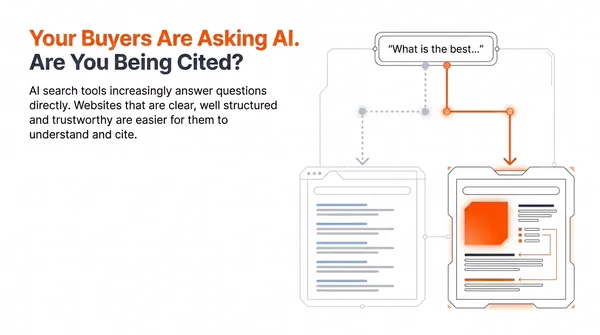
The most reliable way to improve your chances of appearing in AI-generated answers is to make your website accessible, genuinely useful and easy to verify. Technical SEO helps search and retrieval systems find your pages. Clear, original information gives them something worth using. A credible presence elsewhere helps confirm that your business and expertise are real.
There is no universal AI ranking formula, special writing style or guaranteed optimisation technique. Google describes optimisation for its generative search features as an extension of SEO, rather than a separate system requiring special files or hidden markup. Other services, including ChatGPT, Perplexity and Copilot, have different retrieval systems, crawler controls and reporting arrangements.
It is also useful to distinguish three possible outcomes. Your website may be cited as a source, your business may be mentioned or recommended, or someone may visit your site and become a prospect or customer. These outcomes overlap, but they are not the same. A citation does not guarantee a click, and a brand mention does not necessarily include a link.
Understand how AI systems use website content
Retrieval comes before answer generation
A simplified model is that a platform discovers and accesses content, retrieves information relevant to a question, and then uses selected material to construct an answer. The answer may include links to supporting pages, mention a business, or do both.
Google describes a process in which its systems retrieve relevant pages from the Search index to help ground generative responses. For a complex question, it may also explore several related aspects rather than searching only for one exact phrase. A question about choosing a contractor, for example, might involve experience, costs, insurance, planning, location and previous work.
This means a page does not need to repeat a customer’s prompt word for word. It does need to provide information that is relevant to one or more important aspects of the question.
Eligibility is not the same as selection
A page cannot be selected if a system cannot access or understand it. However, being accessible and indexed does not mean it will be cited. Retrieval systems have many potentially relevant sources from which to choose.
This distinction prevents two common mistakes. The first is assuming that a page which ranks well in Google will automatically appear in every AI service. The second is believing that technical changes alone can make a weak page valuable. Access creates an opportunity; useful evidence and clear communication give a system reasons to use the page.
Fix technical barriers before rewriting content
Check crawling, indexing and rendering
Begin by checking whether important pages are indexed and eligible to appear with a normal search snippet. Review Search Console for indexing problems, blocked resources, server errors and pages that are excluded unnecessarily.
Check robots.txt, XML sitemaps, internal links, canonical tags, noindex directives and any access restrictions imposed by your hosting provider, content delivery network or web application firewall. A page that works in a normal browser may still be inaccessible to a crawler because a security service blocks automated requests.
JavaScript also needs testing rather than assumptions. Google can process JavaScript when the necessary resources are available, but heavily client-rendered pages can be more complicated to crawl and render reliably. Important facts should not exist only after a user clicks a control, loads a script or interacts with a visual component. Put essential information in accessible, readable page content wherever possible.
Text embedded only in images, videos, inaccessible tabs or poorly structured documents is harder to retrieve and verify. Use descriptive HTML, meaningful headings, text alternatives for important images and internal links that make related pages discoverable.
Review crawler policies separately
Do not treat all AI crawlers as one category. OpenAI distinguishes between OAI-SearchBot, which is used for search discovery, and GPTBot, which relates to potential model training. A publisher can allow search access while disallowing training access, subject to the relevant technical configuration.
This is an important distinction because permitting content to be found in search is not the same as permitting it to be used for training a foundation model. Check the documentation for each platform you care about, and ensure that firewall and CDN settings do not override your robots.txt choices. OpenAI also advises publishers to account for its published crawler IP ranges, so changing a robots file may not resolve every access problem.
Google states that satisfying its technical requirements does not guarantee crawling, indexing or inclusion. Treat these steps as prerequisites, not promises.
Improve performance without chasing an invented threshold
AI crawlers and search systems need to process large volumes of information. A reliable server, efficient pages and sensible use of client-side scripts are therefore worthwhile. Use caching, compressed assets, suitable image formats and a dependable hosting configuration. Test performance from the locations that matter to your customers.
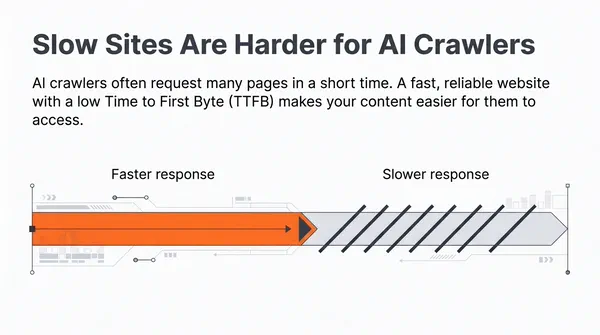
The research identifies concerns about regional delays and crawler timeouts, but it does not establish one universal response-time threshold for every AI platform. Avoid claims that a particular Time to First Byte figure guarantees citation. The practical objective is simpler: make the page respond promptly and deliver its meaningful content without unnecessary technical obstacles.
Create information an AI system has a reason to select
Answer the customer’s main question early
Lead with a direct answer before expanding into background, exceptions and detail. If a page answers “How much does a loft conversion cost?”, begin by explaining the relevant range or pricing factors. Do not make the reader or a retrieval system work through several paragraphs of general history before reaching the substance.
Question-based headings can help readers navigate and can make individual sections easier to understand. A heading such as “What affects the cost of a loft conversion?” should be followed by a self-contained explanation that answers that question directly.
This does not require forcing every paragraph into an artificial 40-word answer block. Google does not require a fixed answer length, and there is no reliable evidence that a particular word count or paragraph size unlocks AI visibility.
Make each section understandable on its own
AI systems may use a passage from the middle of a page rather than reproducing the whole article. Write substantial sections so they remain meaningful when read out of context. Name the subject, product, service or organisation instead of relying on vague phrases such as “we”, “this solution” or “it”.
For example, “West Pro Media Services distributes researched business content across publisher, podcast, video and social channels” is clearer in isolation than “We distribute it widely.” Explicit entities help both people and systems understand who is being discussed and what the statement means.
Use headings that describe the actual subject, explain relevant conditions and acknowledge limitations. A concise answer supported by evidence is more useful than a sweeping claim that leaves out the circumstances in which it may not apply.
Add evidence that can be checked
Generic claims are easy to reproduce and difficult to trust. Strengthen important statements with named sources, dates, measurements, examples, methodology or first-hand experience. Keep the basis of a statistic close to the statistic itself, and distinguish actual results from forecasts or illustrative examples.
For a service business, useful evidence might include a properly described case study, a project completed under particular constraints, an explanation of a difficult decision or a transparent account of what changed. For an ecommerce business, it might include clear specifications, compatibility information, delivery conditions, testing details and limitations.
Original research can be particularly valuable. A survey, benchmark or analysis should explain who was included, when it was conducted and how the findings were produced. A distinctive insight is more valuable than another article that restates widely available advice.
Avoid commodity content at scale
Publishing many pages that change only the wording of the same answer is unlikely to create meaningful authority. Google warns against mass-producing content primarily to manipulate search or generative responses. AI-assisted drafting is not automatically a problem, but the finished page needs human checking, genuine business knowledge and a clear reason to exist.
The strongest content usually comes from expertise already present in the business. Interviews with staff, customer questions, project records, product testing, reviews and real operational experience can supply details that generic writing cannot invent responsibly.
The objective is not to publish the greatest number of articles. It is to build a useful body of answers around the services, decisions and problems that matter commercially.
Build recognition beyond your website
Website optimisation is only one part of becoming easy to identify and trust. AI systems may use information from multiple sources when assessing a business, its services and its relevance to a question.
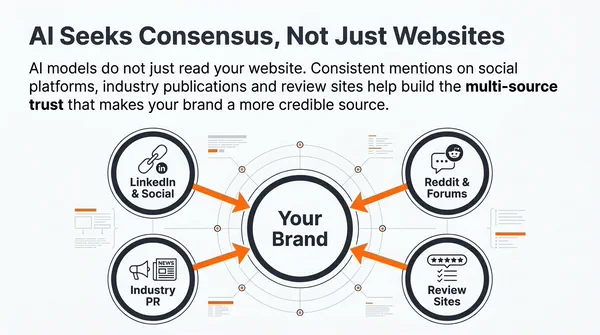
Maintain accurate descriptions wherever the organisation appears. Business names, service descriptions, locations, contact details, qualifications and product information should not contradict one another across your website, business profiles, directories, review platforms and social channels.
The research found associations between wider branded mentions and visibility in Google AI Overviews, but these are observational relationships rather than proof that buying mentions will cause citations. Findings also differ between studies and datasets. One study associated YouTube mentions particularly strongly with visibility, while a later study identified Reddit mentions in ranking discussions. That does not create a permanent channel hierarchy.
A sensible approach is to earn relevant recognition rather than manufacture it. Publish useful research, contribute transparently to industry communities, appear on appropriate podcasts or events, demonstrate your work where video genuinely helps, and seek editorial coverage based on something worth discussing. Distribution creates more opportunities for discovery; independent reviews, recommendations and references provide additional trust.
This can be viewed through three connected stages: recognition, relevance and recommendation. Recognition means a system can identify the business and connect it with the right subject, service or location. Relevance means the connection is supported by useful pages and consistent references. Recommendation requires a stronger basis, such as evidence, reviews, case studies and credible third-party support.
Adapt the work for local and ecommerce businesses
Local businesses need consistent real-world information
A local business should state clearly what it does, where it operates and which customers it serves. Keep the Google Business Profile accurate, including opening hours, contact details, categories and service information. Explain qualifications and accreditations precisely rather than using broad claims.
Local project evidence is more useful than creating dozens of near-identical location pages. A genuine case study can explain the location, the customer’s problem, the work completed and the outcome. Pages that simply replace one town name with another add little value and may create a poor experience.
A local visibility project for Career Garage illustrates the principle: the business established visibility in Stockport for its core service before expanding into neighbouring Greater Manchester locations. Building clear local relevance in a real market is more defensible than attempting to create thin pages for every nearby place at once.
Ecommerce sites must keep product information current
Product pages should make specifications, pricing, availability, delivery terms, compatibility and limitations easy to find. Keep Merchant Center information current and use relevant images or video where they help a customer assess the product.
Do not assume that one feed field, product schema type or image format guarantees an AI recommendation. The purpose of accurate structured product information is to reduce ambiguity and help systems understand what is being offered. The product still needs to be suitable, credible and useful for the question being answered.
Use schema and FAQs for clarity, not as shortcuts
Structured data can help describe visible content and support eligible search features, but Google says there is no special schema required for its generative search experiences. Research into JSON-LD has not shown a dependable citation uplift, particularly on pages that were already receiving substantial citations.
Use accurate schema where it genuinely represents the page, including appropriate organisation, product, article or local business information. Do not add markup for content that is hidden, inaccurate or absent from the visible page.
FAQs are useful when they answer real customer concerns. They should not be added mechanically to every page, and FAQ markup is not an AI inclusion switch.
The same caution applies to llms.txt. Google says it ignores llms.txt and similar files for Search visibility and rankings. Other systems may choose to use such files for their own purposes, especially for documentation, but a file of this kind cannot compensate for blocked pages, unclear content or weak evidence. Keep the core HTML website useful regardless of whether you create one.
Measure visibility and commercial value separately
A sensible measurement process starts with access and eligibility. Monitor indexing, crawl errors, blocked requests, rendering issues and pages that are unintentionally excluded.
Then measure AI visibility. Record which pages are cited, how often your brand is mentioned, the context in which it appears and which competitors are included. Keep citations and brand mentions as separate measures because a business can be mentioned without a link, or a page can be cited without the business being recommended.
Next, examine identifiable referral visits, engagement and enquiries. Finally, connect qualified leads, purchases, pipeline and revenue to the extent your analytics and CRM systems allow. A citation can be valuable for recognition even when it produces no immediate visit, but it should not be presented as a commercial result.
Google announced dedicated generative AI performance reports in 2026, with the worldwide rollout reported as complete by 31 August. Bing’s AI Performance reporting includes cited pages, visible citations, grounding-query information and trends across supported experiences. Bing also makes clear that a citation is not a click or ranking measurement, and that grounding queries are not necessarily the user’s complete original prompt.
For your own testing, create a repeatable set of relevant questions. Separate branded questions from unbranded discovery questions, record the platform, date and location, and repeat the observations over time. Annotate significant technical or content changes. A single missing citation is weak evidence of a lasting decline because AI citations can fluctuate and later return.
Prioritise useful work over AI visibility tricks
Start by removing access problems. Confirm that important pages can be crawled, rendered, indexed and understood. Then improve the pages that support important services or buying decisions, rather than producing a new page for every possible prompt.
Next, add first-hand evidence, clearer answers and stronger explanations. Make business details consistent across owned and third-party channels. Distribute genuinely useful work to relevant audiences and build independent proof through reviews, case studies and credible references.
This creates a connected system of owned authority, distributed authority and independent authority. Your website states what the business knows and does. Distribution creates more opportunities for that expertise to be discovered. Independent evidence helps establish why the business should be trusted.
The best answer in the world has no value if nobody can discover it. But discovery alone is not enough. A website has a stronger chance of being used in AI-generated answers when it is technically available, clearly relevant, genuinely informative and supported by a credible wider presence. None of those conditions guarantees inclusion, so judge progress by both visibility and the business outcomes that follow.
Research Insights
| Topic / Area | Key Finding | Business Impact | Why It Matters |
|---|---|---|---|
| AI Overview citations | 76.1% of cited pages ranked top 10 | Conventional SEO remains valuable | AI visibility and search visibility overlap |
| Brand visibility | Mentions correlated more strongly than backlinks | Reputation deserves attention | Off-site recognition may support selection |
| Search behaviour | 8% clicked traditional results with summaries | Citations may produce limited traffic | Visibility and visits require separate measurement |
| Google reporting | Generative AI reports rolled out worldwide in 2026 | More direct monitoring is available | Older measurement advice is outdated |
| Structured data | No major citation uplift in one study | Schema is not a shortcut | Use markup for clarity, not promises |
Sources
Google Search Central – AI features and your website
Google Search Central – Optimising for generative AI features
Ahrefs – Do higher Google rankings lead to more AI citations?
Ahrefs – Brand mentions and AI Overview visibility
Pew Research Center – Google users are less likely to click links when an AI summary appears
Frequently Asked Questions
How long does it take for website changes to affect AI visibility?
There is no dependable timetable. Technical corrections may affect access after crawling and indexing, while reputation and content improvements usually take longer to establish. Measure trends over repeated observations rather than expecting a citation immediately after publishing or updating a page.
Should I publish a separate page for every AI prompt?
No. Create pages around meaningful customer needs, services and decisions rather than minor wording variations. One well-organised page can address related questions when it provides clear sections, relevant evidence and useful context. Mass-producing near-duplicate pages can reduce quality and create search-policy risks.
Can AI-generated content appear in AI search results?
AI-assisted content can be visible, but using AI to produce large volumes of generic material is not a sound strategy. Review every draft for accuracy, add first-hand knowledge and remove unsupported claims. The value comes from useful information and judgement, not the tool used to create the first draft.
Should a small local business focus on Google or other AI platforms?
Start with strong fundamentals that support several systems: accurate business information, crawlable pages, useful local evidence and consistent third-party references. Then check the platforms your customers use, including Google and Bing-supported experiences. Avoid assuming that advice confirmed for one service applies identically to every other platform.
How can I protect an original business framework from being copied without credit?
Give the framework a distinctive, consistently used name and define it clearly on your website. Support it with examples, evidence and external distribution using the same terminology. This cannot guarantee attribution, but it makes the concept easier to associate with your organisation than an unnamed generic idea.
