
Summary
Yes, distributing content can improve Google visibility, but not simply because it appears on more websites. Effective distribution increases discovery, earns authoritative links, builds topical authority and grows brand trust, all of which strengthen the signals Google uses to rank and recommend your content over time.
Key Takeaways
- Content distribution can improve Google visibility – but the mechanism is indirect, working through earned links, discovery, and topical authority rather than simply publishing in more places.
- Google does not reward volume. Distributing the same content to dozens of low-relevance outlets can actively hurt rankings through duplicate-content issues and spam signals.
- Syndication without proper canonicalization or noindex controls is one of the most overlooked technical risks in any distribution strategy – covered in detail below.
- Metrics beyond rankings – referral traffic, brand search growth, and earned links – tell a far more accurate story of whether distribution is working.
Most digital marketing managers have heard some version of the promise: get your content in front of more people, and Google will reward you. The reality is more layered – and more interesting – than that simple equation suggests.
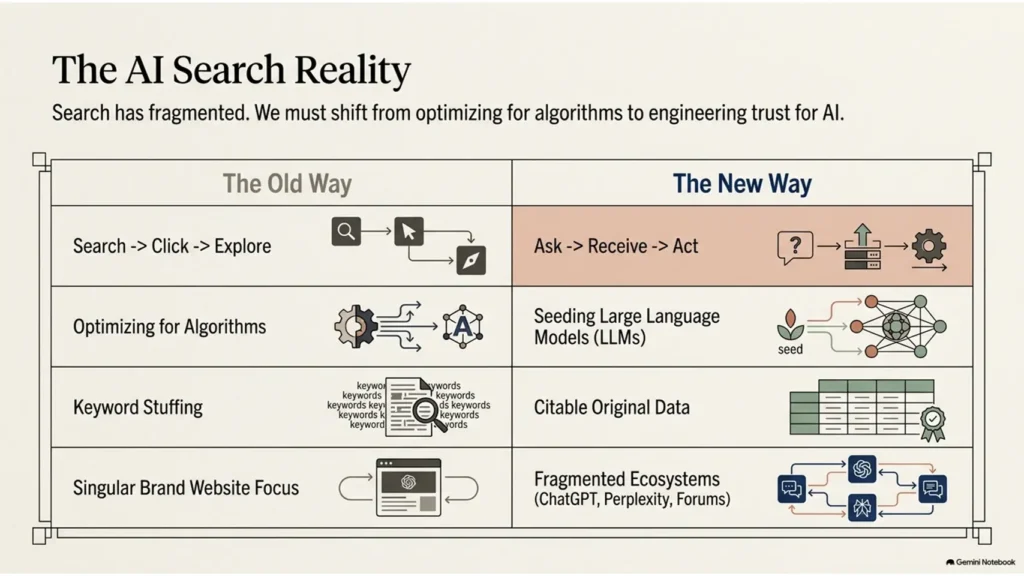
Distribution Works – But Not the Way Most Marketers Think
The default assumption is that putting content on more platforms creates a compounding visibility effect. More placements equal more signals, more signals equal higher rankings. Google does not operate that way. Publishing the same article across twenty outlets does not send twenty positive ranking signals – it creates a canonicalization problem, dilutes measurement, and, at worst, triggers scaled-content abuse flags.
What distribution can do is create the conditions for visibility to improve. A well-placed guest contribution on a relevant trade publication, a newsletter that surfaces a proprietary research piece to a targeted audience, or a webinar that drives qualified traffic back to an owned page – these activities generate real-world outcomes that Google’s systems respond to over time.
Teams at West Pro Media Services work through exactly this challenge with clients: building multicasting strategies that prioritize audience-relevant placements over raw volume, keeping the canonical source protected while maximizing earned reach.
Direct vs. Indirect: What Google Actually Rewards
Google’s documentation is clear that it uses many signals and systems – and that no single activity like content distribution is a standalone ranking factor. What its systems consistently reward is helpful, reliable, people-first content paired with strong E-E-A-T signals (Experience, Expertise, Authoritativeness, Trustworthiness), technical accessibility, and earned third-party validation.
Why “More Places Published” Is a Myth
Social shares do not directly move rankings. A post going viral on LinkedIn is not a ranking signal Google processes the same way it processes a crawlable editorial link. What those shares can do is put content in front of people who might then link to it, search for the brand, or return directly – producing indirect SEO value. The distinction matters because conflating the two leads to strategies that look busy but produce little measurable search impact.
The Real Causal Chain: Discovery, Links, Authority
The honest causal chain looks like this: distribution expands qualified discovery, some of that audience links to or cites the content, Google discovers the original page through those crawlable paths and validates its usefulness, and rankings and impressions improve. That chain takes time, requires genuinely useful source material, and only holds when the original page is technically sound. Skipping any link in that chain and expecting ranking gains is where most distribution strategies fall flat.
Five Indirect Mechanisms That Move the Needle
Earned Editorial Links: The SEO Gold Standard
Editorial links – naturally earned backlinks from journalists, publishers, or subject-matter communities – remain among the most meaningful signals Google uses to validate content relevance and authority. The operative word is earned. Links built primarily to manipulate rankings are classified as link spam under Google’s spam policies. The practical implication: distribution should be designed to put genuinely useful, citable content in front of people who have good reasons to reference it – not to manufacture link volume.
Topical Authority Built Over Time
Consistent distribution of a coherent body of expert material – research, case studies, implementation guides, specialist commentary – makes it easier for readers, journalists, and search systems to associate a brand with a specific topic. This does not appear as a score Google publishes; it shows up as wider keyword coverage, growing non-branded impressions, more relevant referring domains, and repeat citations over a sustained period.
AI Search Visibility and What It Actually Requires
Google’s guidance on AI Overviews and AI Mode is unambiguous: the same foundational SEO practices that drive traditional search visibility apply here too. Pages must be indexed and eligible for Search snippets. Clear structure – logical headings, direct answers, well-organized sections – makes content easier for AI models to interpret and cite. There is no separate technical checklist for AI features. The distribution implication is to invest in content with original evidence and clearly extractable answers, not to spray generic articles across dozens of channels hoping for AI pickup.
Referral Traffic That Signals Genuine Audience Value
Referral traffic from relevant, well-matched publications tells Google something meaningful: real people found the content useful enough to click through. High engaged-session rates from referral sources reinforce that signal. By contrast, bulk referral traffic from irrelevant or low-quality outlets tends to produce high bounce rates – which tells a different story entirely. Audience fit matters more than domain metrics when selecting distribution partners.
Brand Search Growth as a Trust Indicator
When distribution introduces a brand to new, relevant audiences, branded search volume tends to grow over time. People who encounter a company’s research in a newsletter or trade publication may later search for it directly. Google interprets rising branded search as a trust signal – evidence of genuine audience demand rather than manufactured visibility. This is one of the harder mechanisms to measure in the short term but one of the most durable in the long run.
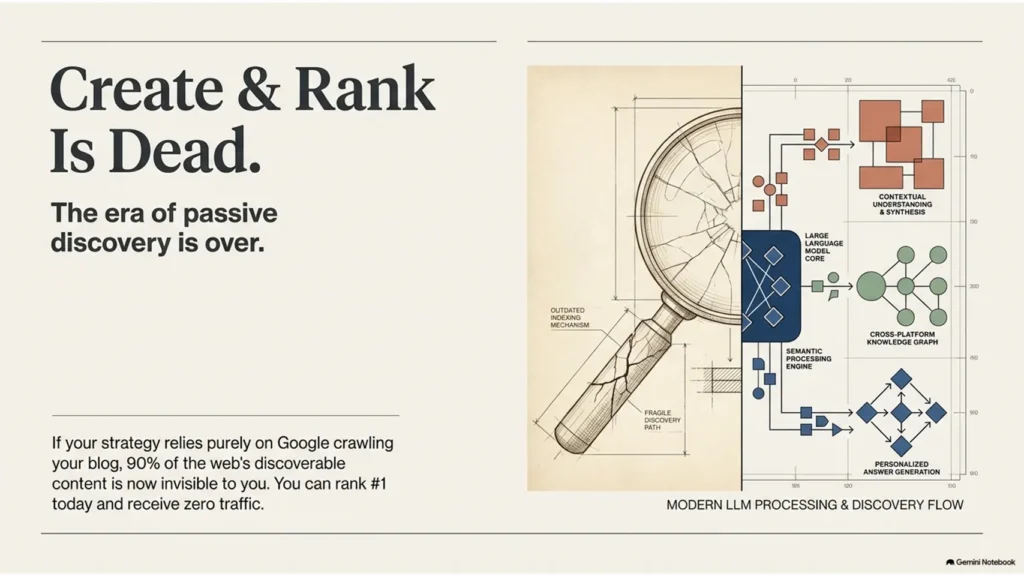
Syndication’s Hidden Technical Minefield
Full-text content syndication is where distribution strategies most commonly create unintended SEO damage. Google’s canonicalization process selects one representative URL from a set of duplicate or near-duplicate pages – and that selection does not always favor the original publisher. A partner’s domain may outrank the owned version, stranding the primary asset in Google’s secondary index.
Why Noindex Is Stronger Than Rel=Canonical for Syndicated Pages
Google’s own canonicalization troubleshooting guidance explicitly states that rel=”canonical” is not the preferred solution for syndicated content because versions are often materially different enough that the hint may be ignored. The more robust approach is a partner-side noindex directive, which prevents the republished copy from competing in organic results altogether while keeping the page visible to readers. If a partner cannot implement noindex reliably, excerpt-based distribution is the safer default.
When Rel=Canonical Still Has a Role
A cross-domain rel=”canonical” can be a useful signal in tightly controlled, near-identical republication arrangements – particularly when the partner has a clear editorial process and the content is genuinely close to identical. It is a hint, not a command. The practical rule: agree on the indexing treatment before publication, monitor the Google-selected canonical via Search Console’s URL Inspection tool after launch, and treat every syndication agreement as both an editorial and a technical contract.
Google’s Helpful Content System Changes the Stakes
In March 2024, Google folded its Helpful Content system into its core ranking infrastructure. Content quality evaluation became a persistent factor – not a periodic update event. Google reported that this shift contributed to a 45% reduction in low-quality, unoriginal content appearing in search results, opening more space for genuinely useful material to surface.
For distribution strategy, the implication is direct: a program built around amplifying original, expert-driven content will be rewarded by the same systems that now actively penalize bulk, generic, or SEO-first production. Distribution can amplify genuine quality – it cannot manufacture it.
Distribution Mistakes That Damage Rankings
Bulk Publishing and Scaled-Content Abuse
Distributing large volumes of AI-generated or lightly rewritten content across multiple outlets to build link networks or expand footprint now falls squarely within Google’s scaled-content abuse policy. The policy applies regardless of whether automation, humans, or a combination produced the content. The determining factor is intent: content produced mainly to game search, rather than to help people, is the target. High-volume, low-differentiation distribution is the clearest signal of that intent.
Mistaking Domain Authority for Audience Relevance
A large but topically mismatched publication can send low-quality visitors, generate weak engagement signals, and dilute rather than strengthen authority. A specialist B2B publication with the right buyer audience – even with lower aggregate metrics – will typically outperform a broad, high-traffic outlet for commercial SEO outcomes. Select distribution partners based on audience fit and editorial standards, not raw domain scores.
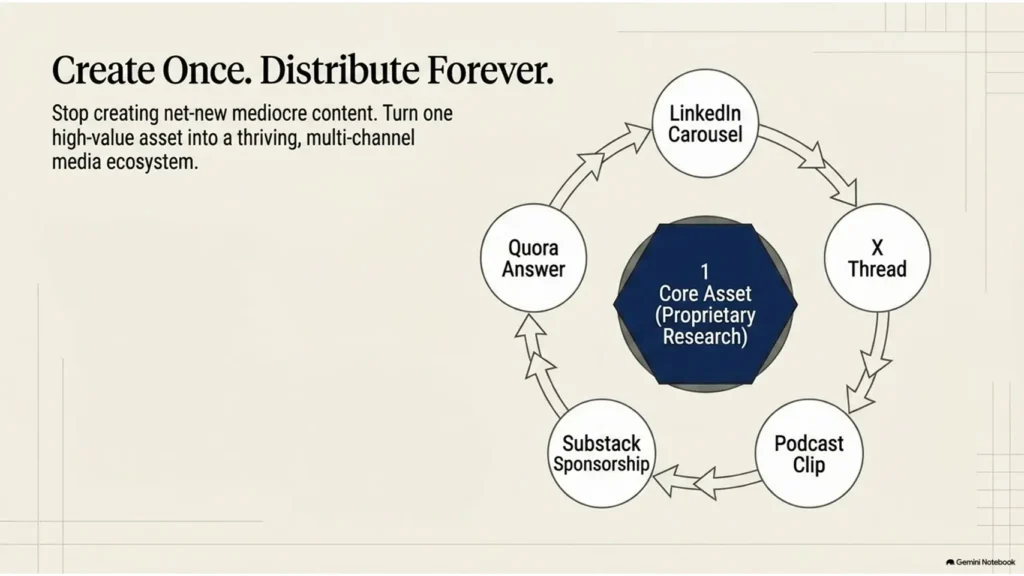
Measure Beyond Rankings to Prove Real Impact
Rankings fluctuate by query, location, device, and SERP feature composition. Reporting a single rank position as the measure of distribution success misrepresents how search visibility actually works. A more complete measurement framework combines:
- Search Console data: non-branded impressions, clicks, CTR, query expansion, and the Google-selected canonical for each distributed asset
- Referral analytics: engaged sessions, assisted conversions, lead quality, and returning users segmented by distribution channel or partner
- Link audits: relevance, editorial context, destination URL, and technical accessibility of newly earned links
- Branded search trends: growth in direct brand queries over the distribution period
Search Console’s Performance report tracks impressions, clicks, CTR, and average position with breakdowns by query, page, country, and device – making it possible to assess whether distribution caused durable gains rather than short-term traffic spikes. Compare against a pre-distribution baseline, not just a point-in-time ranking screenshot.
Distribute Fewer Places, Earn More Visibility
The counterintuitive conclusion the evidence supports: fewer, better-matched distribution placements consistently outperform high-volume, low-relevance ones – for search visibility, for referral quality, and for the earned links that drive compounding SEO value over time. A definitive, well-structured asset published on an owned domain, supported by a handful of channel-native derivatives pointing back to it, is the model that aligns with how Google’s systems actually work. Distribution is a visibility multiplier – but only for content that is already worth multiplying.
| Topic / Area | Key Finding | Business Impact | Why It Matters |
|---|---|---|---|
| Syndicated content | Google may rank a partner version instead | Owned asset can lose organic visibility | Agree indexing rules before republishing |
| Duplicate-content control | Partner-side noindex reduces search competition | Protects original page’s ranking opportunity | Canonicals are signals, not guarantees |
| AI search eligibility | Indexed, snippet-eligible pages can appear in AI features | Existing SEO foundations remain commercially valuable | No separate AI Overview optimisation requirement |
| Scaled-content risk | Mass-produced ranking-first content violates spam policy | Visibility losses and reputational risk increase | Quality and reader value outweigh publishing volume |
| Distribution measurement | Track referrals, links, non-brand growth, conversions | Reveals business value beyond rank snapshots | Supports smarter channel and partner investment |
Frequently Asked Questions
Does syndicating my content improve Google rankings?
Not automatically. Syndication can expand reach and create opportunities for referral traffic, citations, and editorial links, but duplicate versions can compete with your original page. Protect the original with partner-side noindex where possible, rather than assuming more copies mean stronger rankings.
Is content distribution still useful for Google AI Overviews?
Yes—when it helps authoritative, original content reach the people likely to cite, link to, or search for it. Google says AI Overview and AI Mode visibility relies on normal Search eligibility: indexed pages, snippet eligibility, and sound technical SEO, not a separate AI-only optimisation tactic.
Should I use canonical tags or noindex for syndicated articles?
For full-text syndication, ask the partner to apply noindex if you do not want its version to appear in Google. A cross-domain canonical can help in closely controlled cases, but Google notes it may be less reliable when the syndicated page differs materially.
Can publishing AI-written content across many sites harm visibility?
It can, if the material is produced at scale mainly to manipulate rankings and offers little original value. Google’s scaled-content-abuse policy applies regardless of whether content is created by AI, humans, or both; intent and usefulness matter more than production method.
Which metrics show whether content distribution is improving search visibility?
Track non-branded impressions and clicks in Search Console, relevant referring domains, referral engagement, assisted conversions, branded-search growth, and the selected canonical URL. Together, these reveal whether distribution is generating durable demand and authority—not merely short-lived traffic or social engagement.
West Pro Media Services helps businesses build smarter content distribution strategies through their multicasting and digital media services – visit westpromediaservices.com to learn more.
