
Summary
Content Marketing vs Paid Ads is not an either/or decision. Understanding how each contributes to business growth helps you invest in both immediate results and long-term visibility. Paid ads generate results only while you keep paying, whereas high-quality content becomes a long-term business asset that continues attracting qualified prospects over time. The highest-return strategy is not choosing one over the other, but using content to build authority and paid advertising to amplify what is already proven to work.
Key Takeaways
- Paid advertising stops generating leads the moment the budget runs out – content marketing keeps working long after publication.
- The real cost gap between content and paid ads goes beyond CPL; the long-term cost per qualified opportunity reveals the true economics.
- A content-led, paid-amplified strategy is the highest-ROI playbook for most B2B teams – content builds the asset, paid ads accelerate what is already working.
- AI is reshaping how buyers find content, raising the bar for originality, depth, and expert credibility across every channel.
- The sections below break down when each channel wins outright, and how to combine them into a system that compounds over time.
Most B2B marketing debates treat content marketing and paid advertising as rivals. They are not. They operate on completely different economic models – and confusing the two is one of the most expensive mistakes a marketing team can make.
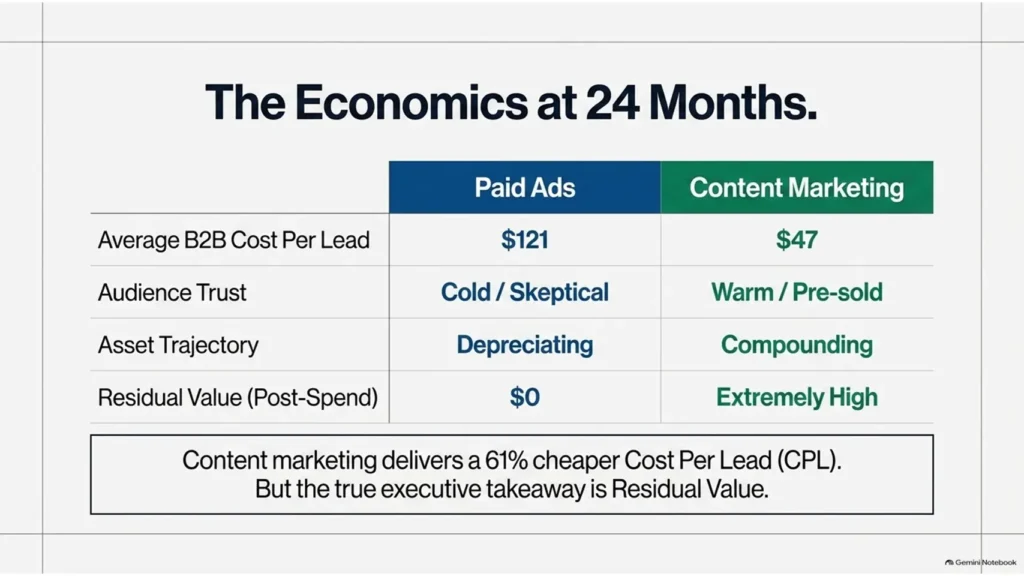
Paid Ads Stop. Content Doesn’t.
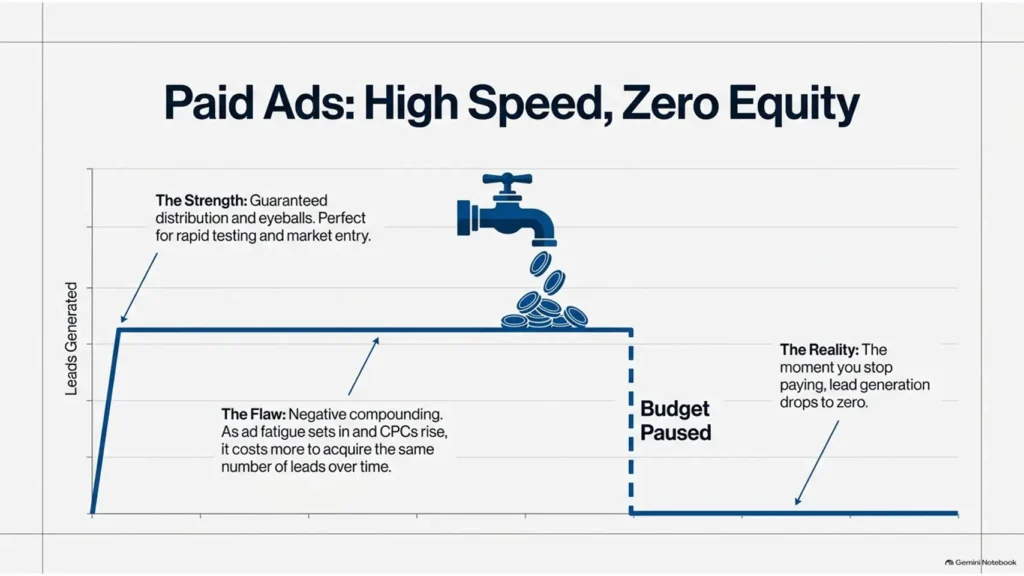
Here is the simplest version of the argument: pause a paid campaign, and lead flow stops that same day. Pause content production, and a well-built library of guides, case studies, and comparison pages keeps attracting, educating, and converting buyers for months – sometimes years.
That is an economic point, not a philosophical one. Paid advertising is a transactional cost. Content marketing is a depreciating asset that, when built well, depreciates very slowly. The moment that distinction clicks, every budget conversation changes.
West Pro Media Services Ltd’s content creation services are built around exactly this principle – treating every piece of content as a long-term asset, not a one-time campaign deliverable.
Two Channels, Two Economic Models
Renting Attention vs. Owning It
Paid media rents attention. The moment payment stops, the attention disappears. Content builds an owned asset base that can earn attention repeatedly – through search, AI discovery, social sharing, email, and sales enablement.
This does not mean content is free. Producing genuinely useful B2B content requires subject-matter expertise, research, editing, design, distribution planning, and ongoing maintenance. The difference lies in the cost curve: paid spend scales linearly with output, while the marginal cost of attracting an additional visitor to existing high-performing content approaches zero over time.
Where the Real Cost Difference Lives
The surface-level comparison – CPL for paid ads versus CPL for organic content – understates the real difference. What matters is the total cost of the system over a meaningful time horizon: production costs, media spend, sales team time, conversion rate, deal size, and customer retention.
A $150 paid CPL looks acceptable until it is compared against a content asset that produces qualified leads at a declining effective cost over 24 months. That is where the compounding math becomes undeniable.
The CPL Gap Is Only Half the Story
Why Low-CPL Paid Leads Can Cost More in the Long Run
Cheap leads are not always good leads. Cold paid traffic – particularly in B2B – often produces buyers with little prior exposure to the brand, lower trust, and higher support requirements. They need more nurturing, take longer to close, and churn at higher rates.
Organic leads, by contrast, have typically consumed multiple pieces of content before raising their hand. They arrive pre-educated, with realistic expectations and a baseline of trust already established. Sales cycles are shorter, close rates are higher, and post-sale friction is lower. CMI’s B2B research found that content relevance and quality – not budget allocation – was the factor most associated with improved marketing effectiveness, cited by 65% of respondents.
The right comparison goes beyond CPL. Cost per qualified opportunity, pipeline influenced, win rate, and payback period – measured using fully loaded costs, not industry benchmarks presented as universal laws – tell a far more accurate story.
When Content Wins Outright
Complex Buying Journeys and Trust-Led Decisions
In B2B categories with long sales cycles, multiple stakeholders, and high-consideration decisions, trust is the primary currency. Buyers do not convert because they saw an ad – they convert because they have spent time with a brand’s thinking, found it credible, and decided the team behind it understands their problem.
Content is uniquely positioned to build that trust at scale. Pillar guides, original research, implementation explainers, use-case libraries, and named expert perspectives do something paid ads fundamentally cannot: they demonstrate competence before a commercial conversation begins. In categories where a wrong vendor decision is politically or financially costly, that demonstration matters enormously.
Maintaining Visibility as AI Reshapes Search Discovery
Google’s AI Overviews have expanded to reach users across more than 200 countries and territories, and AI-powered search is now a primary discovery channel for B2B buyers. Users of AI search tools tend to submit longer, more nuanced queries than traditional keyword searches – a shift that raises the standard for content significantly.
Generic, consensus-level content is becoming invisible. What surfaces in AI-generated responses is content with original evidence, expert perspective, structured depth, and genuine information gain. A well-constructed, experience-backed content asset is more likely to earn a citation in an AI Overview than a thinly reworded summary of what is already ranking. That is a durable visibility advantage no paid placement can replicate.
When Paid Ads Are the Right Tool
None of this is an argument against paid advertising. Paid media excels in specific, clearly defined scenarios:
- Immediate demand capture – targeting buyers who are actively searching for a solution right now
- Product or service launches – generating fast awareness and pipeline before organic authority is established
- Time-sensitive campaigns – events, webinars, limited offers, or account-based pushes with defined windows
- Validated message testing – quickly reading what positioning, pain points, and offers resonate with a defined audience
- Branded search defense – protecting high-intent branded queries from competitors
The problem is not using paid ads – it is using them as a substitute for building owned demand, or measuring their success with metrics such as clicks, impressions, and raw CPL that obscure their true contribution to pipeline and revenue.
The Content-Led, Paid-Amplified Playbook
Test Organically, Then Spend on Winners
One of the most overlooked efficiencies in B2B marketing is using organic channels as a testing ground before committing paid budget. Publish content on LinkedIn, email, and owned channels. Track what generates genuine engagement – comments, shares, replies, time-on-page. Then put paid budget behind the pieces that already proved themselves organically.
This approach removes a meaningful portion of ad testing spend from the equation. The content reaching cold audiences has already earned trust from a warm one – a signal of quality that ad managers alone cannot provide.
Retargeting Warm Readers, Not Cold Strangers
The highest-ROI use of paid ads in a content-led strategy is retargeting. A buyer who spent four minutes reading a detailed implementation guide is a fundamentally different prospect from someone who has never heard of the brand. Serving that warm reader a relevant next step – a case study, a consultation offer, a product tour – opens a completely different conversation than cold prospecting.
The sequence is straightforward: build content that earns attention – use paid to retarget visitors with a conversion-oriented next step – measure qualified pipeline, not just clicks. That loop compounds over time as the content library grows and the retargeting pool deepens.
Measure Pipeline, Not Just Clicks
Reporting Frameworks Aligned to Business Objectives
Most marketing reports over-credit the last paid touchpoint and under-credit the earlier content that made the conversion possible. A prospect might find an original research report through LinkedIn, return via branded search, read a competitor comparison page, and then convert after a retargeting ad. Last-click attribution assigns all value to the ad and zero to everything that came before it.
A more useful reporting framework operates at four levels:
- Visibility: Rankings, AI search citations where measurable, share of voice, non-brand impressions
- Engagement: Return visits, scroll depth, email subscriptions, content journey paths
- Demand capture: Qualified leads, assisted conversions, demo and consultation rate by intent cluster
- Revenue: Pipeline created and influenced, win rate, CAC, cost per qualified opportunity, payback period
CMI’s B2B research found that only 63% of organizations creating thought leadership actually measure its business impact – leads, pipeline, or revenue influence. That gap between production and measurement is where most content programs lose internal credibility, and where budget gets reallocated to paid channels that have cleaner, if misleading, dashboards.
Stop Treating Content as a Short-Term Project
The most common reason content marketing underperforms is patience, not strategy. Teams publish 10 to 20 posts, see no immediate pipeline movement, and declare the channel broken. Content ROI is a 12-to-24-month story. The compounding effect – where each strong asset increases topical authority, earns additional links and citations, improves rankings, and feeds retargeting pools – does not show up in a monthly dashboard.
The fix is straightforward: treat content as a program, not a project. Assign editorial ownership, set review dates, refresh high-value assets as facts and examples evolve, and measure at the right time horizon.
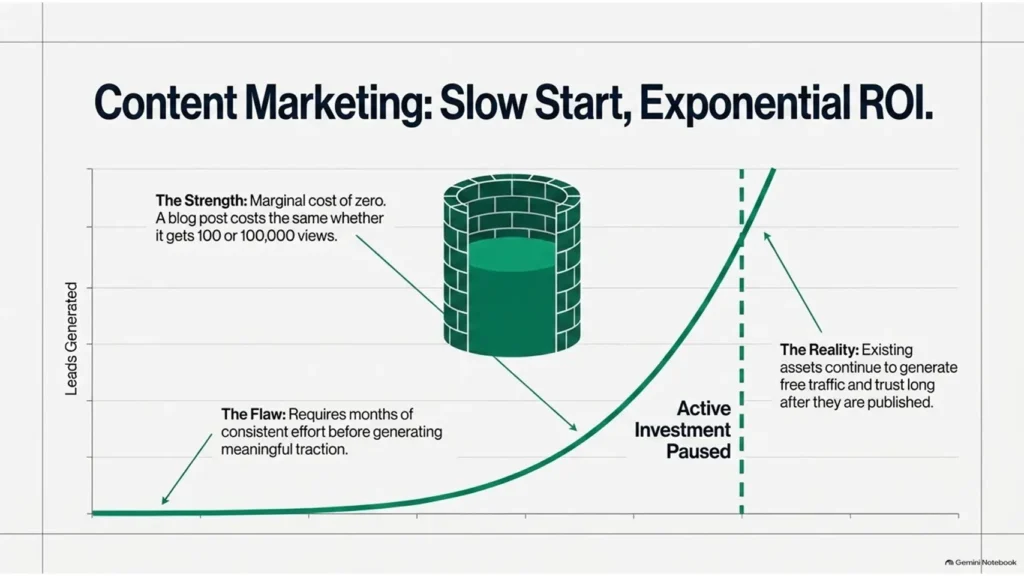
Content Compounds. Use Paid to Accelerate What’s Already Working.
The strongest B2B lead generation systems are built on understanding what each channel is actually for. Content builds a compounding, owned asset base that earns discoverability, trust, and qualified demand over time. Paid ads buy speed, targeting precision, and the ability to capture intent that already exists.
The integrated model is clear: invest consistently in content that reflects genuine expertise and answers real buyer questions; use paid media to validate positioning quickly, defend high-intent searches, and retarget audiences who have already engaged. Measure the whole system at the pipeline and revenue level – not just the channels that are easiest to attribute.
That is a more honest account of how B2B buyers actually make decisions – and how to be present at every stage of that process without paying for the same attention twice.
| Topic / Area | Key Finding | Business Impact | Why It Matters |
|---|---|---|---|
| Content measurement | 63% struggle to attribute content ROI | Pipeline reporting needs multi-touch attribution | Last-click reporting can over-credit paid campaigns |
| Buyer-journey visibility | 66% find customer journeys difficult to track | Connect content engagement to CRM opportunity stages | Reveals content’s role before conversion |
| Content budget direction | 39% expected higher content budgets | Supports sustained asset-building investment | Consistency is essential for compounding returns |
| Paid-media market pressure | European digital ad spend rose 10.5% | Efficiency and lead quality become more important | Rising investment increases pressure to prove paid ROI |
| AI-search readiness | Standard SEO remains relevant for AI features | Prioritise indexable, useful, clearly structured pages | No special AI markup replaces helpful content |
Sources
Frequently Asked Questions
How long does content marketing usually take to generate B2B pipeline?
Most B2B content needs six to 12 months to establish meaningful search visibility, trust and assisted pipeline; compounding returns often become clearer over 12 to 24 months. Faster signals include qualified engagement, repeat visits, email sign-ups and sales teams using content in live opportunities.
Should a B2B business reduce paid-ad spend to invest in content?
Not automatically. Protect paid activity that captures high-intent demand, supports launches or retargets engaged visitors. Reallocate budget from poorly qualified cold campaigns first, then build content around recurring buyer questions, commercial comparisons and expert-led insights that can attract demand for longer.
What is the best way to measure content marketing ROI against paid ads?
Compare both channels using fully loaded cost per qualified opportunity, pipeline created or influenced, win rate, customer acquisition cost and payback period. Avoid judging paid media solely by last-click conversions or content solely by traffic; buyers commonly interact with both before converting.
Can content still drive results if AI search answers questions without sending clicks?
Yes. AI search makes citation-worthy content more important, not less. Create original, clearly structured pages that answer specific buyer questions, provide first-hand expertise and support claims with credible evidence. Measure brand mentions, AI citations, branded searches and downstream pipeline alongside website traffic.
When should paid ads be used to amplify content?
Promote content after it has shown organic evidence of relevance: strong reader retention, shares, replies, return visits or sales-team adoption. Then use paid distribution to reach similar audiences and retarget engaged readers with a relevant case study, demo or consultation offer rather than forcing an immediate cold conversion.
West Pro Media Services Ltd works with B2B teams to build content strategies that function as long-term demand assets – visit westpromediaservices.com to see how a content-first approach can be applied to your pipeline goals.