
Summary
ChatGPT and Perplexity are not business directories, and they do not produce one permanent list of the “best” suppliers. Your business may be missing because its information is difficult to access, its services and locations are unclear, competitors provide stronger evidence for the specific request, or the answer simply changed between searches. Check discovery, relevance and independent proof before assuming you are permanently invisible.
Key Takeaways
- Being known, being cited and being recommended are three different outcomes.
- OAI-SearchBot and PerplexityBot must be able to access relevant public information.
- Clear service descriptions, locations, customer types and evidence make suitability easier to assess.
- Third-party recognition can support visibility, but observed correlations do not prove a ranking formula.
- Measure repeated, realistic recommendation searches rather than relying on one screenshot.
“Never” may not mean what you think
ChatGPT and Perplexity do not work like directories that list every suitable business. They generate answers based on the question asked, the information they can access, the context available about the user and the evidence they find about potential suppliers.
That means your business can be absent for several different reasons. The system may not identify it accurately, may know the business but not consider it suitable for that particular request, or may find stronger evidence for competitors.
The first step is therefore to establish what is actually missing. Can ChatGPT or Perplexity describe your business correctly when asked by name? Does it mention the business but fail to recommend it for an unbranded search? Does it recommend the business but link to another source instead of your website? Or does it cite your content while suggesting a competitor?
These are different problems requiring different responses.
You should also test whether “never” is accurate. Research into AI recommendations found substantial variation between repeated searches. In that study, identical recommendation lists were exceptionally unlikely to repeat, although Perplexity was not included in the experiment. A single disappointing answer, or a single favourable one, is not reliable evidence of a permanent position.
Being known, cited and recommended are different
Can the system identify your business correctly?
Recognition is the foundation. An AI system needs to connect your trading name with the right organisation, services, locations and customer types.
If your website uses vague language such as “innovative solutions for modern businesses”, it gives little practical evidence about what you actually do. A potential customer may understand the phrase, but a recommendation system has fewer concrete facts with which to match your business to a detailed request.
Clear information should explain your services, the people or organisations you serve, the areas you cover, the requirements you handle and any meaningful limitations. Your business name, contact details, location and service descriptions should also be consistent across important public sources.
This is the first stage of a useful framework: recognition, relevance and recommendation. Being recognised does not mean you will be relevant to every prompt. Being relevant does not automatically mean you will be recommended.
Why does a citation not always produce a recommendation?
A citation shows that a source contributed information to an answer. It does not necessarily mean the business named on that page is being presented as the best supplier.
For example, ChatGPT or Perplexity might cite your article because it explains a technical issue clearly, then recommend another company because that business has stronger evidence of serving the relevant location or customer type.
It is therefore useful to record brand mentions, website citations and actual supplier recommendations separately. Treating all three as the same measure can make a visibility report look better than the experience of prospective customers.
How ChatGPT and Perplexity discover business information
Search access is different from model training
OpenAI identifies OAI-SearchBot as the crawler used to help surface websites in ChatGPT search. Its published guidance says that websites opting out may not appear in ChatGPT search answers, although navigational links can still appear.
Perplexity identifies PerplexityBot as a crawler designed to discover and link to websites in search results. Both companies provide guidance about allowing their search crawlers and published IP ranges.
This is separate from training access. Allowing OAI-SearchBot does not mean you must allow GPTBot, which is associated with a different purpose. Businesses can make a considered decision about training crawlers while still permitting legitimate search access.
Robots.txt is only part of the check. Hosting controls, firewalls, content delivery networks and security tools can also block legitimate crawler requests. Important service pages should be publicly accessible rather than hidden behind a login or dependent on a browser session that a crawler cannot reproduce.
Recommendations depend on context
“Recommend an accountant” is a broad request. “Recommend an accountant in Bolton for a small construction company that needs CIS, payroll and quarterly management accounts” is much more specific.
ChatGPT can use location information for local searches, and recommendation systems attempt to match answers to the stated requirements. A business may therefore appear for one prompt but not another without anything technically changing.
Testing only a broad phrase such as “best agency” tells you very little. It may favour businesses with national recognition, a large public footprint or a different specialism. A realistic test should reflect how your own customers describe their situation before making an enquiry.

Why competitors may appear instead
Your business may be difficult to access
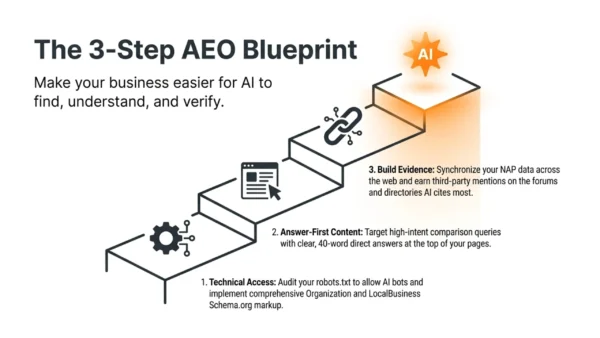
A crawler block is the most basic issue to investigate. Review robots.txt, firewall and CDN rules, then check whether the relevant public pages can be fetched without authentication.
Do not assume that blocking training crawlers also blocks search, or that allowing a general category of “AI bots” solves the issue. The purpose-specific search crawlers matter.
Producing more content will not fix a page that search systems cannot access.
Your offer may be too difficult to assess
A business can be excellent in practice but poorly described online. Generic claims about quality, trust or personal service do not explain why the company fits a particular buying situation.
Make the practical details easy to find. State exactly what the business provides, where it operates, who it serves and which problems it handles. Explain relevant qualifications, memberships, accreditations, processes and exclusions where these help a customer compare suppliers.
Structured data can support clearer machine-readable information when implemented accurately. It should not be treated as a guaranteed recommendation factor, however. The official material examined here does not disclose a weighted formula showing that one schema type will make a business appear.
Competitors may have stronger evidence for the question
A competitor may be recommended because several credible sources describe it in terms that match the request. Those sources might include professional associations, trade publications, genuine reviews, local coverage, supplier profiles, case studies or expert interviews.
The useful question is not simply, “How many pages does the competitor have?” Examine the sources behind repeated recommendations. What capabilities do they confirm? Which locations or industries do they mention? Are the claims supported by evidence?
Research from Ahrefs found associations between AI visibility and broader brand mentions, including mentions on the web and YouTube. These were observational correlations, not proof that publishing videos or acquiring mentions causes recommendations. The sensible response is to build genuine recognition in relevant places, not to manufacture repetition.
Your content may answer questions without supporting decisions
Educational content can explain a subject without showing why your business is suitable. If your website contains general advice but few detailed service pages, case studies, pricing explanations or suitability guides, it may provide information without providing commercial evidence.
Useful content should help someone make a decision. A case study can describe the original problem, the work undertaken and the outcome. A service page can explain who the service is for and when it is not appropriate. A comparison can state the criteria used rather than simply claiming superiority.
This is where owned, distributed and independent authority work together. Your website explains what you do. Relevant distribution helps more people discover that expertise. Independent reviews, references and third-party coverage provide evidence beyond your own claims.
If you never clearly say what you do, AI has less to repeat. But saying it once on your own website may not be enough if nobody else can discover, verify or discuss it.
What should you improve first?
Fix access before creating more content
Check the pages that matter commercially: your main service pages, location pages, product pages and evidence pages. Confirm that the relevant search crawlers can access them and that your infrastructure is not returning errors or blocking legitimate requests.
Only then decide whether new content is needed. A large publishing programme cannot compensate for a technical access problem.
Replace vague positioning with useful facts
A clear business profile should make it easy to answer several questions. What do you sell? Who is it for? Where do you operate? Which requirements can you accommodate? What evidence supports your claims? What are the limitations?
Keep names, addresses, telephone details, service areas and categories consistent across your website and important external profiles. This reduces ambiguity when different sources are compared.
Use headings and structured information to make important facts easy to understand, but do not treat formatting as a shortcut around weak evidence.
Publish fewer, more useful answers
The research does not support a content-volume arms race. Ahrefs found only a weak relationship between site page count and ChatGPT visibility in its analysis. More pages are not automatically more authority.
Prioritise questions that customers ask before choosing a supplier. Explain costs and buying criteria, address common objections, show relevant work and provide honest guidance about suitability. Freshness is worth maintaining where services, prices, regulations or availability change, but changing a publication date without improving the content is not a proven visibility strategy.
Build recognition beyond your own website
Relevant third-party attention can help a business become easier to discover and assess. That might involve useful expert commentary, industry collaboration, credible demonstrations, documented projects, authentic customer experiences or appearances in publications that matter to the target audience.
The objective is not to create the largest possible number of mentions. It is to give independent sources a genuine reason to describe the business accurately.
For ecommerce businesses, the priorities may differ. OpenAI’s product-discovery developments include merchant product feeds and richer product information, although a feed is not required for a product to appear. A local professional service should not be given exactly the same visibility advice as an online retailer.
How to test your visibility without misleading yourself
Start with realistic customer-intent groups. These might include local searches, specialist requirements, comparisons, discovery questions and branded verification.
Run the same types of prompts separately in ChatGPT and Perplexity. Record the date, product or mode, location context, whether web search was active, the complete answer and the sources shown. Repeat the tests rather than treating one response as a ranking position.
Track whether your business was mentioned, whether it was explicitly recommended, whether your own website was cited and whether the description was accurate. Record competitor appearances in the same sample.
Do not combine these measures into one impressive-looking figure. A business mentioned in 12 of 40 sampled answers has an observed mention rate of 30 per cent in that sample. It does not mean 30 per cent of all relevant users will see it.
Finally, connect visibility to business outcomes. Relevant visits, enquiries, qualified leads and sales matter more than a change in the number of screenshots.
No agency can responsibly guarantee that ChatGPT or Perplexity will recommend your business for every relevant question. The defensible goal is to make the business easier to discover, easier to understand and better supported by credible evidence, then measure whether that improves repeated inclusion and real customer activity.
Research Insights
| Topic / Area | Key Finding | Business Impact | Why It Matters |
|---|---|---|---|
| ChatGPT placement | OpenAI says placement is not guaranteed | No permanent position can be promised | Recommendation depends on relevance and reliability |
| Search crawler access | OAI-SearchBot and PerplexityBot support discovery | Blocks may prevent normal search inclusion | Technical eligibility comes before content expansion |
| Recommendation variability | Identical lists repeated less than one time in 100 | One screenshot is weak evidence | Repeated testing produces more meaningful observations |
| Broader brand presence | Web and YouTube mentions correlated with visibility | Recognition beyond owned pages is worth investigating | Correlation does not prove a ranking mechanism |
Sources
- OpenAI – ChatGPT Search FAQ
- OpenAI Developers – OAI-SearchBot documentation
- Perplexity – Perplexity crawlers documentation
- SparkToro – AI recommendations are highly inconsistent
- Ahrefs – AI brand visibility correlations
Frequently Asked Questions
Why does ChatGPT recommend my competitor when my business ranks higher on Google?
Google rankings and AI recommendations are not the same measure. Your competitor may have clearer service information, stronger evidence for the precise customer requirement, better local relevance or more independent references. A higher traditional search position does not guarantee inclusion in an AI-generated shortlist.
Should I block GPTBot if I do not want my content used for training?
GPTBot and OAI-SearchBot serve different purposes. You can make a separate decision about training access while allowing OAI-SearchBot to support ChatGPT search discovery. Review OpenAI’s current crawler documentation and your own privacy requirements before changing robots.txt.
Is schema markup or llms.txt essential for ChatGPT and Perplexity?
Accurate structured data can help describe a business clearly, but the supplied official guidance does not establish schema as a guaranteed recommendation factor. It also does not establish llms.txt as essential. Prioritise accessible pages, clear facts and credible evidence first.
How many times should I test a recommendation prompt?
There is no research-backed universal number that makes a test statistically conclusive. Use repeated searches with recorded conditions, realistic customer prompts and separate measures for mentions, recommendations and citations. More observations are generally more informative than one logged-in result.
Does being cited mean that ChatGPT recommends my business?
No. A system may cite your article for factual or educational information while recommending another supplier. Record citations and recommendations separately, then check whether the cited material actually supports the service, location and capability attributed to each business.
