
Summary
AI assistants are more likely to recommend content that gives clear answers to real customer questions, uses original and verifiable evidence, is easy to access and extract, and is kept up to date. Businesses should focus on useful, credible content that demonstrates genuine expertise and gives AI assistants a reason to trust, cite and recommend it.
Key Takeaways
- AI assistants tend to recommend content that gives a clear, defensible answer to a real customer question, especially when it is original, specific, current, attributable, and independently checkable
- Content has to clear several hurdles before an assistant will use it, including whether it can be crawled, whether it matches the question being asked, and whether the facts inside it can be easily lifted out
- Research on AI-cited pages shows a strong preference for recently updated content: URLs cited by AI assistants average 1064 days old compared with 1432 days for organic search results, with ChatGPT showing the strongest preference of all for newer sources
- Chasing shortcuts like special schema tags or directory submissions does little compared with building genuinely original, well-structured evidence
- Digital marketing teams should track a fuller measurement picture, including citations and referral quality, rather than relying on rankings alone – this piece breaks down exactly what that framework looks like
Search behaviour has quietly changed. Rather than typing a keyword and scanning ten blue links, more customers now ask an AI assistant a direct question and expect a direct answer, often with a business, product, or article named as the trusted source. For digital marketing professionals, this shift raises a question worth answering properly.
What AI Assistants Actually Reward
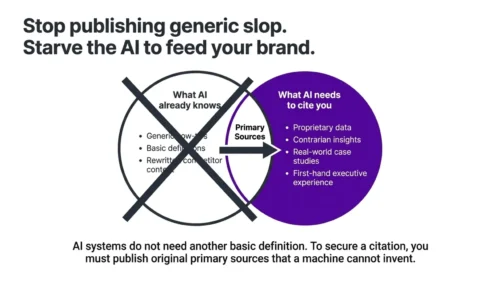
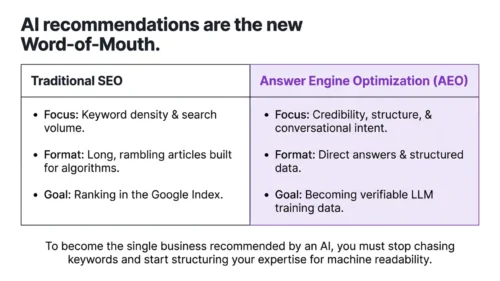
AI assistants are more likely to recommend content that gives them a clear, accessible, and defensible answer to a real customer question, especially where the information is original, specific, current, attributable, and independently validated. That single idea sits behind everything else here, because it marks a real change in what marketing teams need to optimise for. Traditional SEO chased a ranking position for a keyword; the new goal is being selected as trustworthy evidence for a specific answer, a subtly different and often harder target to hit.
This distinction matters because a page can rank well in conventional search yet still get skipped by an AI assistant deciding what to cite. The assistant checks more than whether content exists on a topic; it checks whether the content solves the customer’s actual problem, backs up its claims, and can be trusted enough to repeat. West Pro Media Services works with businesses adapting to exactly this shift, helping them build credible, well-distributed content that both people and AI systems are willing to recommend.
Understanding the mechanics behind that selection process helps marketers stop guessing and start building content with intent. The sections below break down how AI assistants actually search, filter, and choose what to put in front of a customer.
How AI Selects and Cites Content
Getting content in front of an AI assistant’s audience involves more than one step, and separating those steps out makes the whole process far less mysterious.
Retrieval Versus Recommendation
Retrieval and recommendation sound similar but describe different outcomes. Retrieval and citation happen when an assistant finds a web page and links to it as supporting evidence for an answer. Recommendation and mention happen when an assistant names a business, product, or expert as a sensible option, sometimes with a citation attached and sometimes drawing on a broader understanding of that brand’s reputation across the web.
In practice, an assistant works through a sequence: it interprets the question and the intent behind it, searches available sources such as an index, a partner dataset, or a local database, selects evidence that helps answer accurately and safely, synthesises that evidence into a response, and adds citations where its design supports them. Each of those steps is a place where weak, outdated, or unclear content can quietly get filtered out before a human ever sees the result.
Six Tests Content Must Pass
Content earns its place in an AI answer by passing a series of practical tests, best thought of as a checklist rather than a single pass-or-fail moment:
- Eligibility – can the platform actually crawl, render, and index the page?
- Retrievability – does the page match the language and intent behind the question being asked?
- Extractability – can the system pull out concise facts, steps, definitions, or figures without difficulty?
- Credibility – is the claim backed by expertise, evidence, or a reputation worth trusting?
- Usefulness – does the page solve the visitor’s exact problem better than the alternatives?
- Freshness – is the information current enough for the type of question being asked?
A page can be well-written and still fail one of these tests. A well-designed guide that sits behind a login wall fails eligibility. A technically accessible page stuffed with vague marketing language fails extractability. Treating all six as important factors rather than fixating on just one tends to produce content that performs far more consistently.
Traits That Earn a Citation
Passing the basic tests gets content into contention. Standing out from the crowd of pages that also pass those tests takes a further set of qualities.
Answering the Decision, Not Just the Keyword
Customers using AI assistants tend to phrase questions as decisions rather than simple lookups: which option suits their situation, what it will cost, and what could go wrong. Content that only defines a topic misses this. A stronger approach anticipates the follow-up questions a buyer will naturally ask next, including who the service suits, what determines the price, what alternatives exist, and what proof backs up any claims made. Pages built this way give an assistant enough material to answer the first question and the three or four that typically follow it in a real conversation.
Making Claims Explicit and Attributable
Vague, sales-driven language creates a real problem for AI systems trying to extract a usable fact. A sentence promising work built around unique client needs contains nothing an assistant can confidently quote. A sentence stating exactly what is delivered, where, and under what process gives it something solid to work with. Every meaningful claim on a page should fall into one of a few clear categories: a first-party claim explained with how it was measured, a cited external claim linked to its source, a clearly labelled professional opinion, or a dated, time-sensitive statement due for review. This discipline protects against the common failure where confident-sounding but poorly evidenced content gets ignored or, worse, contradicted by a more credible source.
Why Original Evidence Wins
Originality gives an assistant a genuine reason to choose one page over a dozen near-identical competitors. Useful evidence assets include first-party research with a transparent method, original survey data with clear sample sizes and dates, real project case studies showing starting conditions and outcomes, expert commentary from named specialists, and proprietary tools such as checklists or calculators. A generic “benefits of X” listicle is trivially easy to replace with another one just like it. A documented case study or an original dataset is far harder to substitute, which is exactly why it tends to get cited more often.
Freshness as a Trust Signal
Updated content signals ongoing expertise and reliability to AI systems in a way that stale content simply cannot. Research on AI-cited pages found them to be 25.7% fresher than the equivalent organic Google results, with the average age of URLs cited by AI assistants sitting at 1064 days versus 1432 days for URLs appearing in organic results. ChatGPT showed the strongest preference of all for newer sources. That gap is worth sitting with for a moment: it suggests visible publication and review dates, alongside genuinely refreshed facts rather than a cosmetic date change, carry real weight in whether a page gets chosen.
Structure and Technical Access
Even the most original, well-evidenced content can be missed entirely if an AI system struggles to read it correctly.
Formatting for Extraction
AI models parse content rather than reading it the way a person does, which means structure has a direct bearing on whether facts get lifted out accurately. Leading each section with a direct, standalone answer under a clear, question-led heading reduces friction considerably. A useful pattern worth adopting is the “40-60 word rule”: opening a page with a complete, self-contained answer to its primary question in roughly 40 to 60 words, placed immediately after the main heading. Beyond that opening answer, keeping paragraphs to a single idea, and using bullet points or numbered steps wherever the material is genuinely list-shaped, gives an assistant far less work to do when deciding what to extract.
Crawlability Rules for Google and ChatGPT Search
Technical access is a baseline requirement, not a differentiator. For Google specifically, there are no separate technical requirements or special markup needed for inclusion in AI Overviews or AI Mode; the foundational SEO requirements still apply, meaning pages must be indexed, important content must be accessible as text, and structured data must match what visitors actually see on the page. For ChatGPT Search, sites that opt out of `OAI-SearchBot` will not appear in ChatGPT Search answers, even if they still show up as ordinary navigational links elsewhere. Checking crawler permissions across `robots.txt` and any firewall rules is a small task that removes a large and entirely avoidable barrier to being considered at all.
Mistakes That Undermine Credibility
Some of the most common errors come from treating AI visibility as a technical puzzle to be gamed, rather than a trust problem to be solved properly.
Chasing AI SEO Hacks
A special schema tag, an `llms.txt` file, or a bulk directory submission will not make an assistant recommend a page. Visibility is earned through useful, crawlable, well-supported information, not a shortcut applied after the fact. Teams that spend their energy hunting for the next AI SEO trick usually neglect the far more effective, if less flashy, work of building genuinely original and well-structured evidence.
Generic Content and the Sea of Sameness
Widespread use of similar AI writing tools has created what is sometimes called a “sea of sameness,” where competitors publish content that reads almost the same, making it harder for both an AI system and a human buyer to tell them apart. Escaping that sameness means leaning harder into the details only a specific business could know: real project outcomes, named specialists, local market observations, and evidence that could not have come from a generic prompt. Content that could have been written about any business in the sector is, by definition, easy for an assistant to overlook in favour of something more distinctive.
Measuring Whether It Is Working
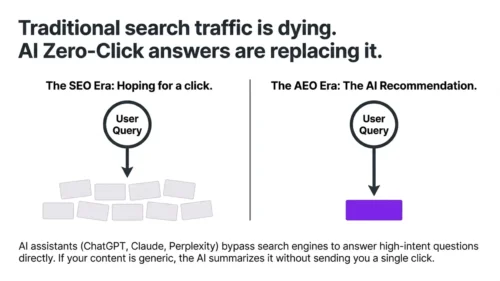
Rankings alone no longer tell the full story of whether content is performing well in an AI-driven search environment. Ahrefs’ April 2026 analysis found that only 38% of pages cited in Google AI Overviews ranked in the top 10 organic results, a sharp drop from 76% in its July 2025 study, underlining how loosely AI citation now tracks conventional rankings. A more complete measurement framework tracks utilisation, impact, and cost together, following roughly how a business adopts and scales any new technology. Practically, that means watching for citations and mentions across AI assistants, monitoring referral traffic and its quality rather than just its volume, and connecting that activity back to genuine enquiries and conversions rather than stopping at surface-level visibility. Zero-click activity, where a customer gets their answer without visiting a website at all, also needs accounting for separately, since traditional click-based metrics will simply miss it.
Google has introduced a dedicated Generative AI performance report in Search Console, rolled out to websites worldwide as of 31 August 2026, giving a clearer view of how content appears across AI Overviews and AI Mode. Marketing teams that build a fuller measurement picture using tools like this tend to spot what is actually working long before a competitor relying on old-fashioned ranking reports does.
Visibility Now Depends on Verifiable Evidence
The businesses that get recommended by AI assistants are rarely the loudest; they are the ones offering the clearest, most checkable answers to the questions customers are genuinely asking. That means original evidence, explicit and attributable claims, content structured for easy extraction, and information kept current enough to be trusted. None of this replaces solid technical foundations or established SEO practice; it builds on top of them.
For marketing teams wanting a practical next step, reviewing how existing content performs across distribution channels and AI-driven discovery points is a sensible place to start, particularly through multicasting services designed to extend a single piece of well-evidenced content across the platforms customers and assistants actually use.
| Topic / Area | Key Finding | Business Impact | Why It Matters |
|---|---|---|---|
| AI Overview citations | Only 37.1% of cited URLs rank top 10 | Strong evidence can outperform ranking alone | Optimise for answer quality, not positions alone |
| AI search measurement | Search Console now isolates generative-AI impressions | Identify pages gaining AI-search exposure | Measure visibility beyond conventional organic reporting |
| Content accessibility | ChatGPT Search requires OAI-SearchBot access | Blocked pages cannot surface in answers | Review robots.txt and firewall crawler permissions |
| Citation-led content | Clear, extractable evidence improves selection potential | Stronger brand mentions and qualified referrals | Original proof makes content harder to replace |
| Zero-click risk | AI summaries can reduce clicks to ranking pages | Traffic alone may understate brand visibility | Track citations, mentions, enquiries and conversions |
Frequently Asked Questions
How can I tell whether AI assistants are mentioning or citing my business?
Monitor branded prompts across major AI assistants, such as “best [service] in [location]” and “who provides [solution] for [audience]?” Record whether your business is named, linked or quoted. Combine this with AI-referral data, Search Console reporting and enquiry-source tracking to distinguish visibility from genuine commercial impact.
Does schema markup help content appear in AI search results?
Schema can help search engines interpret page elements such as products, reviews, events and FAQs, but it is not a shortcut to AI recommendations. Use accurate markup that reflects visible on-page information, then prioritise the factors assistants can evaluate directly: useful answers, trustworthy evidence, clarity and accessibility.
What types of content are most likely to be recommended by AI assistants?
The strongest candidates answer a specific buying or problem-solving question with evidence that competitors cannot easily replicate. Effective formats include documented case studies, transparent pricing explanations, comparison guides, original research, expert-led explainers, local service pages and practical troubleshooting resources updated when circumstances change.
How often should I update content for AI search visibility?
Review commercially important pages at least every six to twelve months, and sooner when prices, regulations, product details, service areas or customer needs change. Make substantive updates: replace outdated data, add new evidence, clarify claims and record the review date. Simply changing a publication date adds little value.
Should I create separate content for Google AI Overviews, ChatGPT and other assistants?
Usually, no. Build one authoritative, crawlable source of truth that answers the customer’s question clearly, then make sure each platform can access it under its crawler and indexing rules. Platform-specific distribution can extend reach, but duplicating generic versions for every assistant often weakens consistency and wastes resources.
