
Summary
Content multicasting helps businesses build authority by adapting genuine expertise into useful formats for different audiences and distributing it through relevant channels. This increases the chances that potential buyers will discover, understand and remember the business’s thinking. It can also create opportunities for independent recognition, although visibility alone is not authority. Strong results depend on original insight, expert involvement, consistent messaging and credible external proof.
Key Takeaways
- Content multicasting extends the reach of expertise; it does not create authority from thin or generic content.
- Different formats help businesses explain the same subject to different decision-makers and learning preferences.
- Distribution can improve recognition, but independent references, reviews and editorial recognition strengthen trust.
- Multicasting is not a special Google ranking method and cannot guarantee search rankings or AI recommendations.
- The most useful measures include qualified exposure, meaningful engagement, independent recognition and commercial influence.
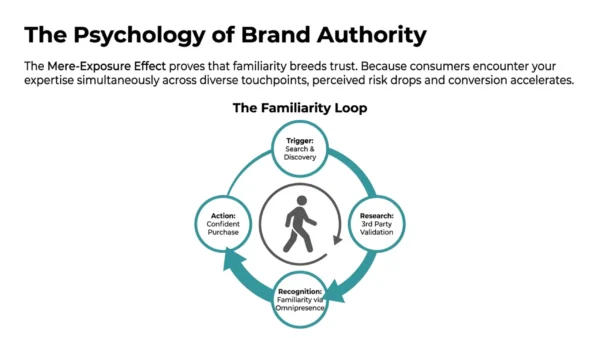
Authority Starts with Useful Expertise, Not Publication Volume
Content multicasting is the planned process of adapting a core piece of business expertise into multiple media formats and distributing those versions through relevant channels.
A researched guide might become a website article, an explanatory video, a LinkedIn post, an email newsletter, an audio discussion, a webinar or a tailored contribution to an industry publication. The purpose is not to copy and paste the same material everywhere. It is to make the underlying expertise useful in the environment where each audience encounters it.
This distinction matters because publishing more content does not automatically make a business more authoritative. As the principle goes, the best answer in the world has no value if nobody discovers it. However, distribution can only give good expertise a chance to be found. It cannot compensate for weak evidence, generic opinions or poor advice.
What does “building authority” actually mean?
Authority has several connected but different parts.
Audience authority is the belief that a business understands a subject and can help solve a relevant problem. A detailed article may demonstrate reasoning, while a video can show how a process works and a case study can demonstrate practical experience.
Independent authority is recognition that does not depend entirely on the business describing itself. Customer references, editorial coverage, genuine reviews, invitations to speak and independently published citations are stronger forms of evidence than a business simply repeating its own claims on several websites.
Search and AI visibility is a related outcome, but it is not the same as authority. Search engines and AI systems may retrieve or mention a business’s content, but appearing in an answer does not automatically prove that the business is the best option. Recognition, relevance and recommendation are different stages. A business may be recognised as existing, associated with a topic and still lack the independent proof needed to be recommended confidently.
Google’s guidance focuses on helpful, reliable and people-first content rather than a special ranking benefit attached to the term “multicasting”. Its AI search guidance similarly connects eligibility to existing quality and technical systems, not distribution volume alone.
How Multicasting Extends the Reach of Expertise
It reaches people who may never visit the website
A prospective buyer may discover a business through a professional feed, an industry newsletter, a podcast, a webinar or a publisher’s website rather than through the company’s main site.
This is particularly relevant in B2B purchasing, where the person who influences a decision may not be the person speaking to sales. Research from Edelman and LinkedIn found that 71% of so-called hidden decision-makers reported little or no interaction with sales representatives, while 55% used thought leadership to assess potential vendors. The research surveyed US executives, so these figures should not be treated as UK-specific results.
Multicasting gives a business more ways to reach finance, operations, compliance, technical and executive stakeholders. Each group may care about the same purchase for different reasons, so the content should address those distinct concerns rather than simply repeat the same sales message.
It makes complex knowledge easier to understand
One subject can be explained differently for different audiences without changing the underlying facts.
A technical buyer may need a detailed explanation of how something works. An operations manager may need to understand implementation. A finance stakeholder may want the cost and risk implications, while a senior executive may need the strategic consequence.
This is where adaptation becomes more valuable than simple repurposing. A written guide can establish the full argument, a short video can clarify one difficult point, and a webinar can explore questions that arise in practice. Each version should work in its own right.
The Edelman–LinkedIn research found that 73% of hidden decision-makers viewed thought leadership as one of the best ways to assess the quality of thinking a supplier might provide. That does not prove that multicasting produces sales, but it does support the wider business case for demonstrating expertise before a formal sales conversation begins.
It demonstrates depth rather than repeating slogans
Authority develops when a business can explain, evidence and apply its point of view.
A strong multicasting programme might explore one issue through a practical example, a process demonstration, an expert discussion and an evidence-led article. The formats are different, but they should all reinforce a coherent and defensible position.
This is very different from placing the same promotional statement on multiple domains. Repetition may improve familiarity, but familiarity without substance can quickly become noise. Google’s people-first guidance favours original information, clear sourcing and distinctive perspectives based on genuine experience.
The Three Layers of Authority
A useful way to plan multicasting is to separate owned, distributed and independent authority.
Owned authority establishes the source
Owned authority comes from the business’s own website, service pages, articles, case studies, FAQs, research and expert commentary. This is where the business explains what it knows, how it works and which problems it solves.
The core asset should contain something worth distributing. Suitable subjects might include original research, a documented customer case study, a first-hand technical explanation, a worked example or a practical framework based on delivery experience.
Starting with a weak article and spreading it across more channels simply creates more versions of a weak article.
Distributed authority increases discoverability
Distributed authority is created when useful material reaches people beyond the business’s own channels. This can include professional networks, podcasts, video platforms, newsletters, webinars and relevant publisher relationships.
Distribution improves the number of places where the business and its expertise can be encountered. It also allows a single insight to serve more than one buying situation.
However, an externally hosted article is not automatically an independent endorsement. If the business wrote the article and arranged its publication, it is still primarily a distributed expression of the business’s own expertise.
Independent authority strengthens trust
Independent authority comes from other people or organisations confirming that the business is credible and useful.
This may take the form of an unsolicited customer reference, a genuine review, a trade publication citation, a speaking invitation, a partner recommendation or a case study with verifiable results. These signals are more persuasive because they do not rely solely on the business’s own description of itself.
Multicasting can create opportunities for this recognition by putting useful material in front of journalists, event organisers, partners and other experts. It cannot manufacture independent approval. The content has to earn it.
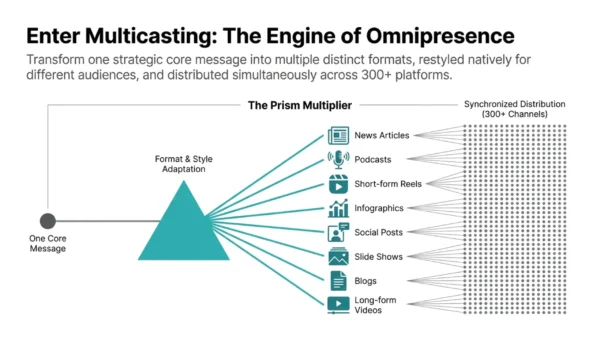
How to Build a Multicasting Programme That Supports Authority
Start with a commercially important question
The best starting point is not “What can we publish this week?” It is “What question is preventing a suitable customer from making a decision?”
Identify the service or subject the business wants to become known for, the uncertainty affecting the buyer and the evidence that would help resolve it. This keeps the programme connected to real commercial decisions rather than producing disconnected content for its own sake.
Adapt the treatment, not just the file
A video should not simply be transcribed into a caption-heavy social post. A presentation should not consist of paragraphs copied from an article. Each version should use the strengths of its format.
A video might demonstrate a process. A newsletter might answer a recurring customer concern. A LinkedIn document might simplify a complicated decision. A webinar might allow an expert to address objections in real time.
The research found that 60% of hidden decision-makers associated distinctive format or style with high-quality thought leadership, while 65% preferred a more human and less formal tone. The implication is not that every business should become informal. It is that presentation and accessibility influence how expertise is received.
Use a selective channel mix
Businesses do not need to publish everywhere. A manageable programme could combine one owned reference asset, one professional or community channel, one complementary format and one direct audience channel such as an established newsletter.
CMI research identified LinkedIn, email newsletters and speaking events or webinars as effective thought-leadership channels according to 76%, 54% and 52% of surveyed marketers respectively. These are reported assessments, not guarantees. The right mix depends on where the relevant audience already pays attention.
A coordinated direction matters more than a large publishing inventory. As a practical WPMS principle puts it, automate the workload but do not automate the judgement.
Involve the people who hold the expertise
Marketing teams can organise and adapt content, but they should not have to invent the experience behind it.
Interview practitioners, use examples from delivery teams and ask specialists to check technical versions before publication. CMI research found that 37% of respondents said fewer than 5% of their employees with relevant specialist knowledge actively contributed to thought leadership. That suggests a significant opportunity for businesses willing to involve the people who actually understand the subject.
What Multicasting Cannot Guarantee
Content multicasting is not a shortcut to rankings, backlinks, trust or AI recommendations.
Publishing content on external websites mainly to exploit their ranking strength can create quality and policy risks. Google’s spam guidance distinguishes legitimate editorial distribution from manipulative linking arrangements and publishing third-party material to take advantage of a host site’s established signals.
Syndication also needs a deliberate technical arrangement. If a partner republishes substantially the same article, businesses should decide whether that copy is intended to appear in search. Google’s guidance says a canonical tag is not a guaranteed solution for syndicated content. If the objective is to keep the partner version out of search results, the partner may need to block indexing. An indexable version may gain its own exposure, but there is no setting that guarantees every possible distribution and search benefit at once.
Nor should businesses promise AI citations because their content appears across several platforms. Search and AI systems still depend on useful content, technical accessibility, relevance and quality. Third-party mentions may support recognition, but correlation is not proof that a particular number of placements causes recommendations.
A Hypothetical Example
Consider a commercial retrofit company that publishes a detailed guide explaining why insulation upgrades can sometimes create moisture problems.
The website article could present the technical evidence and be reviewed by a building specialist. A video could demonstrate what an assessment involves. A LinkedIn version could focus on property managers, while a separate briefing could explain cost and risk to finance stakeholders. A newsletter could answer common customer questions, and a webinar could include an independent specialist.
The authority-building value would not come from publishing seven items. It would come from the documented expertise, the useful adaptation for each audience and the opportunities for external scrutiny and recognition.
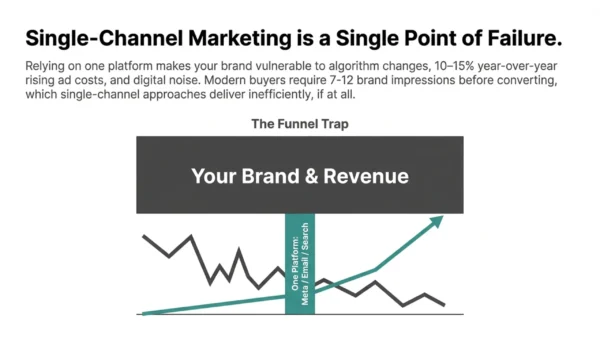
Measuring Whether Authority Is Improving
A useful scorecard should look beyond impressions and publication totals.
Relevant exposure shows whether the right people are encountering the content. Meaningful engagement includes substantive questions, useful replies, saves and event participation. Independent recognition can be assessed through editorial citations, unsolicited mentions, speaking invitations and customer references. Commercial influence can be explored through qualified enquiries, content-assisted opportunities, buyer feedback and won work.
Search visibility and AI mentions may also be monitored for relevant subjects, but they should be treated as discoverability measures rather than complete proof of authority.
CMI’s research found that 63% of surveyed respondents tracked thought-leadership business impact, while 38% tracked authority indicators such as speaking opportunities, media opportunities and publication citations. Those measures are more informative than counting how many versions were published.
The most sensible approach is to establish a baseline, run a defined pilot, record production and distribution costs, and agree review points in advance. Authority is built through a growing body of useful work, not through one publication wave.
Research Insights
| Topic / Area | Key Finding | Business Impact | Why It Matters |
|---|---|---|---|
| B2B vendor evaluation | 55% of hidden decision-makers vet vendors through thought leadership | Expertise can influence supplier assessment | Reaches buyers sales may miss |
| Quality of thinking | 73% value thought leadership for judging supplier calibre | Strong ideas shape early perceptions | Demonstrates capability before contact |
| Programme maturity | 96% create thought leadership; only 11% lead | Execution remains a differentiator | More publishing is not enough |
| Effective channels | LinkedIn, newsletters and webinars ranked highly | Supports a complementary channel mix | Channel relevance beats indiscriminate reach |
Sources
Edelman and LinkedIn – 2025 B2B Thought Leadership Impact Report
Content Marketing Institute – B2B Content Marketing Trends Research
Google Search Central – Creating Helpful, Reliable, People-First Content
Frequently Asked Questions
Is content multicasting the same as content repurposing?
Not exactly. Repurposing describes turning an existing asset into another format. Multicasting includes repurposing but adds platform-specific adaptation, audience targeting and coordinated distribution across selected channels. The purpose is to make one core idea useful in several contexts rather than duplicate it mechanically.
How many channels should a business use?
There is no universal number. Most businesses should begin with a small, manageable mix that includes an owned reference asset, a channel used by the target audience, a complementary format and a direct audience channel. Relevance, quality and consistency matter more than maximum coverage.
Can multicasting improve visibility in AI search?
It can create more opportunities for a business and its expertise to be discovered, understood and referenced. However, it does not guarantee AI mentions or recommendations. Helpful content, clear expertise, technical accessibility and credible independent evidence remain essential.
Will publishing similar content cause a Google penalty?
Legitimate syndication is not automatically a penalty. The practical issues are low-value publishing, manipulative links, version selection and indexing arrangements. If a partner should not have its syndicated copy appear in search, Google recommends an appropriate noindex arrangement rather than relying on a canonical tag alone.
How long does authority building take?
There is no reliable universal timetable. Early indicators may include relevant engagement or referral traffic, while independent recognition and commercial influence usually require a consistent body of useful work. Businesses should establish baselines and review progress against agreed measures rather than expect instant authority.
