
Summary
Local Search Visibility for service businesses in Bolton depends on much more than simply adding location names to website pages. Strong visibility comes from an accurate Google Business Profile, genuine customer reviews, clear service information, consistent business details, useful local content and evidence that the business is trusted both online and in the local area.
Key Takeaways
- Improving local visibility for a Bolton service firm means building a credible local entity, not simply adding “Bolton” to more web pages
- Google confirms that local search results are driven mainly by three factors: relevance, distance, and prominence
- A complete, accurate Google Business Profile is generally the single most important asset for a local service business’s visibility
- Fake locations, cloned town pages, and incentivised reviews can breach Google policy and put a profile at risk of restriction
- AI-powered search tools such as AI Overviews and AI Mode reward the same helpful, trustworthy content that already supports strong local rankings – find out how to prepare further inside
Service firms across Bolton often ask the same question: why does a competitor keep appearing at the top of Google while a perfectly good business stays buried on page two? The answer rarely comes down to luck or budget. It comes down to how clearly a business proves, to both Google and real customers, exactly what it does, where it genuinely works, and why it deserves trust.
Why ‘Bolton’ On A Page Isn’t Enough
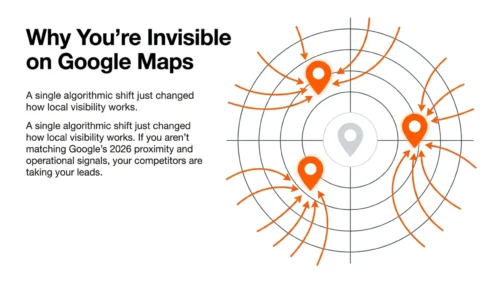
Many service businesses assume that repeating the word “Bolton” throughout a website will unlock better rankings. That approach misunderstands how local search actually works. Google tries to match searchers with the most relevant, trustworthy, and conveniently located business for their query, and a page stuffed with a town name does nothing to prove any of those qualities.
Bolton is a substantial market in its own right, with the metropolitan district recording 295,960 residents in the 2021 Census. That scale justifies a genuinely local focus for service firms, but it does not justify inventing a presence in every surrounding town just to appear in more searches. Improving local search visibility comes down to making it easy for Google and prospective customers to understand what a business does, where it truly operates, why it can be trusted, and how to get in touch.
Building that kind of credibility takes a strategic, joined-up approach rather than a single quick fix, a topic covered in AI visibility and search optimisation support for Bolton-based service firms, particularly as search shifts to AI-driven results alongside traditional listings. The rest of this guide breaks down exactly what drives local rankings, where the biggest opportunities lie, and which common mistakes quietly undermine visibility.
How Google Actually Ranks Local Results
Google has been fairly open about what shapes local search results: relevance, distance, and prominence. Understanding these three pillars gives a service firm a practical framework for deciding where to spend time and effort, rather than chasing tactics that sound clever but achieve little.
Relevance: matching what searchers want
Relevance measures how closely a Business Profile and website match what someone actually typed into Google. A plumber searching term like “emergency plumber Bolton” needs a business profile and website that clearly state emergency plumbing services, not a vague listing under a generic “home services” category. Complete, detailed business information genuinely improves relevance, which means accurate categories, clear service descriptions, and focused service pages all pull their weight.
Distance: why proximity can’t be gamed
Distance reflects how far a business sits from the searcher or the location mentioned in their search. This is the one factor a business simply cannot manipulate through clever copywriting or extra web pages. A Bolton-based electrician might rank strongly for searches in Horwich or Farnworth, then struggle for the same search made in central Manchester, purely because closer, equally credible competitors exist there. Publishing dozens of near-identical location pages will not close that distance gap, and it risks creating thin content that looks like an attempt to manipulate rankings.
Prominence: earning trust online and offline
Prominence is about how well known and trusted a business appears, both online and in the real world. Google draws on signals such as links, articles, directory listings, review volume, and review scores to judge this, and a business’s ordinary organic search performance also feeds into local rankings. In practice, this means the businesses that rank well tend to be the ones customers, other websites, and local organisations already vouch for in some way.
Your Google Business Profile Is The Foundation
For most local service businesses, the Google Business Profile carries more weight than any other single asset, since it directly affects visibility across Google Search and Google Maps. Treating it as a “set and forget” listing is one of the most common reasons visibility stalls.
Getting the basics accurate and complete
Getting the fundamentals right matters more than any advanced tactic. A well-managed profile should include:
- The real trading name used on signage and invoices, never a keyword-stuffed version designed to game search
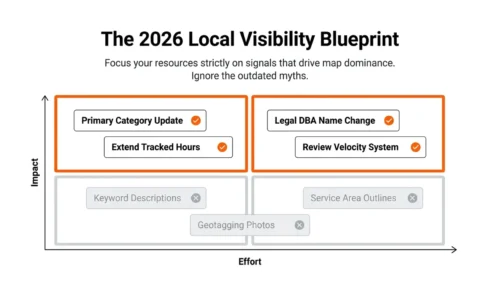
- The most accurate primary category available, since this is one of the strongest relevance signals Google uses to understand what a business fundamentally does
- Only legitimate secondary categories that reflect services genuinely offered
- Complete contact details, opening hours, services, and booking links where relevant
- Original photographs of real work, vehicles, and completed projects rather than generic stock imagery
Consistency matters just as much as completeness. Google’s own guidance stresses that a profile should represent a business exactly as it’s recognised in the real world, with a precise and accurate address or service area.
Service-area businesses: address, radius and separate profiles
Trades and mobile services such as plumbers, cleaners, and mobile locksmiths need particular care here, because this is where many otherwise well-run businesses accidentally breach Google’s policies. A service-area business travels to customers rather than serving them at its own premises, and Google only permits one profile per genuine, staffed location.
The practical rules are straightforward:
- Hide the business address from public view if customers never visit it
- Specify the genuine towns or postcodes served, rather than an unrealistic or exaggerated radius
- Google permits up to 20 service areas and advises that the boundaries of the overall area shouldn’t be more than about two hours of driving time from where the business is based
- Only create a second profile for a separate, real, staffed location – never for a virtual office, mailbox, or friend’s address
Skipping this step, or creating profiles for towns where no real presence exists, is one of the fastest routes to a suspended listing.
Reviews, Website Quality And Local Proof
Beyond the Business Profile itself, two things carry the most weight for local rankings: what customers say about a business, and how well its website supports what the profile claims. Neither can substitute for the other.
Why review count and score shape rankings
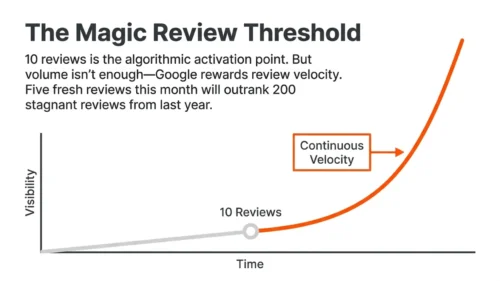
Reviews do double duty: they influence whether someone chooses to call a business, and they directly affect ranking, since Google has confirmed that review count and score are part of its local ranking system. BrightLocal’s 2025 survey found that 83% of consumers used Google to read reviews of local businesses, underlining how central this platform has become to buying decisions. A steady flow of recent, genuine reviews signals ongoing activity and reliability far more effectively than a handful of reviews collected years ago. The most sustainable approach is asking every suitable customer for feedback shortly after a completed job, using a simple, official review link, and replying to both positive and negative reviews professionally.
Building a website Google – and customers – trust
A strong Business Profile cannot make up for a slow, confusing, or thin website, because Google has stated that ordinary SEO performance affects local results too. A useful website for a Bolton service firm typically includes one clear page per core service, an honest “areas we serve” page, and case studies that document real jobs, outcomes, and customer types. Mobile usability deserves particular attention, since most local customers search, browse, and book directly from a smartphone. Sites that publish regular, genuinely useful content also tend to build more indexed pages over time, giving Google more opportunities to understand and rank the business for relevant searches.
Consistent citations and genuine local links
Citations – mentions of a business’s name, address, and phone number across directories and industry sites – work best when they’re accurate and consistent everywhere they appear, from the company website to trade directories and local business listings. One accurate listing on a respected trade body or local organisation’s website often carries more weight than dozens of low-quality directory submissions. Genuine local links and mentions, earned through community involvement, supplier relationships, or media commentary, add real prominence that Google can recognise, while engaging with local causes such as sponsoring an event or working with a regional partner tends to produce far more valuable links than any purchased directory package ever could.
Mistakes That Undermine Local Visibility
Even well-intentioned service firms can damage their own visibility through shortcuts that look tempting but breach Google’s policies or simply fail to work. Recognising these mistakes early saves both time and reputation.
Fake locations and policy-breaking profiles
Creating a Business Profile for every town a service covers, when no genuine staffed location exists there, is a direct breach of Google’s policy and risks the whole profile being suspended. It’s a tempting shortcut for map-pack coverage, but the downside – losing an established, verified listing – far outweighs any short-term gain.
Cloned town pages and keyword-stuffed names
Duplicating a service page across dozens of near-identical “[service] in [town]” pages, changing only the town name, tends to backfire. Google prioritises helpful, reliable, people-first content and actively warns against pages created primarily to manipulate rankings. Similarly, cramming keywords into a business name – something like “Bolton’s Best Emergency Plumber” instead of the real trading name – misleads users and can trigger Google edits or enforcement action.
Fake or incentivised reviews
Paying for reviews, incentivising positive ratings, or filtering out unhappy customers before they leave feedback all fall under Google’s Fake Engagement policy, which is enforced seriously. Businesses that break this policy can lose the ability to receive new reviews, have existing reviews unpublished, or have a warning displayed to consumers that fake reviews were removed. A steady, honest review-request process, applied fairly to every customer, remains the far safer and more durable strategy.
Preparing For AI-Powered Search
Search is expanding beyond the traditional list of blue links, with AI Overviews and AI Mode now shaping how many people find local services. Google’s published position is reassuring for businesses already doing the fundamentals well: the same core principles apply to these AI features as to conventional search, covering technical eligibility, compliance with search policies, and helpful, reliable, people-first content.
Google launched dedicated Generative AI performance reports in Search Console on 3 June 2026, initially rolled out to a subset of UK-based sites, with the worldwide rollout completed by 31 August 2026. These reports show impressions for visibility in AI Overviews and AI Mode, giving businesses a clearer view of which pages are being drawn on by these newer search features.
In practice, this means a Bolton service firm preparing for AI-powered search should focus on the same groundwork already covered above, rather than searching for an entirely separate set of tricks. Clear, verifiable facts about services, service areas, credentials, and pricing help AI features summarise a business accurately. Demonstrating real first-hand experience through case studies, named expertise, and documented outcomes gives these systems something genuine to draw on, while independent corroboration – reviews, trade memberships, local mentions – continues to build the kind of trust that both people and algorithms respond to.
Credibility, Not Volume, Wins Local Search
The businesses that consistently show up in Bolton’s local search results rarely rely on volume tactics like extra town pages or bulk directory submissions. They rely on accuracy, genuine reviews, a website that answers real customer questions, and evidence that they’re trusted both online and in the community. That combination takes more patience than a quick fix, but it builds visibility that holds up over time rather than collapsing the moment Google updates its algorithm or tightens a policy.
Getting started doesn’t require an overwhelming overhaul. For a practical next step, consider reviewing Google Business Profile optimisation and AI visibility support designed for service firms as search shifts to AI-powered local results.</content> Search is expanding beyond the traditional list of blue links, with AI Overviews and AI Mode now shaping how many people find local services.
| Topic / Area | Key Finding | Business Impact | Why It Matters |
|---|---|---|---|
| Local ranking factors | Google prioritises relevance, distance and prominence | Focus investment on controllable credibility signals | Explains why keyword repetition alone rarely improves rankings |
| Google Business Profile | Complete, accurate profiles improve search-query matching | Better Maps visibility and stronger customer conversion | Categories, services and real-world details clarify relevance |
| Reviews and reputation | Review volume and positive ratings can support rankings | Builds trust before a customer contacts you | Reviews influence prominence and local buying confidence |
| Service-area compliance | One profile per genuine staffed business location | Avoids suspension and protects established visibility | Virtual offices and false addresses breach Google guidelines |
| Consumer review behaviour | 42% trust reviews as much as personal recommendations | Makes regular review collection commercially valuable | Recent, detailed customer feedback reduces perceived purchase risk |
Frequently Asked Questions
How long does it take to improve local search rankings in Bolton?
Most service businesses see progress gradually rather than overnight. Updating a Google Business Profile, improving service pages, earning genuine reviews, and correcting inconsistent details can show benefits within weeks, but stronger prominence and competitive rankings often take several months of consistent work.
Can a service business rank in Bolton if it is based outside the town?
Yes, but proximity still matters. A business outside Bolton can appear for Bolton searches when its services, reviews, website, and local reputation strongly match the search, especially for users searching by town name. It should not create a false Bolton address or profile.
What should I include on a Google Business Profile for better visibility?
Use your real trading name, correct primary category, accurate phone number, opening hours, service areas, services, website link, and original photos. Keep the profile active by responding to reviews and updating information whenever business details, availability, or services change.
Are location pages still useful for local SEO?
They can be useful when each page offers genuinely different, helpful information. For example, a page about plumbing services in Horwich could include real jobs completed there, local customer needs, relevant travel details, and specific service guidance—not merely replace “Bolton” with “Horwich” throughout identical copy.
How can my business appear in AI Overviews or AI-powered local search?
There is no separate shortcut or submission process. Focus on clear service information, accurate local details, original case studies, recognised credentials, recent reviews, and content that directly answers customer questions. AI search systems need reliable evidence to confidently describe and recommend a local business.
