
Summary
Authority marketing helps businesses earn trust before a sales conversation begins by making expertise visible, credible and consistently useful. Rather than relying on promotional messaging, it builds long-term recognition through thought leadership, original research, expert insights and strategic content distribution that influences buyers throughout the decision-making process.
Key Takeaways
- Authority marketing is the disciplined process of making expertise publicly visible, verifiable, and useful so trust is built before a sales conversation begins.
- 64% of hidden B2B decision-makers trust thought leadership content more than marketing materials and product sheets when assessing competencies, according to the 2025 Edelman-LinkedIn study.
- Authority cannot be declared – it is earned through proprietary evidence, consistent distribution, and repeated recognition from the people whose trust actually drives revenue.
- A single monthly interview can generate a full month of multi-channel content, making authority-building far more operationally realistic than most marketing teams assume.
- The metrics that prove authority is working go well beyond page views – keep reading to see which commercial signals matter most.
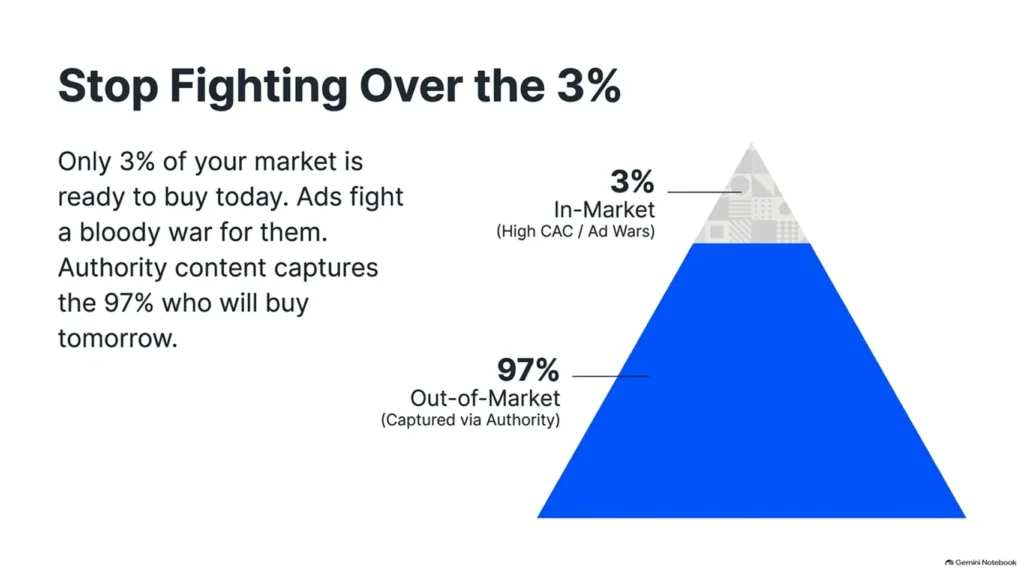
Most B2B marketing budgets chase buyers who are actively shopping right now. That group represents, at best, a small slice of any addressable market. Authority marketing is the strategy that works on everyone else – building the kind of trust and recognition that means when a buyer does enter the market, one name is already at the top of the list.
64% of Hidden B2B Decision-Makers Trust Thought Leadership Over Vendor Marketing
The 2025 Edelman-LinkedIn B2B Thought Leadership Impact Study surveyed 1,934 global business executives and surfaced a finding that should reframe every B2B content budget conversation: 64% of hidden decision-makers – the finance leads, procurement managers, technical reviewers, and legal stakeholders who influence deals but rarely appear on discovery calls – trusted thought leadership content more than marketing materials and product sheets when assessing competencies.
It gets more compelling. 79% of those same respondents said consistently high-quality thought leadership made them more likely to advocate for a supplier during an RFP. And 95% reported being more receptive to outreach from brands with a strong thought leadership presence. These are not passive readers. They are the internal voices that either accelerate or stall a deal.
The takeaway for Marketing Directors is direct: authority content is not a brand-awareness luxury – it is a buying-group strategy. Teams at West Pro Media Services work with B2B businesses to build exactly this kind of multi-channel, expert-led presence – the kind that reaches the stakeholders a sales team will never speak to directly.
Authority Marketing Is Not What Most Brands Think It Is
Expertise vs. Authority: A Critical Distinction
There is a clean way to separate these two ideas: expertise is what you know; authority is the recognition others grant you because your knowledge repeatedly proves useful. A firm can employ the sharpest minds in its sector and still have zero authority in the market if that expertise never becomes visible, verifiable, or useful to buyers.
Authority marketing is the long-term practice of turning internal expertise into public proof – original content, credible named contributors, third-party validation, and consistent presence in the places where buyers learn and evaluate vendors.
What Authority Marketing Is Not
The term gets stretched to cover almost everything, so precision matters here.
- A logo badge. A featured-in mention without sustained, substantive contribution is decoration, not authority.
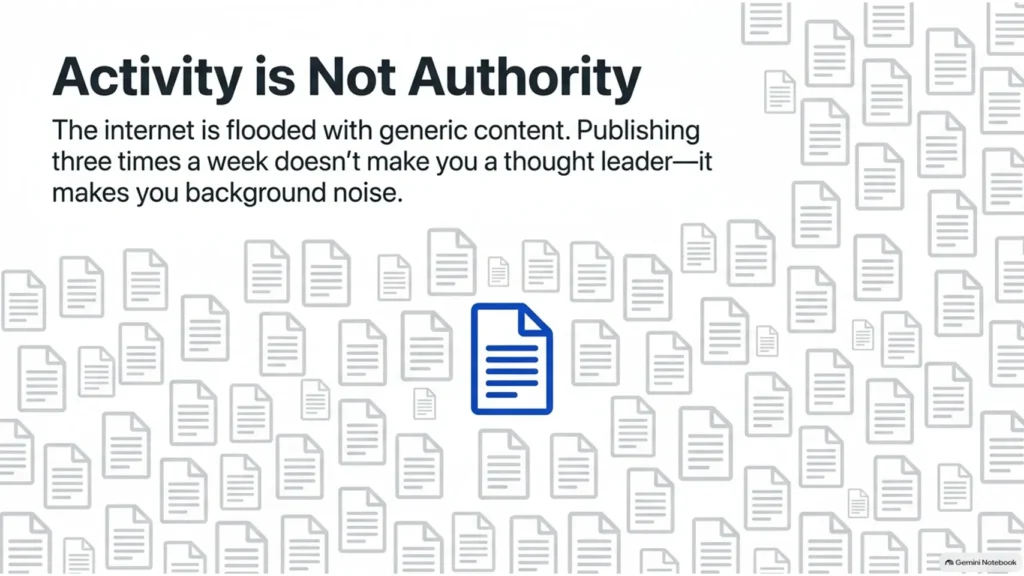
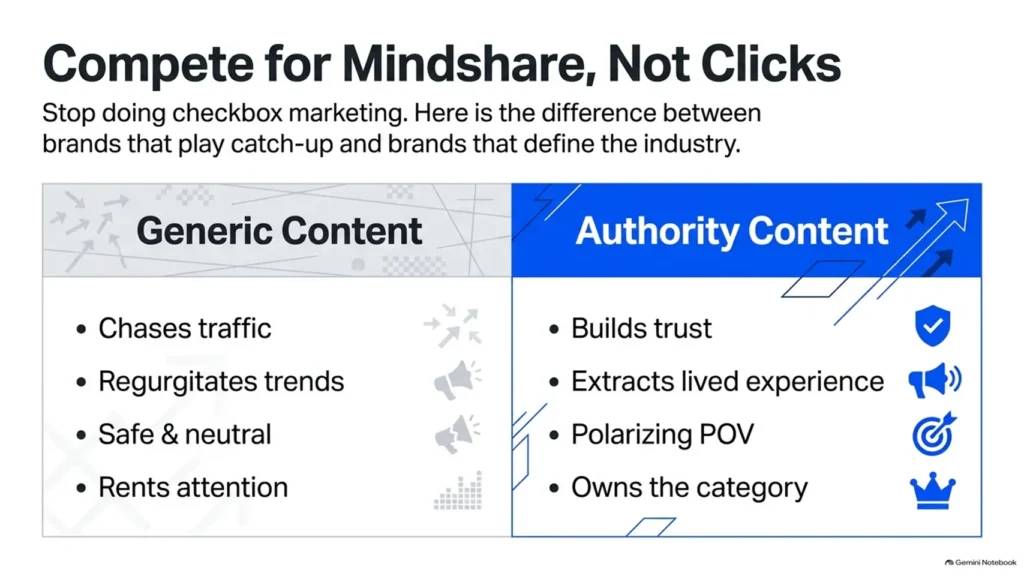
- Content volume. Publishing two generic blog posts a week because it is on the calendar is checkbox marketing. Frequency without genuine insight produces invisibility.
- A high Domain Authority score. Search metrics support authority; they do not create it.
- Brand awareness alone. Awareness builds recognition; authority builds trust in competence – a meaningfully different commercial outcome.
- Thought leadership in isolation. Thought leadership is one of the most powerful assets inside an authority program, but the program itself is broader – covering distribution, evidence, human visibility, and external endorsement.
Why It Changes the Commercial Terms of Every Deal
Reduced Buyer Risk Before the First Call
When a prospect arrives at a sales conversation having already consumed a benchmark report, a detailed framework, or an expert commentary piece from a vendor, the dynamic shifts. The vendor is no longer an unknown quantity being evaluated – they are a familiar, trusted voice being confirmed. Perceived buyer risk drops before anyone opens a proposal document.
This matters especially in complex B2B sales where buying committees are large and misaligned. Research from the Edelman-LinkedIn study found that more than 40% of B2B deals stall because internal buying groups cannot reach consensus. Authority content – risk analyses, implementation guides, concise executive summaries – gives internal champions the material they need to defend a decision to stakeholders the vendor will never meet.
Premium Positioning and Shorter Sales Cycles
Buyers are far less likely to treat a recognized specialist as interchangeable with a generic vendor. That perception shift has a direct effect on pricing conversations and cycle length. Companies that build genuine authority consistently report two commercial improvements: reduced price sensitivity (buyers shift from cost-comparison to value-comparison) and shorter sales cycles (prospects arrive pre-sold on expertise, so fewer qualification conversations are needed).
Authority also compounds. A single well-researched original insight can become an article, a LinkedIn series, a webinar, a sales enablement asset, a podcast segment, a PR hook, and a newsletter – each version reinforcing the same credibility signal across different stages of the buyer journey.
How to Build a Defensible Authority Position
Claim a Narrow, Consequential Territory
Broad category claims are not credible without years of demonstrated expertise and substantial third-party recognition. The more specific the territory, the faster authority accumulates. A useful test: define the specific audience, the consequential problem that audience is trying to solve, and the distinctive expertise or data access the business brings to that problem. Helping UK B2B content teams build practical AI governance workflows identifies an audience, a context, and an outcome – that is a territory worth owning.
Create Proprietary Evidence, Not Recycled Opinions
Original research, named frameworks, transparent case studies, and benchmark reports consistently outperform recycled listicles as authority-building assets for a simple reason: they give journalists, peers, prospects, and AI-powered search systems something concrete to cite rather than merely paraphrase. High-value formats include annual industry benchmark indices, evidence-led case studies that document starting point, actions, constraints, timeframe, and results, and contrarian analysis that shows its methodology and acknowledges trade-offs. Buffer’s State of Remote Work, Ahrefs’ AI Overviews analysis, and HubSpot’s annual State of Marketing report are referenced and cited across the industry for years after publication – that is compounding authority in practice.
Make the Human Source Visible
Every substantive piece of authority content should clearly establish who created or reviewed it, why that person is qualified, when it was published, and what sources or methodology underpin the claims. Google’s people-first content guidance explicitly asks publishers to consider the who, how, and why of content – and buyers apply the same standard intuitively. Named authors with relevant credentials and first-hand experience consistently produce more trustworthy content than anonymous corporate copy.
The 1-Hour Monthly Interview and Zero-Click Delivery Model
Extracting a Month of Content From One Conversation
Most senior B2B leaders do not have time to write long-form content. The practical solution is a structured monthly interview – typically one hour – recorded with a subject-matter expert or founder, then systematically repurposed by a production team. That single conversation yields social media snippets, newsletter sections, blog articles, sales enablement scripts, and short-form video clips, all sourced from authentic, first-hand expertise rather than AI-generated filler.
AI tools can support this process responsibly – running transcripts through language models to identify key moments for human editors, or generating raw outlines from interview content – but the human expert remains the irreplaceable source. That is the distinction between AI-assisted and AI-replaced authority.
Delivering Value Where Buyers Already Are
The zero-click content model is built around a simple behavioral insight: buyers increasingly expect complete value within the platform they are already using. A LinkedIn post that delivers a full, actionable insight – without requiring a click to a landing page – gets consumed by far more of the intended audience than a teaser linking to a gated resource. Hidden decision-makers are scrolling feeds, listening to podcasts, and reading email newsletters, not searching for vendor blog posts. Distribution designed around where buyers learn, rather than where analytics are easiest to track, is what closes the gap between content investment and commercial return.
Metrics That Prove Authority Is Working
Visibility and Recognition Signals
- Branded search impressions and clicks (Google Search Console now offers a dedicated branded-query filter to separate this cleanly)
- Share of voice in target publications, communities, and industry conversations
- Quality and relevance of earned editorial links, citations, and media mentions
- Invitations to speak, contribute to panels, or be quoted as an expert source
Commercial Impact Indicators
- Pipeline influenced by authority content, tracked through CRM attribution
- Sales cycle length and win rate for accounts that engaged with thought leadership before a discovery call
- RFP invitation rate and shortlist frequency
- Deal size and price sensitivity for engaged versus cold accounts
- Customer retention rate and referral volume – both strong indicators that authority extends beyond acquisition
Page views and MQL downloads tell a partial story. The metrics above tell the commercial one.
Common Mistakes That Stall Authority Programs
- Starting too broad. Claiming to help everyone with everything is not a territory. Specificity is what makes authority credible.
- Confusing volume with depth. Posting frequently without a distinctive point of view produces noise, not recognition.
- Making unsupported claims. Language like industry-leading or proven without methodology or independent verification actively weakens trust.
- Producing unedited AI content at scale. AI can assist research and drafting, but derivative, high-volume pages without expert review or original evidence do not demonstrate expertise – they dilute it.
- Ignoring distribution. Excellent work that never reaches target buyers, peer communities, or journalists cannot accumulate external validation, no matter how strong the content is.
- Being promotional too early. Authority content must be useful to someone who never becomes a customer. The moment it reads like a brochure, it stops building trust.
- Measuring only traffic. An authority program can succeed through pipeline influence, referrals, and higher-quality deal flow long before it moves a sessions number.
Authority Cannot Be Declared – Only Earned Through Repeated, Visible Proof
There is no shortcut to this. Authority is not the result of a rebrand, a press release, or a featured-in footer badge. It is the accumulated outcome of making expertise visible, verifiable, and genuinely useful – over and over, in the places where target buyers already learn and evaluate vendors.
The B2B buyers most worth reaching are already consuming thought leadership from someone. The question is whether that someone is a competitor or the brand investing in this now. Every benchmark report published, every expert interview distributed, every framework shared without a sales pitch attached moves that needle incrementally – and those increments compound.
For Marketing Directors building the case internally: authority marketing does not replace demand generation. It reduces the cost and friction of every demand generation effort that follows it.
| Topic / Area | Key Finding | Business Impact | Why It Matters |
|---|---|---|---|
| Hidden B2B buyers | 95% become more receptive to outreach | Strengthens sales access beyond named contacts | Influencers often shape decisions privately |
| Thought-leadership adoption | 96% of B2B marketers create it | Standing out requires depth, not participation | Content volume alone no longer differentiates |
| Effective distribution | LinkedIn leads; newsletters and webinars follow | Reach buyers where professional learning happens | Expert insight needs repeatable multi-channel delivery |
| Measurement and ROI | 63% measure leads or pipeline influence | Connect authority work to commercial outcomes | Traffic alone rarely proves strategic value |
| Execution challenge | Fewer than 5% of employees contribute | SME interview systems unlock authentic expertise | Authority depends on visible human expertise |
Sources
Frequently Asked Questions
How is authority marketing different from thought leadership?
Thought leadership is a major authority-building asset: it shares a useful, distinctive perspective on an industry problem. Authority marketing is broader. It combines expert-led insight with proof, distribution, third-party recognition and consistent visibility, so buyers repeatedly see evidence that a business is credible.
How long does authority marketing take to show results?
Expect early visibility signals—such as stronger branded search, relevant engagement, invitations and sales conversations—within several months of consistent work. Commercial effects usually take longer because B2B buying cycles are long. The aim is cumulative recognition, not a one-off spike in traffic or leads.
What content builds authority most effectively in B2B?
The strongest formats offer evidence that competitors cannot easily copy: original research, transparent case studies, practical frameworks, expert interviews and well-supported contrarian analysis. Content should solve a real decision-making problem, name its author and explain its sources, method or first-hand experience.
Can AI-generated content build genuine authority?
AI can accelerate transcription, research organisation, outlining and repurposing, but it cannot substitute for lived expertise, original evidence or accountable editorial judgement. Use it to help experts communicate more consistently—not to publish unverified, anonymous content at volume. Buyers and search systems both need clear signs of human credibility.
How do you measure the ROI of authority marketing?
Measure whether authority changes commercial behaviour, not merely whether pages receive visits. Track branded-search growth, relevant citations and media mentions, expert speaking invitations, RFP shortlists, pipeline influenced by content, win rates, deal values and sales-cycle length. Search Console’s branded-query filter can help distinguish brand demand from non-branded discovery.
To find out how West Pro Media Services helps B2B brands build and distribute expert-led content at scale, visit westpromediaservices.com.
