Summary
Content distribution is the strategic process of getting your content in front of the right audience across multiple channels, while social media posting is just one tactic within that strategy. Businesses that combine owned, earned and paid media with a structured distribution plan generate greater visibility, build stronger authority and achieve better long-term marketing results than relying on social posts alone.
Key Takeaways
- Content distribution is a strategic, multi-channel system – social media posting is just one tactic within it, not the whole plan.
- The owned, earned, and paid framework is the clearest way to understand how distribution actually works – and where most budgets go wrong.
- Social media algorithms actively suppress posts with outbound links, which means posting alone will never replace a real distribution strategy.
- Engagement metrics like likes and impressions are diagnostics, not business outcomes – qualified clicks, email signups, and pipeline tell a more honest story.
- West Pro Media Services outlines how a structured multicasting approach solves the exact gap most content teams run into: producing assets without a system to move them.
Posting Is Not a Strategy
Every marketing team publishes content. Far fewer actually distribute it. That gap – between hitting “post” and ensuring the right people repeatedly discover, consume, and act on a piece of content – is exactly where most B2B content budgets quietly leak.
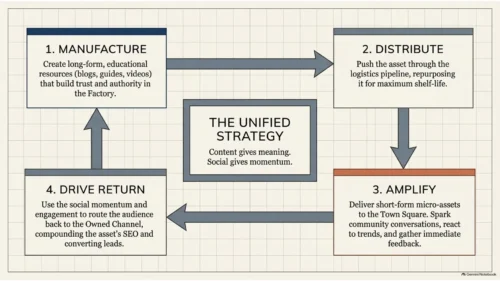
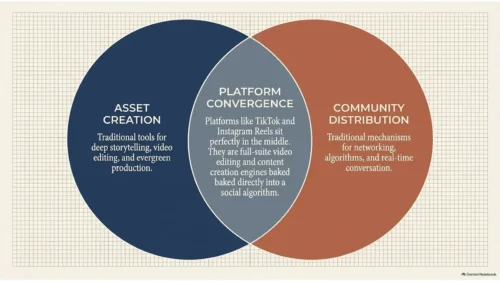
Social media posting is the act of publishing content on a platform like LinkedIn, Instagram, or X to generate reach and engagement. Content distribution is something larger: the end-to-end system for getting content in front of the right audience through owned, earned, and paid channels – with a plan for what happens after someone sees it. A useful way to frame the difference: posting puts content on social media; distribution ensures the right people repeatedly discover, consume, and act on it – on social and beyond.
According to Content Marketing Institute, 89% of B2B marketers use organic social platforms to distribute content. But 84% also use corporate blogs, 71% use email newsletters, and 63% use email directly. That data tells the real story: social is a major distribution channel, not a complete distribution strategy. Treating it as the latter is one of the most common – and costly – mistakes content teams make.
Two Different Jobs, One Confused Budget
Conflating these two disciplines doesn’t just create confusion – it actively misdirects resources. When social posting gets mistaken for distribution strategy, teams optimize for the wrong metrics, skip the channels that compound over time, and burn budget amplifying content that was never built to convert.
Content Distribution: The Full System
Distribution is the strategic layer. It defines which audiences need which ideas, in which channels, and what should happen after they engage. It spans the full buyer journey – from initial awareness through search and social discovery, to conversion via email nurture, to long-term retention through owned communities and evergreen content. The goal is repeatable, measurable reach that builds toward pipeline and revenue.
Social Media Posting: One Channel, One Window
Social posting operates at the channel level. It means publishing platform-native content organically, within a concentrated window of visibility. Most engagement on a social post happens within hours. The audience reached largely belongs to the platform, not the brand. That’s not a reason to dismiss social – it’s a reason to position it correctly within a broader system rather than let it carry the whole load.
The Owned, Earned, Paid Framework
The clearest way to understand content distribution is through the owned, earned, and paid framework – a widely recognized industry standard that maps directly to how a distribution strategy should be structured, with each channel type playing a distinct role in reaching and converting audiences.
Owned: Channels You Control
Owned media includes any channel a business substantially controls: the website, blog, email list, newsletter, podcast, and customer community. These are the most durable distribution assets because they don’t depend on a third-party algorithm to reach an audience that was already earned. A well-optimized blog post can attract qualified organic traffic for years. An email list, once built, can be reached directly. The strategic goal of owned distribution is compounding discoverability and audience ownership – not a one-time traffic spike.
Social posts should drive toward owned channels: encouraging subscriptions, signups, event registrations, or deeper content engagement – not serve as the final destination.
Earned: Credibility You Can’t Buy Directly
Earned media is exposure gained because someone else chooses to share, cite, feature, or recommend content. This includes PR coverage, editorial backlinks, expert quotes, customer advocacy, influencer mentions, and community discussion. Earned distribution typically carries high credibility precisely because it isn’t purchased. The trade-off is less predictability. The way to earn it consistently is to create assets worth citing: original research, useful frameworks, distinctive viewpoints, and well-structured data.
Paid: Controllable Reach With a Catch
Paid distribution – social ads, search ads, sponsored newsletters, paid syndication, retargeting – offers controllable reach and supports testing. Content Marketing Institute data shows 84% of B2B marketers use paid channels, with PPC rated as the most effective among them. The catch is that paid amplification works best when it’s amplifying something that already has proven organic resonance. Boosting every post regardless of performance wastes budget fast. The smarter model: test organically, then scale selectively with spend behind content that generates qualified action.
Why Algorithms Work Against Distribution
Understanding the algorithm isn’t about finding hacks – it’s about understanding the constraints that make social posting an incomplete distribution strategy on its own.
The Outbound Link Penalty
Platforms like LinkedIn and Facebook are built to keep users inside their ecosystems. Posts containing outbound links to external websites are actively suppressed in organic reach because they direct traffic away from the platform. This is a structural reality, not speculation – and it directly contradicts the common advice to “share your blog posts on social media.” A better approach: write native, value-first content on the platform, and place external links in the comments or bio rather than the post body itself.
Engagement Signals That Actually Matter
Across platforms, the signals that tend to drive algorithmic reach include retention and dwell time, meaningful engagement (comments, saves, shares, DMs), relationship history with an audience, and content originality. TikTok has stated that finishing a longer video is a stronger interest signal than passive contextual factors. YouTube frames its recommendation objective around viewer satisfaction, not raw view counts. Content that earns genuine reactions from a defined audience will consistently outperform content engineered for surface-level impressions.
Longevity: Blogs vs. Posts
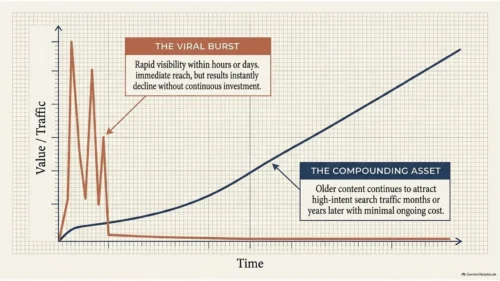
One of the starkest differences between distribution-led content and social-first posting is shelf life. A well-structured, SEO-optimized blog post can attract consistent organic traffic for months or years after publication. A social media post – even a high-performing one – typically exhausts most of its engagement within 24 to 48 hours before disappearing down the feed.
The stronger model is to build a flagship asset first, then distribute it through multiple formats and channels. A long-form article becomes a LinkedIn text post, a short video hook, a newsletter insight, a sales enablement piece, and a retargeting creative. That single asset, properly distributed, generates far more return than the same effort spent publishing isolated posts day after day.
