
Summary
Content syndication and guest blogging achieve different goals. Syndication expands the reach of existing content to generate awareness and leads, while guest blogging builds authority and credibility by publishing original content on trusted third-party websites. The strongest B2B marketing strategies use both together, choosing each tactic according to the business objective rather than treating them as alternatives.
Key Takeaways
- Content syndication and guest blogging are not interchangeable – they solve fundamentally different problems at different stages of a B2B marketing strategy.
- Syndication is a distribution engine for existing assets; guest blogging is an authority-building investment that requires original, publication-specific thinking.
- SEO controls like noindex and canonical tags matter – but neither is foolproof, and the wrong setup can cost your source page its ranking edge.
- The strongest B2B content programs run both tactics in parallel, with separate content, separate metrics, and separate success criteria – a portfolio approach covered in detail below.
- West Pro Media Services Ltd’s multicasting service is built around the principle that great content deserves strategic distribution – not just publication.
B2B marketers constantly conflate these two tactics, and the cost of that confusion is real. Both put your content in front of new audiences – but the mechanism, the intent, and the downstream value are entirely different. Getting clear on which one to use, and when, is the difference between burning budget and building pipeline.
Two Tactics, Two Completely Different Jobs
Content syndication and guest blogging look similar on the surface. Both involve your content appearing somewhere other than your own website. That is where the similarity ends.
Syndication takes something that already exists – a research report, a buyer guide, a webinar recording – and distributes it across third-party platforms, publisher networks, or newsletters to expand its reach. The asset is yours. You are simply putting it in front of more of the right people.
Guest blogging means writing something entirely new, specifically for another publication’s audience. The editorial bar is higher, the relationship is personal, and the goal is credibility rather than reach.
A clean way to frame it: syndication amplifies an asset. Guest blogging creates a new one for someone else’s audience. Both can generate leads, but they earn trust through completely different mechanisms.
What Each Strategy Actually Does
Content Syndication: Distributing What Already Exists
Content syndication involves republishing existing content – articles, reports, white papers, videos – across third-party platforms to expand visibility, generate leads, and drive brand presence at scale. B2B marketers have widely adopted syndication because it stretches the value of content that took significant resources to produce.
The business case is strong when the asset is worth distributing. Syndicated content can drive meaningful increases in referral traffic and, when paired with strong ICP targeting, supports Account-Based Marketing by surfacing buying committees within key accounts. B2B companies that use syndication to generate high-quality leads – not just form fills – have reported notably higher sales achievement rates.
The operative phrase is high-quality leads. A content syndication lead is typically someone who downloaded an asset on a third-party platform. That is an intent signal, not purchase readiness. The real commercial value is unlocked through nurture, not immediate handoff to sales.
Guest Blogging: Creating Something New for Someone Else’s Audience
Guest blogging means writing an original, bylined article for a publication your target audience already reads and trusts. Done well, it builds authority that no paid distribution channel can replicate – because the publisher is implicitly vouching for the contributor’s expertise.
The results, when earned properly, compound over time. Case studies from B2B tech companies show that strategic guest blogging campaigns can meaningfully increase Domain Authority and organic traffic within six months. Brand awareness gains from consistent guest contributions have been reported across multiple studies, though individual results vary significantly based on publication quality and content relevance.
The key word is earned. Guest blogging is only effective when the content is genuinely useful to the host publication’s readers – not when it is thinly veiled promotion dressed up as editorial content.

Head-to-Head: Objectives, Costs, and Lead Quality
Dimension Content Syndication Guest Blogging Primary Objective Reach, lead generation, pipeline Authority, referral traffic, brand trust Content Created? No – existing asset redistributed Yes – original piece per publisher Time to Impact Faster top-of-funnel reach Slower, compounds over time Lead Type Third-party intent signal; requires nurture High-intent referral; pre-qualified by context Key Metric Pipeline value, cost per SQL Referral sessions, branded search lift SEO Risk Duplicate content, ranking split Link spam if scaled without quality controls
B2B benchmark data places median content syndication cost at around $173 per MQL – but that number only matters alongside downstream conversion rates. With a median MQL-to-SQL conversion of 13% across B2B demand generation, lead volume alone is never the right yardstick. Pipeline quality is.
When Syndication Wins
You Have a High-Value Asset Worth Distributing
Syndication works when the asset has genuine standalone value – benchmark reports, original research, buyer guides, practical templates, and data-led playbooks. A specific, useful asset like a 2026 SaaS Onboarding Benchmark Report is inherently more distributable than a generic blog post. It gives prospects a real reason to engage, and it gives your team something worth measuring.
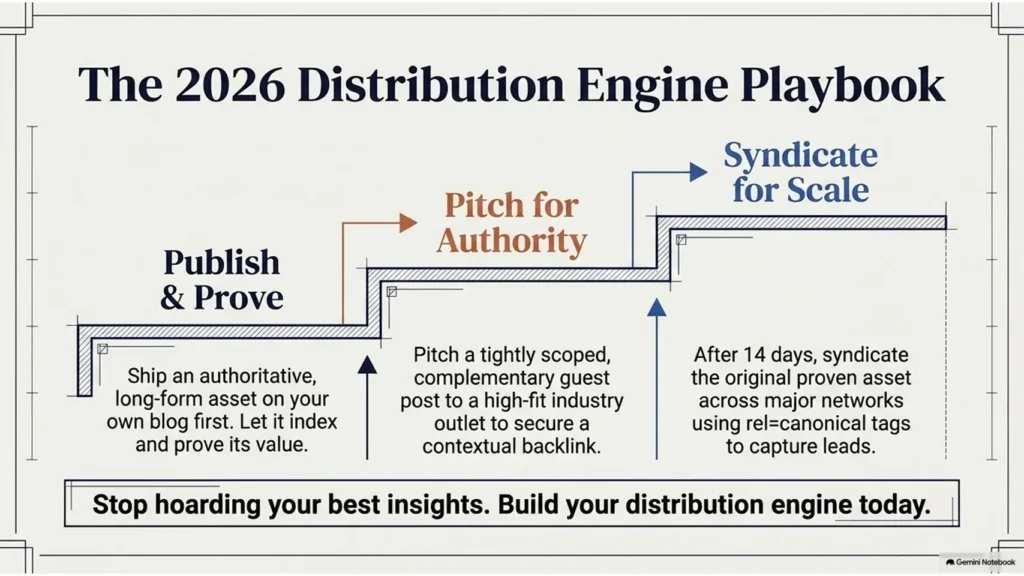
The prerequisite is publishing the original on your own domain first, with a stable URL, clear authorship, and a conversion path matched to the buyer’s stage. Syndication amplifies what exists – it cannot rescue a weak source asset.
Nurturing and Targeting Make the Difference
Syndication is most powerful when paired with tight ICP targeting and a deliberate nurture sequence. When content is distributed to audiences filtered by industry, role, company size, or buying intent, the leads that come back carry stronger account-match potential. The follow-up sequence matters as much as the distribution itself. A report download should trigger a related case study or diagnostic checklist – not immediate generic sales outreach. The goal is converting third-party engagement into first-party trust.
When Guest Blogging Wins
Authority Is Your Constraint, Not Reach
For consultants, SaaS founders, and emerging B2B brands, the problem is often that the right people do not yet trust them. That is the constraint guest blogging is built to solve.
Publishing original thinking in a respected industry publication positions a brand as a practitioner, not just a vendor. Unlike paid distribution, that credibility transfers. When a trusted editor publishes a bylined article, they are implicitly endorsing the author’s expertise – a signal no ad budget can replicate.
The pitch matters enormously. An article titled Why More Content Is the Wrong Response to AI Search: A Visibility-Stacking Model for B2B Teams is a guest post worth placing. Ten Content Marketing Trends is not. Publication-specific, thesis-driven, experience-backed – those are the criteria that earn placements worth having.
Brand Awareness Gains Are Measurable and Compounding
Guest blogging’s brand impact accumulates in ways that are easy to undervalue. Editorial backlinks build long-term domain authority. Bylines in respected publications strengthen E-E-A-T signals. Branded search lifts, assisted conversions, and inbound partnership inquiries all trace back to a consistent editorial presence. High-performing B2B teams increasingly use a strategic combination of both tactics – which suggests the compounding effect of guest blogging is well understood by the teams getting the best results.
SEO Implications Neither Strategy Can Ignore
Why Noindex Often Outperforms Canonical Tags for Syndicated Content
A rel=canonical tag signals to Google which version of a page is the original – but it is a hint, not a command. Google has confirmed that if the goal is to prevent a syndicated version from appearing in search results, the republishing site should apply a noindex meta tag. That blocks indexing entirely while keeping the page accessible to human readers.
In practice, three setups cover most scenarios:
- Excerpt + link to original – Lowest duplicate content risk; cleanest SEO outcome.
- Full republish + canonical to original – Useful when the partner needs full content; relies on Google honoring the canonical signal.
- Full republish + noindex – Strongest control over search visibility; requires the partner to implement correctly.
Do not assume canonical tags prevent ranking issues. The real risk is Google selecting the syndicated version as the canonical, splitting authority signals away from the source page.
Link Intent, Spam Risks, and E-E-A-T Signals
Google does not penalize editorial guest contributions that genuinely serve a publisher’s audience. What it does penalize is large-scale article campaigns where the primary purpose is link acquisition – particularly when combined with keyword-rich anchor text, duplicate content across many sites, and writers with no demonstrable subject knowledge.
The practical rules: link sparingly, use contextual anchors, and point readers to genuinely useful resources rather than commercial service pages. For paid placements, use rel=sponsored. For editorial links, earn them through relevance. E-E-A-T also means the author bio should establish real credentials, link to a substantive author page, and align with verifiable experience evident in the article itself.
The Portfolio Play: Running Both Without Diluting Either
The most effective B2B content strategies architect both tactics to work in sequence. A practical model looks like this:
- Publish an original research-led guide on the brand’s own domain.
- Distribute an executive summary or excerpt through select syndication partners, with proper canonical or noindex controls in place.
- Write two original guest posts for relevant specialist publications, each exploring a different angle of the research – with links back to the full guide.
- Nurture syndication leads with the insights and tools from those guest posts, building familiarity over multiple touches.
- Measure success at the account level: pipeline contribution, sales-accepted leads, and opportunity rate – not just downloads.
This approach keeps each tactic doing what it does best. Syndication scales distribution. Guest blogging deepens authority. Neither undermines the other when the content strategy is designed from the outset with both in mind.
Common Mistakes That Undermine Both Tactics
Syndication: Optimizing for Lead Volume Over Pipeline Quality
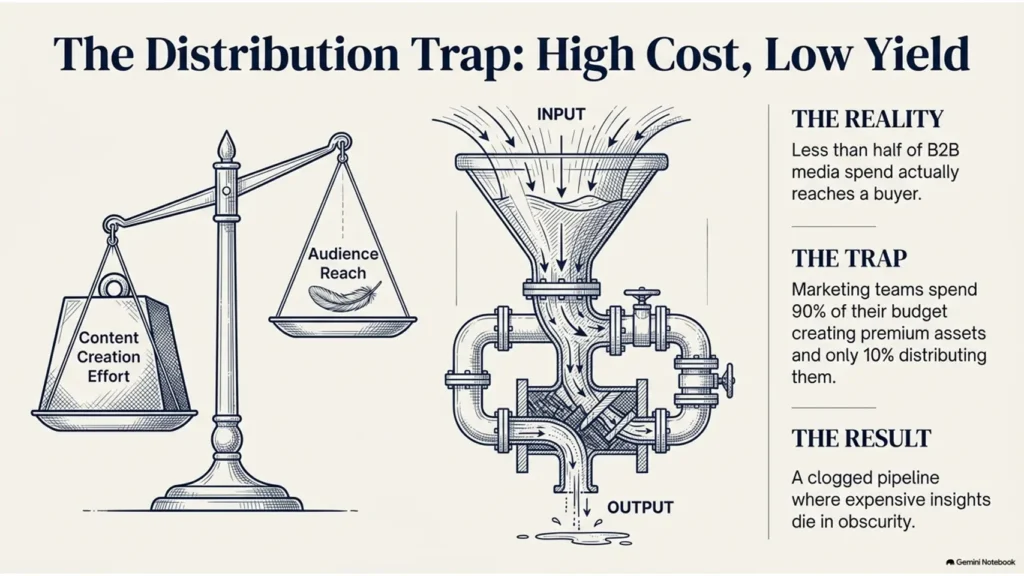
The most common syndication mistake is treating cost per lead as a success metric. Cheap contacts that never convert to sales-accepted opportunities are a budget leak. Effective syndication programs measure ICP match rate, MQL-to-SQL conversion, opportunity rate, and pipeline value. Data governance matters too: consent status, suppression lists, and CRM deduplication are program requirements, not afterthoughts.
Guest Blogging: Writing for Links, Not Readers
Mass-producing similar posts across many sites, using keyword-stuffed anchor text, or paying for editorial placements that are actually link schemes – these approaches do not build authority. They actively risk it. Google’s guidance on large-scale article campaigns is clear: when link acquisition is the primary goal, the practice violates link spam policies.
Every guest post should deliver most of its value on the host site. The link back to owned content should extend the reader’s journey – to a relevant template, case study, or implementation guide – not redirect them to a generic homepage.
Neither Strategy Wins – Your Objective Does
There is no universally superior tactic. Content syndication wins when the constraint is reach – when a high-value asset needs to get in front of defined target accounts at scale, and a nurture engine exists to qualify interest downstream. Guest blogging wins when the constraint is trust – when a brand needs to demonstrate expertise to a precisely relevant audience before it can earn consideration.
The clearest way to settle the debate: guest blogging builds borrowed trust; content syndication earns or buys borrowed reach. Both create durable business value – but only when the content is genuinely useful, the audience fit is precise, the technical controls are in place, and success is measured by pipeline quality rather than activity volume.
| Topic / Area | Key Finding | Business Impact | Why It Matters |
|---|---|---|---|
| Content distribution adoption | 84% of B2B marketers use paid distribution | Owned assets need budgeted amplification | Publishing alone rarely delivers sufficient reach |
| Brand awareness | 87% say content marketing builds awareness | Supports long-term demand creation | Guest contributions can reinforce trusted brand exposure |
| Channel selection | 85% rate LinkedIn their highest-value social platform | Strong fit for B2B promotion and thought leadership | Useful for distributing assets and amplifying guest posts |
| SEO control | Google recommends noindex for syndicated copies | Protects the source page’s search visibility | Canonicals are signals; indexing control is stronger |
| Guest-post governance | Ranking-focused link campaigns can be treated as spam | Poor practices risk lost visibility and credibility | Originality, relevance, and editorial value must lead |
Frequently Asked Questions
Should B2B companies use content syndication or guest blogging first?
Start with the constraint holding growth back. Choose syndication when you already have a strong asset and need targeted reach or lead volume. Choose guest blogging when buyers need more evidence of your expertise. Most established programs should run both, with separate objectives and measurement.
Does syndicated content hurt SEO or create a duplicate-content penalty?
Syndication does not automatically trigger a “duplicate-content penalty,” but it can create visibility problems if Google indexes a partner’s version instead of yours. Publish the source first and ask partners to use noindex where possible. Google specifically recommends noindexing syndicated copies when they should not appear in search.
How do you measure whether content syndication leads are actually valuable?
Measure beyond cost per lead. Track ICP match rate, consent and data quality, MQL-to-SQL conversion, opportunity creation, pipeline value, and sales-accepted-lead rate by syndication partner. A lower-volume supplier that produces qualified opportunities is usually more valuable than one delivering many cheap, unengaged contacts.
Are guest-post backlinks still worthwhile for SEO?
They can be, but the reader and editorial relevance must come first. A useful, original contribution on a trusted industry site may generate qualified referral traffic and brand credibility. Avoid paying for dofollow links, keyword-heavy anchor text, or scaled guest-post campaigns designed primarily to manipulate rankings.
Can AI-generated content be used for syndication or guest posts?
AI can accelerate research, outlining, repurposing, and adapting a message for a specific audience, but it should not replace subject-matter expertise or editorial judgement. For guest posts especially, add original analysis, lived experience, examples, and a clear point of view before submitting anything to a publisher.
For B2B marketers building or refining a content distribution strategy, West Pro Media Services Ltd specializes in helping brands get more commercial value from the content they already create – through smart, targeted distribution built around real business outcomes.
