
Summary
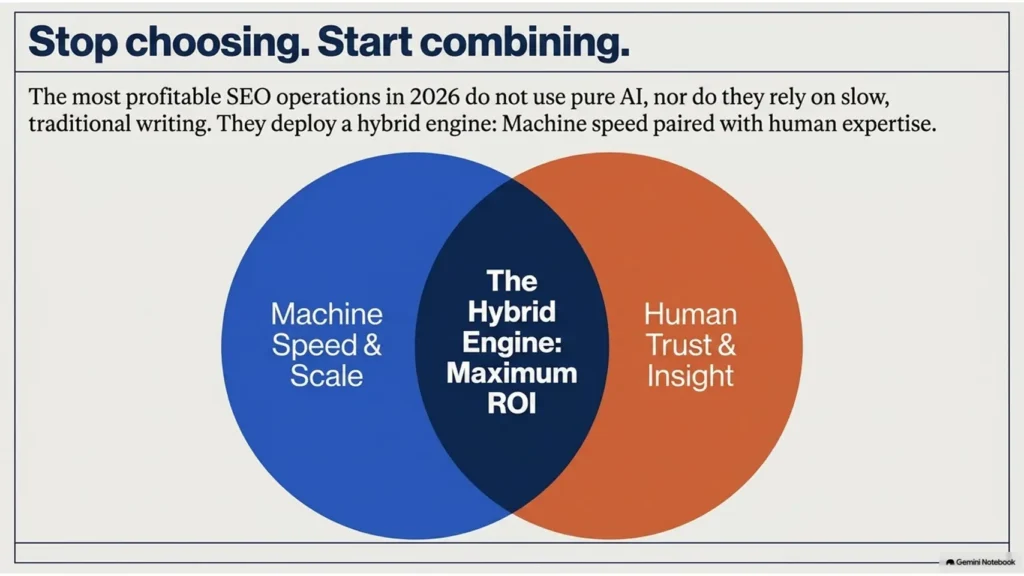
AI-generated content and human writers each have strengths, but neither delivers the best SEO results alone. AI speeds up research, outlining and drafting, while human expertise provides the experience, judgement and original insights that search engines and AI systems value most. The most effective approach combines AI efficiency with human oversight to create trustworthy, authoritative content that ranks and earns citations.
Key Takeaways
- Google doesn’t penalize AI-generated content for being AI-generated – it penalizes low-value, unoriginal content, regardless of how it was produced.
- The Experience component of E-E-A-T is the hardest signal for AI to replicate, because it requires real-world interaction, firsthand testing, and genuine accountability.
- A Semrush analysis of 42,000 blog posts found that human-written pages had an 80.5% probability of holding position one, compared to just 10% for fully AI-generated pages.
- The workflow that consistently outperforms both pure AI and pure human production is human-led and AI-assisted, with original evidence and structured QA built in.
- Measuring AI-era SEO performance means tracking more than clicks: AI Overview visibility, branded search growth, and assisted conversions are becoming essential metrics.
The real debate is not AI or human. It is about which parts of the content process benefit from automation – and which parts require human judgment, accountability, and lived experience to produce something worth ranking. That distinction has become the defining challenge for content marketers and SEO professionals working in increasingly competitive search.
Helpfulness Wins – But Authorship Builds the Trust Behind It
Google’s evaluation of content has always centered on one question: does this page genuinely help the person searching? What has shifted is the texture of what helpful demands. With AI making it trivially easy to produce structured, keyword-covering text at scale, the bar for standing out has quietly moved toward something harder to manufacture – evidence, accountability, and a real point of view.
AI can produce a serviceable draft. It can match search intent, hit the right subtopics, and structure a readable article in minutes. What it cannot do is stand behind the content. There is no named author, no professional track record, and no firsthand knowledge informing the conclusions. For competitive or high-stakes queries, that absence is felt in the rankings. The content creation team at West Pro Media Services works through this exact challenge with clients – figuring out where AI accelerates production without sacrificing the signals that actually drive visibility.
What E-E-A-T Actually Measures
E-E-A-T stands for Experience, Expertise, Authoritativeness, and Trustworthiness. It is not a single ranking factor – Google uses a mix of signals intended to identify pages that embody these qualities. Think of it less as a checklist and more as the cumulative impression a page creates: does this source know what it is talking about, have reason to know it, and give readers reason to trust it?
Why Experience Is the Hardest Signal to Fake
The addition of Experience to the original E-A-T framework was deliberate. Google’s Search Quality Rater Guidelines specifically call out firsthand interaction – product reviews based on actual usage, how-to guides drawn from real implementation, field observations that go beyond what is publicly available. An AI model has no history. It cannot describe what failed on a real client project, share a screenshot from an actual test, or explain what it noticed after running the same process twelve times. That kind of evidence carries weight precisely because it is difficult to fabricate without the underlying experience.
YMYL Topics Raise the Stakes
For Your Money or Your Life content – health, finance, legal, safety – Google places even greater weight on E-E-A-T. These are topics where bad information carries real-world consequences. Content in these categories is expected to be produced or reviewed by qualified experts, with clear credentials and transparent sourcing. AI cannot fulfill that accountability role independently, which is why YMYL content without expert human involvement is a particular ranking liability.
Where AI Genuinely Falls Short
Hallucinated Facts and Fabricated Citations
AI models can generate confident-sounding claims that are simply wrong. Statistics get misattributed. Studies get invented. Source links point nowhere, or to pages that do not say what the text implies. This is a known and documented failure mode. Every material claim in an AI-assisted draft needs to be verified against the primary source before publication – not skimmed, but opened, read, and confirmed. Skipping that step is one of the fastest ways to erode trustworthiness with both readers and search systems that evaluate source quality.
Generic Voice, No Real Point of View
AI can imitate a writing style, but it cannot develop a genuine commercial position. Ask an AI to write about B2B lead generation and it will produce familiar advice – define your ICP, use LinkedIn, create content, nurture leads. The output is structurally reasonable and topically on-point, and also indistinguishable from the next fifty articles on the same subject. A human writer with real field experience can say: we audited 24 B2B service firms and the failure was not content volume – it was the absence of a named problem category, proof assets, and a distribution plan. That version creates something citable. The generic version does not.
What the Ranking Data Actually Shows
The data on AI content and rankings contains a useful tension worth understanding. Ahrefs reports that a substantial majority of content in Google’s top 20 includes at least some AI-generated material – suggesting AI assistance is now normal among high-ranking pages. At the same time, Semrush’s analysis of 42,000 blog posts found that fully human-written pages carried an 80.5% probability of ranking at position one, versus just 10% for pages classified as fully AI-generated. These findings coexist rather than contradict: AI assistance is widespread, but differentiated human input is what tends to drive the very top position.
Citability Over Clicks: How AI Overviews Reward Strong E-E-A-T
Ahrefs data shows that 52% of AI Overview citations come from pages already ranking in Google’s top 10 – so traditional SEO remains the foundation for generative search visibility. But citation behavior across AI search platforms diverges significantly: the vast majority of top-mentioned sources are not shared between ChatGPT, Perplexity, and Google’s AI features. The practical goal is not to write for an LLM. It is to build credible, well-structured, evidence-rich source material that satisfies real searchers and is easy for any search system to understand and cite.
The Workflow That Outperforms Both
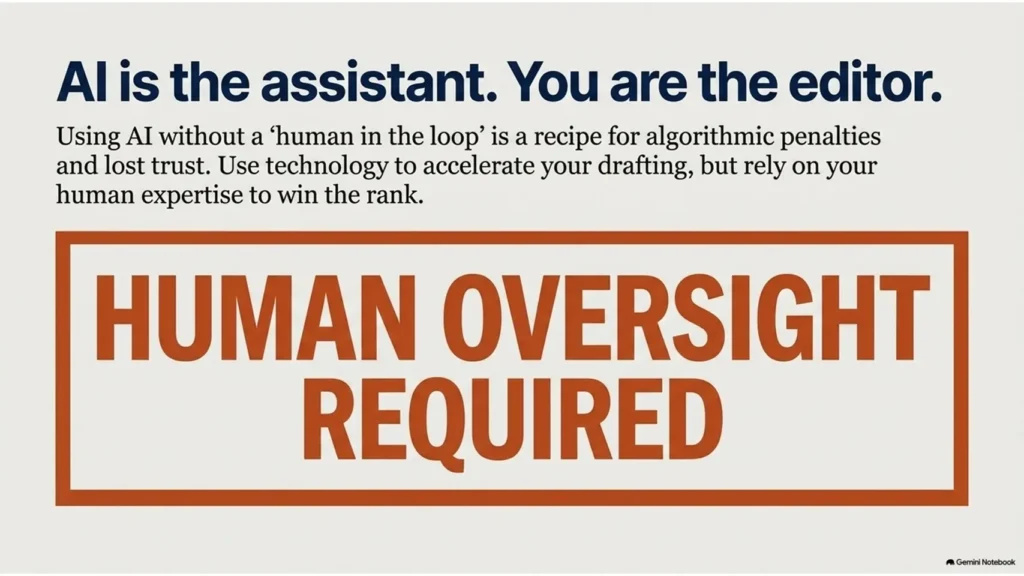
The model that consistently produces the best outcomes is human-led and AI-assisted – with clear roles for each. Semrush found that a majority of SEO teams already operate this way, with most reporting their work as fully human-created or heavily human-led. The workflow has three defining features.
Where AI Belongs in the Process
AI adds genuine operational value at the preparation and scaffolding stages: expanding topic maps, identifying coverage gaps in competing pages, generating outline alternatives for different search intents, turning interview transcripts into draft structures, and flagging passages that need freshness review. It is also useful for producing metadata variants, FAQ schemas, and social distribution versions after the canonical article is approved. Where it is least reliable: deciding what deserves emphasis, evaluating source quality, interpreting field evidence, or taking a strategic position on a contested topic.
The Non-Commodity Evidence Layer
Every article in a serious content operation should be built around at least two or three elements that AI cannot invent: firsthand implementation detail, original survey or benchmark data, a practitioner interview, workflow screenshots or test results, a named decision framework, or explicit trade-offs drawn from real experience. Google’s helpful content guidance specifically asks whether a page contains original research or analysis, goes beyond obvious summaries, and demonstrates firsthand expertise. These are the structural difference between a page that earns citations and one that disappears into the middle of the index.
Human QA as a Required Production Stage
QA is not a final polish step – it is a production requirement with a named owner. A publishable AI-assisted draft should pass factual verification against primary sources, a source integrity check that removes invented citations, an originality test, a voice pass to remove generic transitions and empty intensifiers, and a risk review for any YMYL or regulated topic. Cosmetic editing is not the same as editorial accountability.
Mistakes That Quietly Weaken Rankings
Mass-Producing Low-Value Pages
Publishing large volumes of city, industry, or FAQ pages that differ only superficially is explicitly addressed in Google’s spam policies under scaled content abuse. The policy applies regardless of whether a human or a generative AI produced the pages. A coherent body of credible, interlinked, experience-backed content is more defensible than volume alone.
Superficial Updates That Change Nothing
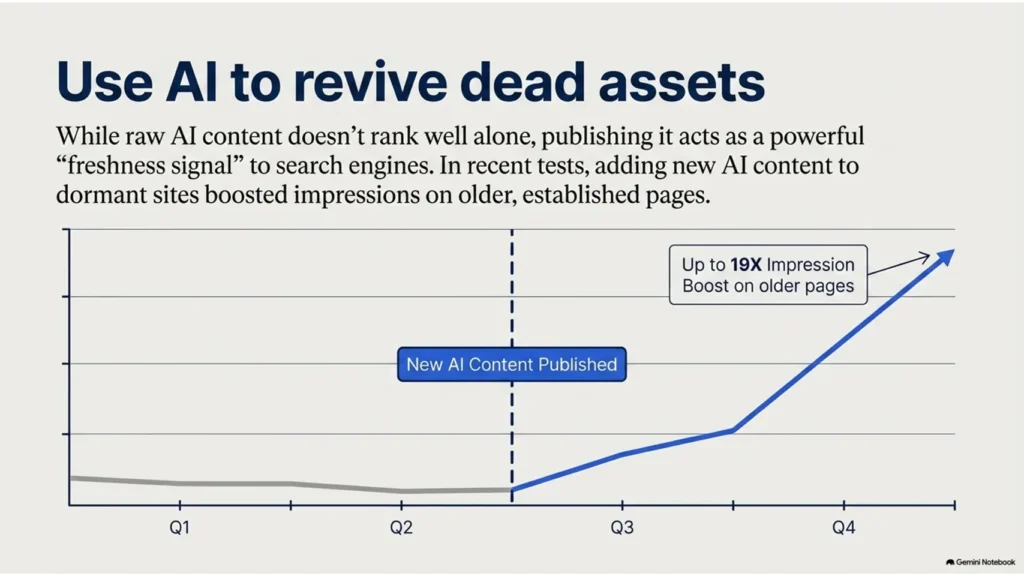
Changing a publish date without substantively revising the content does not earn freshness signals and is considered an unhelpful practice by Google, which prioritizes genuinely updated content. Freshness signals are earned by updating evidence, examples, product details, recommendations, and conclusions. AI is genuinely useful for identifying stale passages and proposing revisions; the human role is deciding whether the proposed update is factually correct and whether the overall argument still holds.
Anonymous Content and Eroded E-E-A-T
Anonymous AI-generated advice is a particular liability for complex B2B, financial, health, legal, or technical decisions. Named authorship, visible credentials, an identified reviewer for sensitive topics, and a transparent explanation of research methodology all contribute to the trust signals that E-E-A-T measures. These are how readers and search systems evaluate whether a source deserves credibility.
Measuring Beyond the Click
In June 2026, Google began rolling out dedicated Search Console reports for generative AI features, exposing impressions, pages, countries, and device data for appearances in AI Overviews and AI Mode. That makes AI visibility a measurable dimension of SEO performance for the first time. Tracking should now include which pages receive generative-feature impressions, how those compare across topics and devices, and whether frequently shown pages are converting. Ahrefs data also notes that AI Overviews reduce clicks to websites by an estimated 58%, which reinforces the value of content that wins brand exposure and drives direct demand – not just traffic.
Use AI for Speed. Use People for Trust.
The clearest operating principle for content teams: automate the repetitive, low-judgment work – briefing support, topic expansion, draft scaffolding, metadata variants, content refresh audits. Reserve human time for the high-judgment work – research design, source evaluation, experience capture, strategic positioning, fact-checking, and decisive editing. Original proof should be the center of the workflow, not an optional addition at the end. That is the content that earns citations, builds authority over time, and gives readers a genuine reason to trust the source behind it.
| Topic / Area | Key Finding | Business Impact | Why It Matters |
|---|---|---|---|
| Ranking performance | Human-written pages held position one 80.5% of the time | Pure AI publishing risks weaker premium-keyword visibility | Human expertise remains a meaningful competitive differentiator |
| AI-assisted workflow | AI accelerates research, outlining, repurposing, and refresh audits | Reduces production time without removing editorial ownership | Use automation for scale; reserve people for judgment |
| Original evidence | Unique data, testing, interviews, and case evidence differentiate content | Stronger authority, conversions, and potential citations | Competitors cannot easily replicate genuine experience |
| AI Overview visibility | Only 37.9% of cited URLs appeared in top-ten result blocks | Ranking helps, but does not guarantee generative-search exposure | Clear, evidence-rich passages can earn visibility beyond page one |
| Governance and QA | Unverified claims and scaled low-value pages create quality risks | Protects brand trust and reduces costly content remediation | Fact-checking and named accountability should be mandatory |
Frequently Asked Questions
Can AI-generated blog posts rank on Google?
Yes. Google does not automatically demote content because AI helped produce it. Ranking depends on whether the page is useful, accurate, original, and satisfies search intent. AI drafts perform best when a knowledgeable editor adds evidence, judgment, and clear accountability.
How much human editing does an AI-written article need?
Human review should go beyond proofreading. Verify every significant claim and source, add firsthand examples or expert input, sharpen the point of view, and check that recommendations genuinely fit the reader’s situation. For regulated or high-stakes topics, qualified expert review is essential.
Will AI Overviews reduce traffic to SEO blog posts?
They can reduce clicks for straightforward informational searches because users may receive an answer directly in the results. However, cited content can still build brand awareness and trust. Prioritise distinctive research, practical tools, strong opinions, and conversion paths that give readers a reason to visit.
What content should writers avoid generating entirely with AI?
Avoid publishing unreviewed AI material where accuracy, safety, or professional accountability matters, including financial, medical, legal, and technical guidance. Also avoid AI-only case studies, product testing, interviews, and statistics: these require real evidence, permission, verification, and identifiable human ownership.
How can a business make AI-assisted content genuinely original?
Start with proof that competitors cannot reproduce: customer interviews, internal data, implementation lessons, test results, screenshots, expert commentary, and transparent trade-offs. Then use AI to organise and extend that material rather than inventing it. Original inputs create more useful pages and stronger citation potential.
West Pro Media Services helps businesses build content operations that combine production efficiency with the editorial accountability competitive search demands – visit westpromediaservices.com to learn more.
