
Summary
Organic social and paid ads work best as a connected system, not competing alternatives. Organic content helps reveal customer questions, objections and promising messages, while paid social distributes selected ideas to defined audiences. Repurposing creates efficiency only when each version is adapted to its platform, audience and objective. Measure full marketing ROI, not just platform-reported ROAS, and test whether results are genuinely incremental.
Key Takeaways
- Organic social is a testing and relationship-building environment; paid ads provide controlled distribution.
- Repurposing means adapting the idea, format, context and call to action, not copying the same post everywhere.
- A popular organic post is a useful signal, but it is not proof that the content will convert cold paid audiences.
- Measure production, management and media costs alongside revenue, contribution and lead quality.
- Incrementality testing helps distinguish additional business generated from conversions that would have happened anyway.
Organic Social and Paid Ads Do Different Jobs
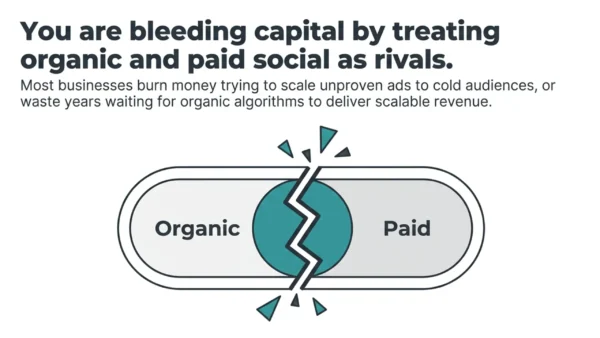
Organic social and paid social are often presented as an either-or decision. For most businesses, that is the wrong starting point. The more useful question is what each channel needs to accomplish.
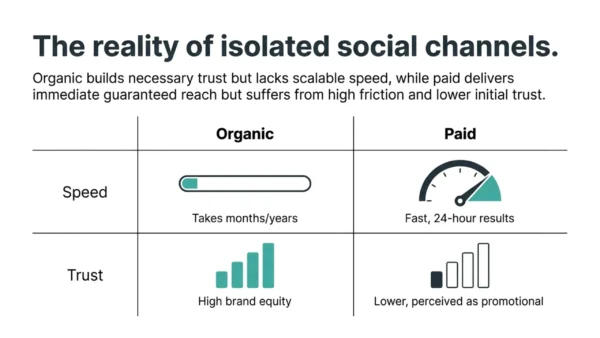
Organic social is the unpaid distribution of content through a brand’s or individual’s social presence. It can demonstrate expertise, answer customer questions, create conversations and develop familiarity over time. It has no media fee, but it is not free. Content production, editing, community management and measurement all require time or budget.
Paid social places advertising in front of selected audiences through social platforms. It can provide more predictable access to particular people, support defined campaign objectives and distribute useful content beyond an existing following. Paying for distribution does not, however, guarantee profitable outcomes. Creative quality, audience fit, the offer and the post-click experience all matter.
Boosting an existing post is simply one tactical form of paid distribution. It should not replace decisions about the campaign objective, audience, conversion path or measurement plan.
Paid search has a different role again. It responds to expressed search intent, whereas paid social generally places a message in front of people based on audience characteristics, behaviour or platform signals. This article focuses mainly on paid social because it is the most natural destination for repurposed organic content.
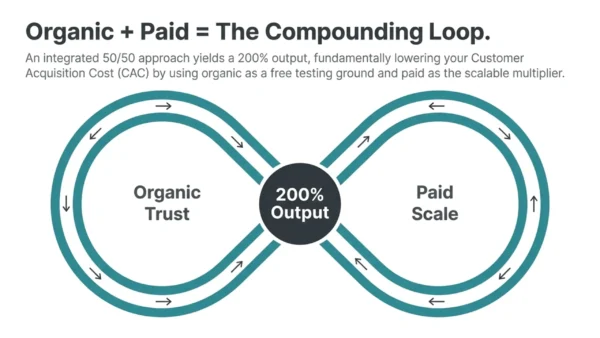
The central principle is simple: organic content can help a business learn what is relevant, while paid distribution can help it reach more of the right people. Neither channel proves the commercial value of the other automatically.
Repurposing Is Adaptation, Not Duplication
Repurposing turns an existing idea or asset into another useful format or application. It is not the practice of publishing an identical message across every platform.
A customer interview might become a detailed case study, a short video explaining the main problem, a document post showing the decision process and an advert pointing to relevant evidence. The underlying expertise is shared, but each version has a different job.
This distinction matters because people encounter content in different contexts. Someone who already knows a consultancy may watch a detailed explanation. A cold prospect may need a shorter introduction, proof that the problem is relevant and a low-friction next step before considering a consultation.
A cut-down webinar clip may also fail if it begins halfway through an argument. To work independently, it may need a new opening, captions, context and a clear conclusion. A paid version may require a stronger relationship between the message, the offer and the landing page.
Creating more versions does not automatically create more value. A weak source asset produces several weak derivatives. The strongest source material usually contains first-hand evidence, customer problems, explanations, objections, examples and a useful next action.
Use Organic Content as Evidence, Not Proof
Organic performance can reveal language and ideas worth investigating. Comments may expose recurring questions. Saves may suggest practical usefulness. Conversations can identify objections that a formal customer survey never captured.
However, organic engagement is not the same as buying intent. A post may attract reactions from industry peers because it is entertaining or controversial, while generating little commercial interest. A technical explanation may receive modest public engagement but be highly relevant to a small group of potential buyers.
The existing audience and a cold paid audience are not interchangeable. Organic followers may already understand the business, trust its expertise and recognise the problem being discussed. Cold audiences need more explanation and may respond to a different offer.
The right selection test is therefore not simply, “Did this post get the most likes?” It is, “Does this idea address a problem for the audience we want to reach, and can it support the next business action?”
A Practical Repurposing Workflow
Start with a business question
Begin with the decision a customer is trying to make rather than a production target such as creating ten posts from one webinar.
Ask what the audience needs to understand, what misconception is slowing progress, what evidence the business can provide and what useful next action should follow. “Help operations directors evaluate implementation risk” is a stronger brief than “make social content from this presentation”.
Build from a substantive source asset
A detailed customer interview, original research report, expert webinar, case study, demonstration or practical guide can provide enough material for several worthwhile derivatives.
Before extracting content, confirm that the source contains genuine expertise and evidence. Repurposing should make valuable knowledge easier to discover, not disguise a lack of substance with more formats.
Extract ideas before choosing formats
Separate the source into customer problems, explanations, proof points, objections, practical guidance and commercial next steps. This prevents every quotation or paragraph being treated as equally valuable.
One idea may suit a short educational video. Another may work better as a checklist, comparison guide, case-study document or sales resource. Format should follow the communication job.
Adapt the audience, placement and call to action
Each derivative should have one main message, a defined audience, a suitable opening, supporting evidence, a format, a destination where relevant and a measurement objective.
The organic version may invite discussion. The paid version may invite a guide download or an assessment. A remarketing version may point to a case study because the audience has already engaged with the educational material.
The call to action should reflect what the content has helped someone understand. Adding the same consultation offer to every derivative creates unnecessary friction, particularly for people encountering the business for the first time.
Test meaningful differences
Testing five cosmetic variations of one advert produces less learning than testing different propositions. A business might compare cost saving with risk reduction, customer evidence with expert explanation, or a demonstration with a practical guide.
Record recurring questions, misunderstood claims and sales objections. Feed those findings back into the original article, future webinars and sales materials. Repurposing then becomes a learning system rather than a one-way publishing process.
Match the Offer to the Audience Temperature
Warm and cold audiences should not receive identical commercial treatment.
A warm audience may include people who watched a video, visited a website or engaged with a profile. They may be ready for a case study, product demonstration, webinar or more specific conversation. This does not mean every warm audience is ready to buy, but the business can usually provide more contextually relevant follow-up.
A cold audience has not necessarily recognised the problem or developed confidence in the business. An advert aimed at that audience may need a clearer explanation, stronger proof and a lower-friction next step. Sending cold traffic directly to a high-commitment consultation can create a mismatch between the advert and the buyer’s level of trust.
This is why a successful organic post can fail as a paid advertisement. Its organic success may depend on an existing relationship, while the paid campaign asks strangers to take an action for which they have not been prepared.
A sensible repurposing system creates separate versions for introduction, education, proof, objection handling and evaluation. These should be treated as planning roles, not as a guaranteed sequence that every customer follows.
Measure ROI Rather Than Mistaking ROAS for Profit
ROAS is attributed advertising revenue divided by advertising spend. It is useful for understanding media efficiency, but it excludes many costs and does not equal profit.
Marketing ROI should include the broader investment. A practical contribution-based formula is:
Marketing ROI = (incremental contribution before marketing costs − total marketing costs) ÷ total marketing costs × 100
Relevant costs may include source-content production, editing, design, copywriting, adaptation, advertising spend, agency or freelancer fees, software, landing-page work, campaign management and reporting.
For example, imagine a campaign with £1,000 of content and adaptation costs, £2,000 of media spend and £500 of management and measurement costs. If it records £10,000 of attributed revenue at a 50% contribution margin, advertising ROAS is 5. Contribution before marketing costs is £5,000. After £3,500 of marketing costs, net contribution is £1,500 and marketing ROI is approximately 43%.
This is a hypothetical calculation, not a benchmark. More importantly, the result is only a measure of causal return if the revenue was genuinely generated by the marketing. If it is based solely on platform attribution, it should be described as attributed performance.
Measurement works best across three layers. Content diagnostics show attention, viewing behaviour, clicks, saves and questions. Commercial reporting shows qualified enquiries, opportunities, customers, revenue and contribution. Causal evaluation uses holdouts, lift tests or suitable matched-market experiments to estimate what additional outcomes the activity created.
Attribution and incrementality answer different questions. Attribution asks which touchpoints received credit. Incrementality asks what happened because of the activity that would not otherwise have happened. This distinction is particularly important in remarketing, where an advert shown before a purchase may receive credit for a decision already in progress.
Use consistent asset identifiers, campaign names and UTM parameters. Connect enquiries to CRM outcomes where possible, distinguish prospecting from remarketing, separate new from existing customers and reconcile platform figures against business records. Do not add conversion totals from multiple platforms without accounting for duplication.
Respect Platform Context and Avoid Common Traps
Organic recommendation systems and paid advertising auctions are different systems. Platforms do not publish a complete, permanent formula that businesses can reduce to a few posting tricks.
LinkedIn’s March 2026 feed guidance describes distribution that considers the subject and meaning of a post, member profile information, interaction history, changing interests, freshness and relevance. The practical lesson is to make the topic, professional audience and original contribution clear. It is not evidence for a guaranteed hashtag count, posting time or engagement threshold.
Meta’s guidance also distinguishes original content from low-value reuse of somebody else’s material. A business turning its own webinar into several genuinely useful formats is different from downloading another creator’s video, making minor edits and re-uploading it. The latter can be treated as unoriginal and receive reduced distribution.
Paid delivery also depends on relevance and quality. User feedback, the selected objective, audience eligibility, creative, bidding conditions and landing-page experience can all affect results. A large budget cannot rescue an irrelevant message or a poor destination.
The most common strategic mistake is treating organic social as free and paid ads as a complete growth engine. Another is boosting a post because it has many reactions without checking whether the audience, message and objective are commercially relevant. Reposting identical material everywhere creates a similar problem: it ignores the context in which people encounter the content.
A unified content calendar and measurement dashboard can prevent organic and paid teams from working in isolation. The same source asset can support organic education, paid prospecting, warm-audience follow-up and sales enablement, but each use should have its own purpose and tracking.
A Hypothetical Repurposing System
Suppose a consultancy records a webinar about an expensive customer problem. The full recording becomes a website guide with supporting evidence. An organic LinkedIn post explains the problem in plain language. A document post presents a decision checklist. Several short clips answer distinct objections. A paid educational video introduces the issue to an appropriate prospect audience, while a separate proof-led advert points an interested audience towards a relevant case study.
The business can then compare which derivatives attract relevant attention, which generate qualified opportunities and which assist sales conversations. The important question is not how many assets the webinar produced. It is which assets helped generate additional opportunities at an acceptable total cost.
This reflects a broader visibility principle: creating content is only part of the job; distribution gives useful expertise a chance to be discovered. The strongest system connects owned content, wider distribution and independent proof rather than relying on one social post or one advertising channel.
There is no universal 70/30 or 50/50 split between organic effort and paid spend. Resource allocation should reflect the business’s audience access, production capacity, sales economics, conversion journey and ability to fulfil new demand. Treat budget rules as hypotheses to test, not permanent formulas.
Research Insights
| Topic / Area | Key Finding | Business Impact | Why It Matters |
|---|---|---|---|
| Content repurposing | 37% of surveyed B2B marketers reported it as challenging | Requires process, not just more content | Operational friction can erase efficiency gains |
| ROI attribution | 56% reported difficulty attributing content ROI | Channel reports need business-level reconciliation | ROAS alone can mislead decisions |
| B2B video adoption | 78% of B2B marketers used video | Video is established, not universally superior | Repurpose where audience and message fit |
| Organic feed relevance | LinkedIn considers meaning, profile context and interaction history | Clear expertise matters more than popularity alone | Avoid engagement-bait assumptions |
| Incrementality | Attribution does not prove additional outcomes | Causal testing improves investment decisions | Remarketing credit may overstate impact |
Sources
Content Marketing Institute – B2B Content Marketing Trends Research 2025
LinkedIn – 2025 B2B Marketing Benchmark: The Video Influence Effect Starts With Trust
INCRMNTAL – Incrementality Testing: The Key to Measuring Advertising Effectiveness
Frequently Asked Questions
Is organic social really free?
No. Organic social has no media fee, but it still requires strategy, production, editing, publishing, community management and measurement. Include those costs when comparing organic activity with paid campaigns or calculating the return from repurposed content.
Should every high-performing organic post become an advert?
No. Organic performance is a useful signal, not proof of paid conversion potential. Check whether the topic is relevant to the intended paid audience, whether the offer suits their awareness level and whether the landing page supports the action being requested.
Can the same video be used organically and in paid ads?
Yes, but it may need adaptation. Review the opening, length, captions, context, branding, call to action and destination. A video that works for existing followers may need a clearer explanation and lower-friction offer for cold audiences.
How should a small business test incrementality?
Start with reliable lead and sales records, consistent campaign naming and a clear reporting period. Where volume permits, use a suitable holdout or lift test. If that is not practical, label results as attributed rather than claiming that every reported conversion was caused by advertising.
How much should a business spend on organic activity versus paid ads?
There is no reliable universal split. Base the decision on the quality of existing content, audience access, commercial margins, production capacity, sales process and fulfilment resources. Test the allocation and judge it by incremental contribution rather than reach alone.
