
Summary
To prove my expertise to customers who have never heard of my business, I need to replace marketing claims with evidence they can independently assess. Detailed case studies, named experts, relevant credentials, specific customer reviews, original thought leadership and consistent business information all reduce uncertainty. Expertise is not something a business can simply declare. It is a conclusion potential customers reach after seeing enough credible, verifiable proof.
Key Takeaways
- Businesses build trust with first-time customers by replacing vague claims with checkable proof, such as named experts, real case studies, credentials, and consistent online profiles
- Expertise is a conclusion a cautious buyer reaches after seeing evidence, never something a company can simply declare about itself
- Star ratings alone carry less weight than they used to: the share of consumers who trust online reviews as much as a personal recommendation fell from 79% in 2020 to 42% in 2025, so pairing them with independent verification matters more than ever
- Thought leadership content is increasingly seen as more trustworthy than traditional marketing material when buyers judge a supplier’s real capabilities
- Turning scattered proof points into a coherent, verifiable digital presence is worthwhile for any business seeking sustainable growth
Every new customer walks in with the same silent question: can this business actually be trusted? Before a single word of marketing copy gets read, prospects are quietly scanning for reasons to believe or reasons to walk away. This piece looks at why bold claims rarely settle that question, and what kind of proof actually does the job.
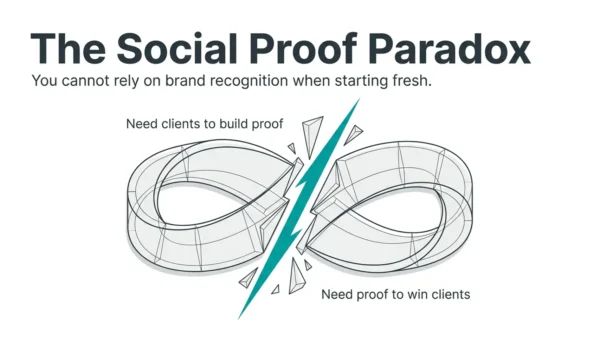
Why New Customers Doubt Unknown Businesses
Familiarity breeds trust, and unfamiliar businesses simply do not have it yet. When someone has never worked with a company before, they cannot lean on past experience, word of mouth from a friend, or a track record they have personally witnessed. Instead, they are forced to make a judgement call based on whatever signals are available in the moment, usually within seconds of landing on a website or scrolling through a Google Business Profile.
That uncertainty creates perceived risk, and perceived risk is the real barrier standing between a first-time visitor and a booked appointment or completed sale. The questions running through a sceptical buyer’s mind tend to be practical rather than emotional: can this business solve a problem like mine, have they handled something similar before, are they legitimate, and what happens if things go wrong? Answering questions like these needs evidence, not slogans.
This is where many small and medium-sized businesses stumble, not because their work is poor, but because their marketing has not caught up with how much scepticism modern buyers bring to the table. Content that demonstrates real expertise, rather than simply asserting it, is often the missing piece, and it is a topic West Pro Media Services regularly helps businesses work through as part of building a credible online presence. Getting this right early tends to pay off across every other part of a marketing strategy, from local search visibility to conversion rates.
Claims That Fail To Persuade Strangers
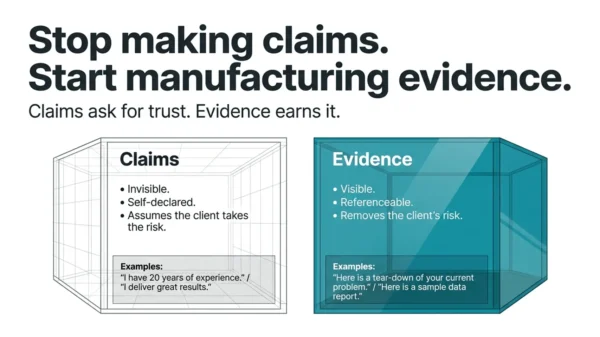
Plenty of businesses describe themselves as experienced, reliable, or industry-leading. The trouble is that anyone can type those words, regardless of whether they are true, so a sceptical reader tends to skim straight past them without a second thought.
Why ‘Trusted Expert’ Statements Fall Flat
Phrases like “trusted expert” or “leading provider” are self-authored, meaning the business is grading its own homework. There is no way for a stranger to verify a superlative claim, so it carries almost no persuasive weight on its own. Worse, when a page is full of unsupported adjectives and short on specifics, it can quietly signal the opposite of what was intended, making a business look like it has something to hide rather than something to prove. The fix keeps confident language while backing every strong statement with something a reader can actually check.
What A Cautious Buyer Actually Checks
Rather than taking claims at face value, a cautious buyer looks for details that are harder to fake. This typically includes:
- Whether the business has handled a situation similar to their own before
Whether real people, beyond a logo, stand behind the work
- Whether other customers have said anything specific and detailed
- Whether credentials, certifications or memberships can be independently confirmed
- Whether contact details, addresses and business information are consistent everywhere they appear
None of these checks take long individually, but together they form a quick mental audit that either builds confidence or raises doubt. Businesses that anticipate this checklist and make the answers easy to find are the ones that convert scepticism into enquiries.
Ten Forms Of Verifiable Proof
Verifiable evidence comes in many shapes, and the strongest businesses tend to layer several types together rather than relying on just one. Genuine proof turns an abstract promise into something a reader can actually inspect.
Case Studies Versus Vague Testimonials
A testimonial that says “great service, highly recommend” is pleasant, but it does very little heavy lifting. A proper case study walks the reader through the client’s starting situation, the specific problem, what was actually done, and the measurable outcome that followed. That level of detail gives prospects a precedent to weigh their own situation against, rather than a generic compliment they have seen a hundred times before on other websites. Where possible, pairing a handful of detailed case studies with shorter supporting reviews tends to outperform a long list of vague quotes.
Named Experts And Documented Experience
Anonymous copy makes even a genuinely skilled business feel less accountable. Naming the person who will actually carry out the work, along with their relevant experience and background, reassures a first-time customer that there is a real, identifiable expert behind the promises. This matters especially for advisory, technical, and higher-value services, where the buyer wants to know exactly who they will be dealing with before they commit.
Credentials, Standards And Independent Validation
Licences, insurance, professional memberships and recognised standards all reduce risk in a buyer’s mind, particularly where safety, compliance or specialist skill is involved. The key is explaining what each credential actually means and, where possible, giving the reader a way to confirm it independently rather than simply displaying a badge. A credential without context does very little; a credential explained in plain terms, tied to how it benefits the customer, does much more.
Thought Leadership As Trust Signal
Original insight, well-argued opinion pieces, and detailed explainers all show how a business thinks, which is often the clearest window into genuine expertise. A majority of professional buyers trust high-quality thought leadership more than traditional marketing material when judging a supplier’s real capabilities, and a large share of buyers said strong thought leadership makes them noticeably more receptive to being contacted at all. That is a meaningful signal for any business trying to stand out among competitors who are only publishing promotional pages.
Why Reviews Alone Aren’t Enough
Reviews remain one of the most-consulted trust signals available, with the overwhelming majority of consumers reading them before choosing a local business. However, treating a star rating as the finish line rather than one part of the picture is a mistake worth avoiding.
Falling Trust In Star Ratings
Confidence in online reviews has slipped noticeably over recent years, with the share of consumers who trust reviews as much as a personal recommendation falling from 79% in 2020 to 42% in 2025. Concerns about fake or incentivised reviews have played a large part in that shift, and sceptical readers now tend to discount glowing feedback that lacks any real detail. A wall of five-star ratings with no context can actually raise more questions than it answers.
Checking Reviews Across Multiple Sources
Because trust in any single review platform has softened, many buyers now check more than one source before deciding, comparing what shows up on Google against independent directories or industry-specific platforms. A business that only manages its Google reviews while ignoring everything else risks leaving gaps that a determined buyer will eventually notice. Encouraging detailed, dated, specific reviews across a spread of relevant platforms, and responding to them thoughtfully, does far more for credibility than chasing volume on one site alone.
AI-driven discovery has added another layer to this picture. A growing share of consumers had asked a generative AI tool for a local business recommendation in the past year, rising from 6% to 45% year over year, and most of those consumers still fact-check the reviews an AI tool cites before acting on them. Google’s guide on optimising for generative AI features in Search confirms that AI Overview and AI Mode citations are earned through standard search practices rather than any separate set of AI-specific technical requirements, alongside tips on providing valuable, original content and useful local, shopping, image and video information. In practice, this means AI tools may speed up how a business gets discovered, but they do not remove the need for transparent, corroborated proof.
Building A Website That Proves Itself
A website is often the first place genuine proof gets tested, so it needs to do more than simply describe the business in flattering terms. Within a few minutes, a first-time visitor should be able to work out who runs the business, what it actually does, what relevant experience it has, and what happens after they get in touch.
Essential Pages Skeptical Visitors Look For
Certain pages consistently carry the most weight for sceptical readers:
- A detailed About page explaining the company’s history, people and specialisms
Service pages that explain process and suitability, along with a detailed list of features
- Case study pages with real context, dates and outcomes
- Author pages for any expert articles, showing relevant background
- Clear contact details alongside any legal, privacy or complaints information
Original content built around these pages, rather than generic filler copy, is exactly the kind of asset that content creation services are designed to strengthen, giving a business the evidence-rich foundation that sceptical visitors are quietly searching for.
Consistency Across Every Online Profile
A polished website loses much of its power if the business name, address or phone number does not match across Google Business Profile, social channels and directory listings. Inconsistency, even something as small as an outdated logo or a dead social account, gives a cautious buyer a reason to hesitate. Auditing every major listing on a regular basis, and keeping business information current everywhere it appears, is unglamorous work, but it is foundational to looking legitimate at a glance.
Common Mistakes That Undermine Credibility
Several habits quietly erode credibility even when the underlying work is genuinely good. Treating credentials as a stand-alone selling point, without connecting them to what the customer actually needs, leaves buyers unsure why a qualification matters to their specific situation. Publishing vague testimonials instead of detailed case studies, hiding the real people behind the business, and leaning on unqualified superlatives such as “best” or “number one” without any supporting detail all chip away at trust rather than building it.
Piling up volume over quality causes similar damage. A handful of detailed, well-documented case studies will always outperform dozens of thin testimonials or low-quality directory listings, and a single respected trade-body profile carries more weight than a long list of forgotten ones. Using stock imagery in place of genuine project photos, staying vague about pricing and process, and letting old accreditations or dead profiles linger online all send the same message: that the business has not kept its own house in order, which makes it harder for anyone to trust what it says about anything else.

Trust Is A Conclusion, Not A Declaration
No business can talk its way into being trusted. Trust is something a first-time customer arrives at on their own, built from an accumulation of small, checkable signals rather than a single confident sentence on a homepage. The businesses that consistently win over sceptical strangers are the ones that treat every claim as something to be proven, and that keep their evidence current, specific and easy to find.
Getting started does not need to be complicated. Auditing the strongest claims currently made across a website and swapping the weakest ones for real evidence, one case study or credential at a time, is a practical way to begin turning a business from unknown into demonstrably credible in the eyes of the customers who matter most, and reviewing content creation services can be a useful next step for businesses ready to build that evidence base properly.
| Topic / Area | Key Finding | Business Impact | Why It Matters |
|---|---|---|---|
| Detailed proof | Specific case studies outperform unsupported capability claims | Reduces perceived buying risk and improves enquiry quality | Customers can compare your experience with their situation |
| Review credibility | Buyers increasingly assess reviews across multiple sources | A diversified review presence strengthens reputation resilience | One platform alone may leave trust gaps |
| Thought leadership | 73% trust it over marketing materials | Helpful insight can differentiate expertise before sales contact | Demonstrates how your business thinks and solves problems |
| AI-search readiness | Original, crawlable, well-organised content supports generative visibility | Evidence-led pages can earn discovery beyond conventional listings | Google prioritises useful, accessible content—not AI-specific shortcuts |
| Sources | BrightLocal · Google Search Central · LinkedIn / Edelman |
Frequently Asked Questions
How many case studies does a small business need to look credible?
You do not need dozens. Start with three to five detailed case studies that cover your most valuable services, customer types or common problems. Each should explain the starting challenge, your approach, the result and, where possible, include customer approval, dates and evidence.
What should I include in a case study if results are confidential?
Protect confidential figures, but retain the useful context. Describe the client’s sector, the problem, scope of work, timeframe, process and a proportionate outcome, such as reduced delays, stronger lead quality or improved compliance. Ask permission to use anonymised quotes, screenshots or before-and-after evidence.
How can customers verify that my qualifications and accreditations are genuine?
State the full qualification or membership name, the issuing body, the date achieved and what it enables you to do for customers. Where a public register exists, link to it or provide your membership number. Remove expired badges promptly and explain the customer benefit in plain English.
Do I need reviews on more than Google?
Usually, yes—but only on platforms your customers genuinely use. Google remains important for local discovery, while trade directories, professional bodies, Trustpilot, Checkatrade or sector-specific sites can corroborate your reputation. Consumers commonly consult multiple review sources, so consistency and specificity matter more than sheer volume.
Can AI search tools help new customers discover and trust my business?
They can help people find you, but they cannot manufacture credibility. AI tools and Google’s generative search features still rely on useful, original, accessible information and established search-quality signals. Keep your expertise pages, reviews, case studies, contact details and third-party profiles accurate, visible and easy to verify.
