
Summary
Choosing the right marketing agency means looking beyond increases in traffic, rankings and impressions to whether its work generates genuine enquiries and sales. The strongest agencies focus on buyer intent, improve the path from visitor to enquiry, define what counts as a qualified lead and track results through to commercial outcomes. Ask for evidence that connects marketing activity to enquiries and revenue, rather than relying on impressive-looking traffic figures alone.
Key Takeaways
- Rising website traffic means little unless it converts into genuine enquiries that can be traced through to actual sales outcomes
- High-intent visitors searching for a specific service consistently outperform large volumes of general traffic in producing qualified leads
- Clear definitions for an enquiry, a qualified lead, an opportunity and a customer make marketing reports far more honest and useful
- About 79% of raw leads never convert into sales without proper nurturing and qualification, which is why fast follow-up and lead quality matter as much as lead volume
- Vague case studies that mention only traffic increases, with no enquiry or revenue data, are a common warning sign when choosing a marketing agency
Business owners often check their website stats with a sense of pride when the visitor numbers climb. A bigger number feels like proof that marketing is working. Yet traffic on its own tells very little about whether a business is actually growing, because a thousand new visitors who never pick up the phone or fill in a form are worth far less than fifty who do.
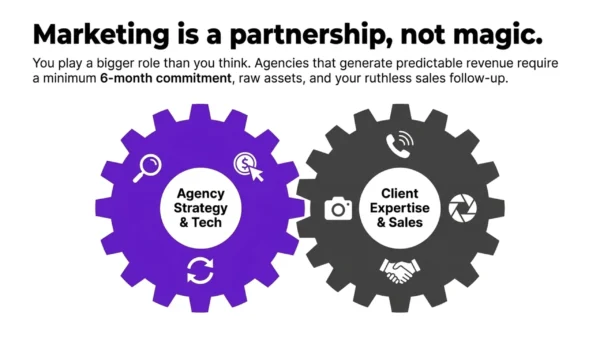
Rising Traffic, Flat Sales: The Hidden Gap
A common scenario plays out across countless small and medium businesses every month: the monthly marketing report shows sessions up sharply, keyword rankings climbing, and social reach expanding. Meanwhile, the sales team is still fielding the same number of calls, the enquiry inbox looks just as quiet, and revenue has barely moved. This gap between activity and outcome is one of the most frustrating experiences a business owner can have, because the numbers look encouraging while the bank balance tells a different story.
The explanation usually comes down to intent. A website can attract thousands of extra visitors while producing no additional revenue if the content targets the wrong audience, chases broad keywords with no buying intent, or pulls in researchers and browsers rather than people ready to act. Many businesses end up focused on metrics such as traffic volume, social likes and impressions, none of which correlate directly with revenue growth. A smaller volume of high-intent visitors, people actively searching for a specific service, comparing providers or ready to request a quote, tends to build a far healthier pipeline than a flood of general interest.
A clear idea sits at the centre of this: traffic is only valuable when it is relevant, converts into genuine enquiries, and can be traced through to sales outcomes. Content creation services built around that principle focus on attracting the right visitors rather than simply the most visitors, a subtle but important shift in thinking for any business trying to grow steadily.
From Click To Customer: Define The Terms
Before judging whether a marketing campaign is working, it helps to agree exactly what is being measured. Too many businesses use words like “lead” and “enquiry” loosely, which makes it almost impossible to know whether results are genuinely improving or simply shifting around the same pool of unqualified contacts.
Enquiry, Qualified Lead, Opportunity, Customer
Four distinct stages sit between a website visit and a signed deal, and treating them as separate checkpoints makes reporting far more honest.
- An enquiry is any initial contact: a form completion, phone call, live-chat conversation, WhatsApp message or meeting request.
- A qualified lead meets an agreed standard, such as service fit, location, budget range, decision-maker involvement or realistic timing.
- An opportunity is a qualified lead that sales has accepted and is actively pursuing.
- A customer is a won deal.
Agreeing these definitions before a campaign even launches means everyone, from the marketing team to the business owner, is judging success against the same yardstick. Without that agreement, a report showing “40 leads this month” could mean 40 genuine prospects or 40 random form fills from people with no intention of buying.
What Email Conversion Benchmarks Really Measure
Conversion benchmarks are useful for context, but they should never be treated as universal targets. Published 2026 marketing figures put average email marketing conversion rates at 2.4% for B2B brands and 2.8% for B2C brands. These figures vary enormously depending on sector, average order value, sales cycle length, device mix and how strictly a business defines a lead in the first place. A specialist professional-services firm with fewer visitors and a higher-value outcome will naturally look very different on paper to an ecommerce store selling low-cost products at high volume, so benchmarks work best as a starting point for diagnosis rather than a scoreboard.
Why High-Intent Visitors Beat Volume
Not all website visits carry equal weight. Someone searching for general information is in a completely different mindset to someone typing “emergency plumber near me” into their phone at 9pm. High-intent visitors, people actively searching for specific services or solutions, are far more likely to convert into qualified leads than a large volume of general traffic ever will.
This matters because many agencies chase the easier win of raising overall visitor numbers through broad, high-volume informational content. Sessions and keyword counts rise, and the report looks impressive, but the audience may consist largely of researchers, students or people with no buying intent whatsoever. A more disciplined approach targets service, problem, comparison and location-led searches instead. Traffic growth might be slower on paper, but the visitors arriving are measurably more likely to request a quote, book a call or make direct contact.
Matching Content To The Buyer’s Purchasing Stage
Marketing activity works best when it matches the stage a prospective customer has actually reached. Someone typing a broad “what is…” question is still in the research phase and responds well to helpful guides, explainers and simple email capture. Someone searching “how to solve…” or asking about cost is weighing up options and benefits from problem-focused pages, cost guidance and comparison content. Someone searching “service near me” or “quote for…” is ready to buy, and this is where focused service pages, local landing pages, genuine reviews and a clear call to action matter most.
A useful question for any business owner to ask an agency is whether they can produce a keyword and intent map rather than a vague promise to “rank for more terms.” A tradesperson, for example, might prefer to rank strongly for a handful of precise local searches rather than chase one high-volume but vague keyword that attracts no realistic buyers at all.
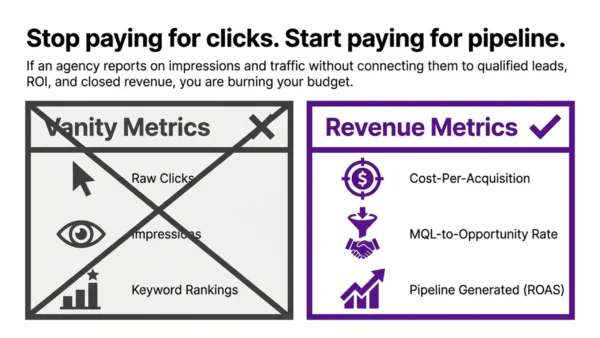
Turning Visitors Into Genuine Enquiries
Attracting the right visitor is only half the job. If the website itself makes it hard to take the next step, even the best-matched traffic will bounce without converting. Treating traffic generation and conversion as two halves of the same system, rather than separate projects, tends to produce far better results.
Conversion-Path Fixes That Matter
A handful of practical fixes consistently improve how many visitors turn into enquiries:
- A clear statement of who the business helps and why it can be trusted.
- Service pages built around a specific customer problem rather than generic brand copy.
- A visible, obvious call to action such as “Request a quote” or “Book a consultation.”
- Click-to-call phone numbers with tracked call activity, particularly useful for local service businesses.
- Short, proportionate forms asking only for what is genuinely needed at that stage.
- Proof placed close to the call to action, such as testimonials, case studies or relevant accreditations.
- Fast-loading, mobile-friendly pages that remove friction from booking or contacting the business.
Testing changes against real data, rather than guessing, keeps this process honest. A sensible hypothesis such as “would a local case study next to the enquiry form increase quote requests?” can be tested and measured rather than assumed.
Why Most Raw Leads Never Convert
Even with a strong conversion path, raw leads rarely convert into sales on their own. About 79% of leads never convert into sales, usually because of weak nurturing and qualification, which highlights why lead quality matters just as much as lead volume. Speed also plays a significant role in whether an enquiry ever becomes a sale, which is why a slow or inconsistent response process can quietly undo good lead generation work. A business generating plenty of enquiries but responding slowly, or without a clear qualification process, is effectively paying for leads it will never close.
Proving It: Tracking Enquiries Through To Sales
Generating enquiries is only useful if a business can prove what happens to them afterwards. Without that visibility, nobody can honestly say which marketing activity is actually paying for itself and which is simply creating noise.
Closed-Loop Reporting And Attribution
Closed-loop reporting connects outcomes recorded in a customer relationship management system, such as qualified leads or won revenue, back into the advertising platforms that generated them. Without this feedback loop, automated bidding systems can only learn to find the cheapest people likely to submit a form, not the people most likely to actually buy. Google Analytics 4 supports this kind of discipline through specific tracking events: `generate_lead` for the initial contact, and `close_convert_lead` for the moment a qualified lead becomes a paying customer. Google’s enhanced conversions for leads also use hashed first-party information, such as a customer’s email address or phone number, alongside the Google Click ID to sharpen conversion measurement and attribution across campaigns. Offline conversion imports and enhanced-conversion-for-leads uploads are moving to Google’s Data Manager API and are being blocked in the Google Ads API for new adopters and developer tokens that have not already sent a request; businesses already using the Google Ads API for this can keep doing so while they integrate with the Data Manager API.
Reports That Separate Visibility From Revenue
Strong monthly reporting answers business questions rather than simply marketing questions. A weak report says organic traffic rose by a certain percentage. A better report says organic search generated a specific number of enquiries, how many met agreed qualification criteria, and how many became genuine opportunities. The most useful dashboards separate four distinct layers: visibility metrics like impressions and rankings, engagement metrics like time on page and return visits, conversion metrics like calls and form submissions, and commercial metrics like qualified leads, win rate and revenue. Traffic still matters in this picture, but only as one input among several, never as the final measure of success.
Red Flags When Choosing A Marketing Agency
Choosing a marketing agency on the strength of a confident pitch is risky when the pitch focuses entirely on traffic and rankings. A handful of warning signs tend to show up again and again among agencies that over-promise and under-deliver.
Vague Case Studies And Guaranteed Rankings
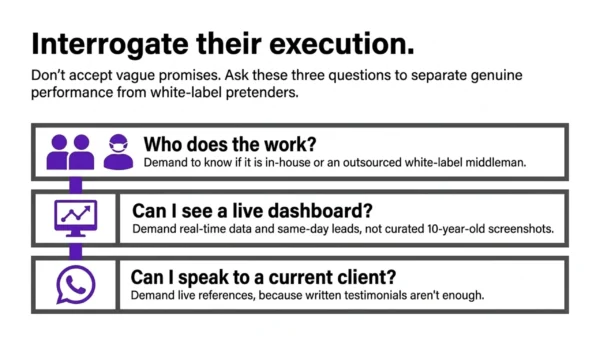
The single biggest mistake many businesses make is selecting an agency based on promises of large traffic increases or unusually cheap raw lead costs, since neither figure proves commercial value on its own. A persuasive, trustworthy case study should set out the client’s starting point, the market they operate in, the work actually completed, the timescale and investment involved, and the real enquiry or revenue outcomes that followed. Case studies built purely around a traffic percentage, with no mention of enquiries, qualified leads or sales, deserve healthy scepticism. Equally, any agency offering a guaranteed search ranking or a fixed enquiry volume should raise questions, since search algorithms, competitor activity and buyer behaviour all sit partly outside anyone’s control. A transparent agency talks openly about risk, measurement and what happens when a tactic isn’t producing qualified demand, rather than hiding behind confident guarantees.
Qualified Enquiries, Not Visits, Drive Growth
A rising traffic graph can feel reassuring, but it says nothing about whether a business is actually attracting the right people or converting them into paying customers. The businesses that grow steadily are usually the ones that ask harder questions of their marketing: who is actually arriving on the site, what happens when they land, how many genuinely enquire, and how many of those enquiries eventually become sales. Agreeing clear definitions for enquiries, qualified leads, opportunities and customers turns a vague monthly report into something genuinely useful for decision-making.
For business owners reviewing their own marketing performance, the practical next step is simple: start asking for enquiry and revenue data alongside traffic figures, not instead of them. For a clearer path from visibility to genuine sales, it helps to work with content built around buyer intent rather than content designed purely to chase visitor numbers.
| Topic / Area | Key Finding | Business Impact | Why It Matters |
|---|---|---|---|
| Lead-quality measurement | 40% prioritise lead quality and MQLs | Shifts reporting beyond traffic and clicks | Better metrics support stronger budget decisions |
| Closed-loop attribution | First-party data increased conversions by median 10% | Improves campaign measurement and bidding decisions | Connects advertising investment with eventual sales |
| Conversion-goal setup | Track qualified or converted leads, not forms | Reduces optimisation towards low-value enquiries | Platforms learn which prospects actually become customers |
| Local purchase intent | 18% of local mobile searches purchase daily | Local service pages can generate urgent demand | Clear calls, locations and phone options remove friction |
| Sales follow-up capacity | 57% say sales cycles are getting longer | Slow response wastes valuable qualified demand | Agencies and sales teams need shared lead processes |
Frequently Asked Questions
How long should it take before a marketing agency generates qualified enquiries?
A credible agency should set expectations around your sales cycle, market competition and starting visibility rather than promise instant leads. Early improvements may appear within weeks, but consistent qualified enquiries often require several months of targeted content, conversion improvements and testing.
What should count as a qualified marketing lead?
A qualified lead is not simply anyone who submits a form. It should meet agreed criteria such as being in your service area, needing the service you offer, having an appropriate budget, realistic timing and access to the decision-maker. Define this with sales before reporting begins.
How can I tell whether my marketing enquiries become sales?
Connect website forms, calls and ad clicks to your CRM, then record whether each contact was qualified, progressed into an opportunity or became a customer. This creates closed-loop reporting, showing which channels and campaigns generate revenue—not merely the cheapest form completions. Google’s enhanced conversions for leads supports more accurate matching using securely hashed first-party lead data.
Should I prioritise SEO traffic or paid advertising for lead generation?
Neither channel wins automatically. SEO can build durable visibility for service, comparison and local-intent searches, while paid advertising can capture demand more quickly. Judge both by qualified enquiries, sales value and cost per acquired customer—not clicks, impressions or traffic alone.
What evidence should a marketing agency show before I hire them?
Ask for case studies that state the client’s starting point, work completed, budget range, timescale and commercial outcome. Strong evidence includes qualified-lead volumes, conversion rates, opportunity value and revenue where available. Be cautious if an agency can show only rankings, sessions or broad traffic-growth percentages.
