Summary
SEMrush vs Ahrefs is an important comparison for small marketing agencies choosing an SEO platform. SEMrush generally suits agencies managing SEO, PPC, content and client reporting, while Ahrefs is often better suited to specialists focusing on organic search, backlinks and competitor research. The right choice depends on your services, budget and daily workflows.
Key Takeaways
- For most small agencies offering broad SEO, content, and paid-search services, SEMrush provides a more complete all-in-one workflow.
- Ahrefs is often the stronger, more focused platform for specialist agencies concentrating on organic search strategy, backlink analysis, and digital PR.
- The true cost of a platform includes not just the subscription price, along with additional user seats, project and keyword limits, and reporting add-ons.
- Agencies should choose the platform that removes the most operational friction from their daily client work, rather than focusing on which has the largest database.
- Both platforms are now incorporating AI visibility tracking, allowing agencies to monitor brand mentions and presence in generative AI search results.
Choosing between SEMrush and Ahrefs can feel like a defining decision for a small marketing agency. Both are powerful, packed with features, and represent a significant monthly investment. The debate often centres on which has the bigger keyword database or the most accurate backlink checker, but for an agency owner, the real question is simpler: which platform will remove the most friction from your daily work and help you deliver better client results?
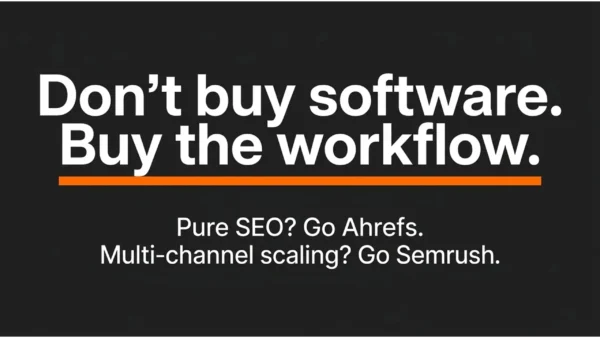
The best choice depends entirely on your agency’s service model. For businesses that manage a mix of SEO, content, and paid search campaigns, one platform often provides a more integrated workflow. For agencies focused squarely on organic growth and link building, the other presents a cleaner, more specialised toolset. Success comes from matching the tool’s strengths to your primary revenue-generating activities.
The Short Answer For Agency Owners
For most small agencies offering a broad mix of digital marketing services – including SEO, PPC, content strategy, and regular client reporting – SEMrush is often the more complete all-in-one platform. It’s built to handle varied workflows across multiple clients.
In contrast, for specialist agencies that concentrate on organic search strategy, deep competitor analysis, content-led growth, and digital PR, Ahrefs is frequently the sharper, more focused choice. Its strength lies in backlink intelligence and research clarity.
What Actually Sets These Platforms Apart
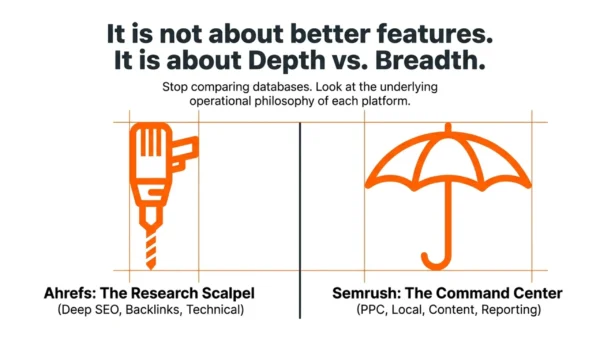
While the feature lists of SEMrush and Ahrefs have grown to overlap significantly, their core philosophies still cater to different agency needs. This difference becomes clear when you look at how they handle common agency tasks.
Where SEMrush Wins For Multi-Client Workflow
SEMrush works well as a central hub for agencies managing SEO, paid search, and content marketing under one roof. Its integration of PPC keyword research with organic data is a major advantage for teams running campaigns on Google Ads alongside SEO retainers. The platform’s structure suits a multi-client dashboard view, making it easier to track projects, run site audits, and generate scheduled reports from a single environment. For account managers who need to translate data into client-facing narratives quickly, SEMrush often provides the more direct path.
Where Ahrefs Wins For Backlinks And Research
Ahrefs is widely valued for its intuitive interface and the depth of its backlink analysis tools. For agencies where link building, digital PR, and content strategy are core deliverables, its Site Explorer and Content Explorer are exceptional. The platform makes it straightforward to analyse competitor backlink profiles, identify content gaps, and find pages that successfully attract links and organic visibility. SEO specialists often prefer its clean presentation of data for research-heavy tasks, finding it faster for deep dives into organic performance.
Plan Limits And Seat Costs That Change The Decision
The advertised monthly price is only the beginning. For a small agency, the true cost of ownership is determined by plan limitations on projects, keywords, user seats, and essential features like reporting.
SEMrush’s Tiered Websites, Keywords And AI Prompts
The capacity of your plan directly affects your agency’s profitability. SEMrush’s entry-level SEO + AI plan typically includes five monitored websites and 500 daily tracked keywords. Its Pro+ tier expands this to 15 websites and 1,500 keywords. An agency owner should calculate whether current and near-future client load fits within these caps. With multiple team members needing access, the cost for additional users – listed from $45 per month – can add significantly to the total monthly spend.
Reporting Add-Ons Worth Budgeting For
Client reporting is a critical, time-consuming task for any agency. SEMrush offers reporting functionality in its plans, but white-labelling and advanced features often come via paid add-ons. The Base Report add-on is listed at $10 per month, while the Pro Report add-on, which includes custom branding, is around $20 per month. These costs, while small individually, should be factored into the total platform investment when comparing it to Ahrefs, which may require a more manual reporting process depending on the plan.
AI Visibility: A New Battleground
The rise of AI-powered search has introduced a new frontier for SEO, and both platforms are developing tools to measure visibility within these new environments.
Ahrefs’ Brand Radar: Seven Engines, 447 Million Prompts
Ahrefs has invested heavily in this area with its Brand Radar tool. It tracks brand mentions and visibility across seven major AI platforms, including ChatGPT and Google’s AI Overviews, drawing on a database of more than 447 million search-backed prompts. This is particularly useful for agencies wanting to offer advanced analysis of how clients are being cited and perceived in generative AI responses.
Custom Prompt Allowances Across Ahrefs’ Paid Tiers
Beyond its broad index, Ahrefs allows agencies to track custom prompts. Its Lite plan includes 150 custom prompt checks per month, with higher tiers offering more. This enables an agency to monitor the specific commercial questions that matter to a niche client, which may not appear in a generic keyword database. SEMrush also integrates AI prompt tracking, with its starter plan offering 50 daily prompt checks.
Matching The Tool To Your Agency Model
The most effective way to choose is to audit your own agency’s services and client needs.
Full-Service Agencies Running SEO, PPC And Reporting
If your agency provides a holistic digital marketing service, SEMrush is likely the better fit. The ability to conduct paid search competitor analysis, manage local SEO listings, plan content, and generate branded reports from a single subscription creates real operational efficiencies, streamlining the workflow when a single client has retainers for both SEO and PPC.
Specialist Agencies Focused On Organic Growth And Links
If your agency’s reputation rests on delivering strong organic growth, authoritative content strategies, and high-quality backlinks, Ahrefs is a compelling choice. The platform is built for the research-focused professional. Its strengths in analysing link intersections, finding content opportunities, and reviewing SERP history align well with the needs of a boutique SEO or digital PR agency.
Mistakes That Cost Agencies Time And Margin
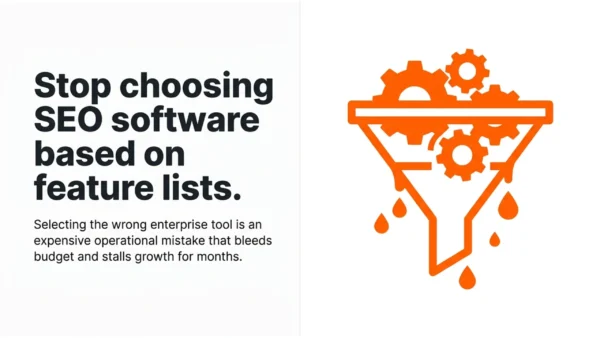
Choosing the wrong platform, or using the right one poorly, can quickly erode profits. A common error is buying a subscription based on a single headline feature without modelling the total cost of ownership, including extra seats and project limits. Another mistake is exporting raw data or audit reports directly to clients without adding interpretation, priority, and a clear action plan. A long list of technical “errors” without context creates anxiety, not value.
Choose By Friction Removed, Not Database Size
The size of a platform’s backlink index or keyword database is a vanity metric. These numbers are not directly comparable and don’t guarantee better client outcomes. The smarter choice is the platform that removes the most operational friction from your most frequent and valuable tasks. Treat tool data as directional intelligence to form hypotheses, but always check it against the client’s actual performance data in Google Search Console and their CRM.
The right platform should help your team turn research into smarter decisions, faster delivery, and measurable results for your clients. For help developing a strategy that drives real growth, consider how West Pro Media Services can support you in building a credible digital presence.
| Topic / Area | Key Finding | Business Impact | Why It Matters |
|---|---|---|---|
| Client capacity | Semrush Pro+: 15 websites; Ahrefs Standard: 20 projects | Sets capacity for monitored client accounts | Match limits to your expected client growth |
| Team access | Semrush extra users from $45/month; Ahrefs Standard: $60/month | Additional seats increase ongoing delivery costs | Budget for everyone needing direct platform access |
| Automated reporting | Semrush Base Report: $10/month; Ahrefs reporting upgrade: $99/month | Scheduling requires budgeting beyond core subscription costs | Compare report capacity, branding and integration requirements |
| AI visibility | Semrush Starter: 50 daily prompts; Ahrefs Lite: five | Included allowances differ substantially between entry plans | Compare platform coverage and check limits before purchasing |
| Performance evidence | Organic traffic figures are estimates, not measured visits | Treat competitor figures as directional research | Validate client outcomes against actual search performance data |
Sources
Semrush — Plans and pricing — website limits, seats, reporting and AI allowances.
Ahrefs — Plans and pricing — project capacity, users, reporting and prompt limits.
Ahrefs — Traffic estimation methodology — explains why estimated traffic differs from measured clicks.
Frequently Asked Questions
Is Ahrefs cheaper than SEMrush for a small agency?
Ahrefs Lite currently costs $129 monthly, compared with $139 for Semrush’s SEO plan or $199 for its SEO + AI Starter plan. However, compare equivalent workflows rather than entry prices: additional users, reporting upgrades and AI monitoring can change which subscription offers better value.
Which SEMrush or Ahrefs plan is suitable for an agency with ten clients?
For ten separate client websites requiring ongoing monitoring, Semrush Pro+ supports 15 websites, while Ahrefs Standard supports 20 projects. Both offer room to grow, but check your combined keyword requirements, crawl allowances and team access before buying. Website capacity alone does not determine the right plan.
Can SEMrush and Ahrefs automate client SEO reports?
Both now offer report-building tools, so Ahrefs should not automatically be treated as a manual-reporting option. Semrush lists scheduling in its Base Report add-on and white-labelling in Pro Report. Ahrefs includes limited Report Builder access, with a paid upgrade offering scheduling and expanded report capacity.
Do I need a separate subscription to track visibility in ChatGPT and AI search?
Not necessarily. Semrush’s SEO + AI plans include daily prompt tracking, while Ahrefs’ core paid plans include smaller custom-prompt allowances. Broader Ahrefs Brand Radar database access is sold separately. Compare included checks, platforms and client-domain limits before assuming either subscription covers your complete AI reporting service.
Why do SEMrush and Ahrefs show different traffic figures from Google Search Console?
Semrush and Ahrefs estimate organic traffic using keyword rankings, search demand and modelling; Google Search Console records clicks from Google Search. Their figures therefore measure different things. Use estimates to compare competitors and identify opportunities, but use client-owned performance data when reporting actual search results
