
Summary
Getting more enquiries from your website without paying for ads means improving both the quality of visitors you attract and the percentage who become genuine prospects. Clear service pages, strong customer proof, an optimised Google Business Profile, useful content and an easy route to make contact can increase enquiries without simply chasing more website traffic.
Key Takeaways
- More website enquiries usually come from improving qualified organic visibility and conversion rate together, not from buying more clicks
- Enquiries follow a simple equation: relevant visitors multiplied by conversion rate, so a small conversion improvement can double results without any extra traffic
- Unbounce’s Q4 2024 data reports a median landing-page conversion rate of 6.6% across all industries, and the top quartile for a good e-commerce conversion rate starts at 11.4% or higher
- Fixing contact friction, adding proof, and building service-led content often matters more than chasing raw traffic numbers
- Google Business Profile completeness plays a direct role in local visibility, and there is a practical way small businesses can strengthen it
Every small business owner knows the feeling of watching website visitors arrive without ever hearing from them. The traffic looks fine on paper, yet the phone stays quiet and the enquiry form gathers dust. Understanding why this happens, and what to do about it, does not require an advertising budget at all.
The Equation Behind More Enquiries
Enquiries follow a simple equation: relevant visitors multiplied by conversion rate equals enquiries. A website receiving 500 relevant visitors a month with a 2% conversion rate produces 10 enquiries. Raise that conversion rate to 4% and the same website produces 20 enquiries, without a single extra click being bought or earned. This calculation separates businesses who feel stuck chasing traffic from those who quietly grow their pipeline using what they already have.
Business owners often assume more traffic is always the answer. It rarely is on its own. Improving Google Business Profile optimisation often does more for genuine enquiry volume than a broad traffic campaign, because it connects a business directly with people who are already searching for what it offers nearby.
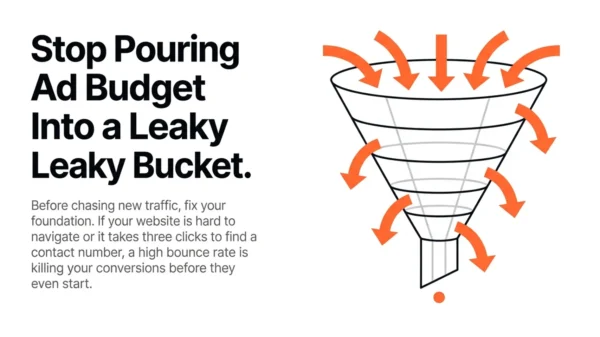
The practical implication is reassuring: a business does not need a bigger audience before it can get more enquiries. It needs a website that is clearer, more trustworthy, and easier to contact, paired with visibility that reaches people who are already looking. Chasing clicks before fixing the conversion path resembles pouring water into a bucket with holes in it.
Why Traffic Alone Won’t Fill Your Inbox
Traffic is only useful when it is the right traffic and when the website knows what to do with it. A spike in visitors from an unrelated blog post or a viral social share might look impressive in analytics, but if those visitors have no interest in the service on offer, the enquiry count will not move. Growth built on irrelevant volume tends to disappoint precisely when it matters most.
Relevant Visitors vs Conversion Rate
Doubling unqualified traffic tends to simply double irrelevant enquiries, wasting time on leads that were never a good fit. The more useful question is not “how do we get more visitors?” but “how do we get more of the right visitors, and what happens once they land?” Search Console and Google Analytics answer two different halves of this puzzle: Search Console shows whether people are seeing and clicking the website in Google, while Analytics shows what happens once those visitors arrive. Comparing the two prevents a common trap, such as celebrating rising clicks while the actual enquiry rate quietly falls.
What Counts as a Good Conversion Rate
There is no single universal target, since a good conversion rate depends heavily on industry, deal size, sales cycle, and even the device a visitor is using. That said, some benchmarks are useful as a directional guide. Unbounce’s Q4 2024 data reports a median landing-page conversion rate of 6.6% across all industries, and the top quartile for a good e-commerce conversion rate starts at 11.4% or higher. Rather than chasing that figure as a fixed goal, a business is better served by measuring its own current baseline first, then working to beat it. Dedicated landing pages built around a single service or offer converted 65% higher than general website pages in the same analysis, which strongly supports building focused pages rather than funnelling every visitor to a generic homepage.
Fixing the Website Before Chasing Clicks
Before spending time or money attracting more visitors, it pays to check whether the website currently in place is actually built to turn interest into action. A confusing homepage, a buried phone number, or a form that asks too many questions can quietly cancel out even the best traffic-building efforts.
Clarity, Proof and Calls to Action
A conversion-focused service page should answer, near the top, what exactly is on offer, who it is for, and what problem or outcome it addresses. A headline like “Kitchen extensions in Bolton, designed and built by [business name] tells a visitor far more in a few seconds than a vague slogan about “building better futures.” Beneath that clarity, proof does the heavy lifting: reviews, case studies, project photographs, qualifications, and named team experience all reduce the sense of risk a prospective customer feels before making contact.
Every important page benefits from a clear structure that guides a visitor naturally into enquiring:
- A service-led headline stating what is offered and for whom
- A short explanation of the outcome, process, and ideal customer
- A visible primary call to action, such as “Request a quote” or “Book a survey,” rather than a vague “Get in touch”
- Evidence including reviews, case studies, and real project imagery
- Further service detail, process explanation, and frequently asked questions
- A second call to action after the proof has been presented
- A straightforward contact method at the very end of the page
Cutting Contact Friction
Even a persuasive page can lose an enquiry if the final step feels like hard work. Telephone numbers should be visible, clickable, and consistent across every page, particularly for mobile visitors who expect to tap and call immediately. Initial contact forms work best when they ask only for what is genuinely needed to start a conversation, with a short note on when the business typically responds. Long, multi-step forms, mandatory account creation, and intrusive pop-ups all add friction at exactly the moment a prospective customer has decided to act. For higher-value or more complex work, a longer form can still make sense, but only when it clearly benefits the prospect, such as producing a more accurate estimate.
Earning Visibility Without Paying For It
Once the website itself is ready to convert, attention can shift to bringing in more of the right people without paying for every click. This is where organic visibility, local search presence, and trust signals work together as a long-term system rather than a one-off campaign.
Service and Problem-Led Content
Content built around actual customer demand tends to outperform content built around a publishing calendar. Useful starting points include core services described in plain, specific language, high-intent phrases such as cost, quote, or specialist, and decision-stage questions like “is it worth it?” or “do I need this?” Objection-handling content that covers pricing, timing, and guarantees answers the questions a prospect is already asking before they pick up the phone. Google’s own guidance on helpful content favours original information, first-hand expertise, completeness, and content that genuinely helps a reader reach their goal, rather than thin pages built purely to attract search traffic.
Getting Found on Google Business Profile
For many small and local businesses, a Google Business Profile can act as a direct enquiry channel in its own right, while also serving as a stepping stone to the website. Google states that a complete and accurate profile increases the likelihood of appearing in local search results, which are based on relevance, distance, and prominence. Keeping business name, category, service information, opening hours, and contact details accurate and consistent across the web supports this, as does adding current photographs and updates. There is no way to pay for a better local ranking; the framework Google describes rests on those three factors rather than budget.
Building Trust Through Reviews and Referrals
Genuine reviews requested ethically after completed work, then responded to professionally, add a layer of social proof that marketing copy alone cannot replicate. Beyond reviews, referral relationships with suppliers, partners, and past clients introduce a business to buyers who might never have found it through a generic search at all. Locally relevant mentions through trade bodies, community activity, and professional associations build the kind of prominence that supports both local search visibility and everyday word-of-mouth trust.
Measuring What Actually Drives Revenue
None of these improvements mean much without a way to track whether they are working. The most useful measurement hierarchy moves from search visibility, through traffic quality, to website action, and finally to sales outcome. Tracking should focus on actions that represent genuine intent, such as form completions, clicks on telephone numbers, booked consultations, and qualified live chat conversations, alongside offline outcomes like quotes issued and revenue generated.
HubSpot’s 2025 report states that B2B marketers rate websites, blogs, and SEO as top marketing channels in 2024, reinforcing the commercial case for organic visibility and conversion work rather than relying on advertising spend alone. Reporting on rankings alone can be misleading, since rankings fluctuate by location, device, and query type. Leads, lead quality, booked work, and revenue tell a far more reliable story of progress.
Mistakes That Quietly Cost Enquiries
Several habits creep in that quietly undermine enquiry growth, even when a business believes it is doing everything right.
- Chasing broad, informational traffic that never connects to a service or a clear next step
- Publishing generic service pages that could describe almost any competitor, rather than specific, verifiable detail
- Creating near-identical “service in [town]” pages that offer little genuine value to the reader
- Relying on mass-produced, unverified content instead of original expertise and first-hand experience; Google’s spam policy on scaled content abuse applies regardless of how the content is produced, whether by AI, by a person, or by a mix of both
- Hiding contact information or leaving response times unexplained
- Treating reviews as decoration on a single testimonials page rather than placing proof next to the service it supports
- Ignoring the mobile experience, despite many prospects comparing providers from a phone
- Redesigning pages based on appearance alone instead of testing a clear hypothesis against measured results
Building an Asset, Not a Traffic Spike
Paid advertising stops producing enquiries the moment spend stops. Organic visibility, a well-built website, genuine reviews, and useful content behave differently, compounding over time into an asset that keeps working long after the initial effort was made. The businesses that grow steadily without relying on adverts tend to be the ones that treat their website as a living system: measured, tested, and improved a little at a time rather than left untouched between campaigns.
Getting started does not require an overhaul overnight. A sensible first move is auditing where current enquiries are being lost, tightening the highest-value service pages, and making sure the local search presence accurately reflects the business before layering in new content and authority-building work.
| Topic / Area | Key Finding | Business Impact | Why It Matters |
|---|---|---|---|
| Landing-page conversion | Median conversion rate: 6.6% across industries | Small gains can materially increase enquiries | Benchmark current performance before chasing more traffic |
| Mobile enquiry journeys | 82.9% of landing-page visits come from mobile | Click-to-call and short forms protect demand | Mobile friction can waste high-intent local visitors |
| Focused service pages | Dedicated landing pages converted 65% higher | Build one clear page per core service | Specific intent needs specific messaging and proof |
| Local search visibility | Complete profiles improve local-search appearance likelihood | Accurate details support calls, visits and enquiries | Google matches local results using relevance, distance, prominence |
| Measurement discipline | Track calls, forms, quotes and revenue—not rankings | Reveals which improvements produce commercial outcomes | Traffic growth alone can conceal poor lead quality |
Sources |
Frequently Asked Questions
How long does it take to get more enquiries from SEO and website improvements?
Some changes can have an immediate effect. Making your phone number prominent, shortening an enquiry form, or clarifying a service-page call to action may improve conversions within weeks. Organic visibility usually takes longer, particularly for competitive searches, so track enquiries and lead quality monthly rather than expecting overnight results.
What should I improve first if my website gets visitors but few enquiries?
Start with the pages that already attract relevant visitors, especially core service pages. Check whether each explains the service, who it helps, likely outcomes, proof of experience, and the next action clearly. Then remove obstacles: hidden contact details, lengthy forms, slow mobile pages, or unclear response expectations.
How can I tell which website pages are losing potential customers?
Use Google Search Console to find pages receiving impressions and clicks, then use Analytics to see whether those visitors call, submit forms, or leave quickly. A page with strong visibility but weak enquiry activity may have mismatched search intent, unclear messaging, insufficient proof, or a poor call to action.
Will improving my Google Business Profile bring enquiries without paid advertising?
It can, particularly for local, service-led searches where people want to call, request directions, compare reviews, or visit a website quickly. Keep your profile accurate, complete, and specific about services, categories, hours, photos, and contact details. Google says local visibility is driven mainly by relevance, distance, and prominence, not by paid placement.
Should I create FAQ content for every service I offer?
Create FAQs where they answer genuine buyer questions: price ranges, timescales, suitability, preparation, guarantees, locations served, and what happens after an enquiry. Avoid adding generic questions simply to make a page longer. Google’s guidance favours original, people-first content that helps readers achieve their purpose rather than content made primarily to influence rankings.
